
Brenipatide: what the trials show, status and safety
Summary
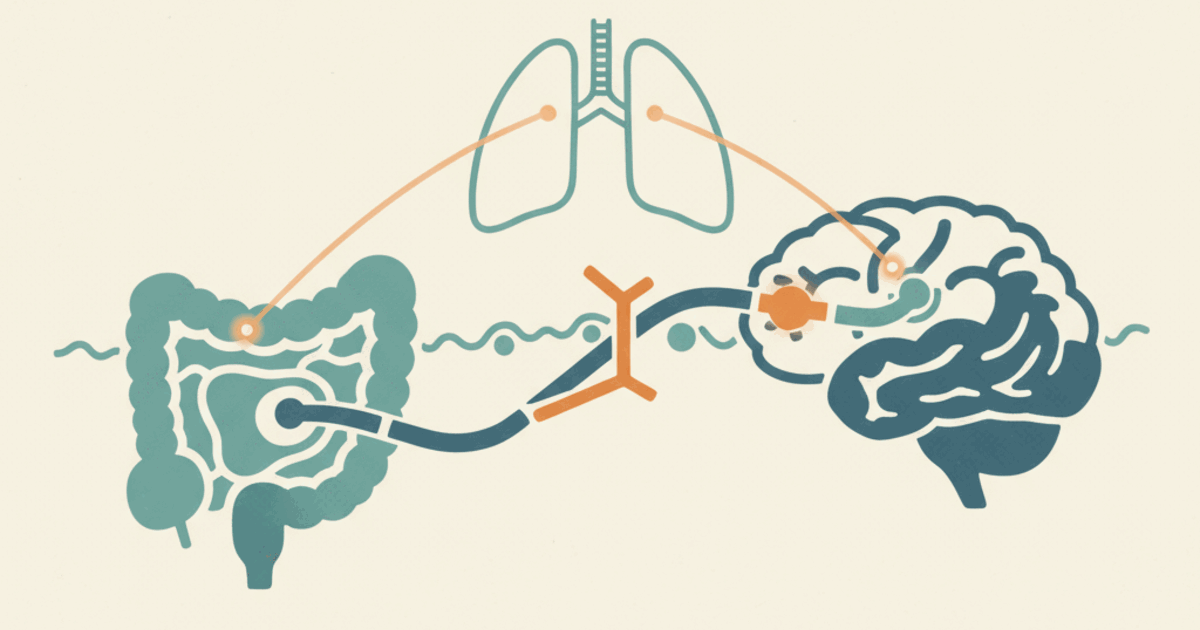
Brenipatide is an experimental weekly injection from Eli Lilly that activates two gut-hormone receptors, GIP and GLP-1, like tirzepatide. Unlike tirzepatide, it is being developed for addiction, depression and other psychiatric disorders, irritable bowel syndrome, asthma and COPD, not for obesity or type 2 diabetes. The only human results come from a conference poster on 212 volunteers: a half-life of 9.08 to 12.5 days and mostly mild side effects, with an unexplained skin-sensation signal in 15.2 per cent. There are no efficacy data in any target condition, and no country has approved it.
Key findings at a glance
- It is aimed at the brain, the gut and the lungs, not at weight. Lilly's pipeline lists brenipatide in phase 3 for alcohol use disorder and major depression, and in phase 2 for seven more conditions. Obesity and diabetes are not among them [1].
- One poster holds all the human data. It reports interim results from 212 randomised volunteers in a phase 1 study, presented at Psych Congress in September 2026. No peer-reviewed paper exists [2], [3].
- The half-life is 9.08 to 12.5 days. Blood levels rose in step with the amount given and stayed steady, with a peak-to-trough ratio of 1.35 to 1.59 on weekly injections [2].
- Stomach and bowel complaints were no more frequent than on placebo. They affected 25.0 per cent in both groups, although diarrhoea was reported by 11.4 against 3.6 per cent [2].
- An unusual skin-sensation signal appeared. Altered, often burning or tingling skin sensation (dysaesthesia) affected 15.2 per cent on brenipatide and nobody on placebo, and 41.7 per cent in one normal-weight group [2].
- There are no efficacy data in any target condition. None of the 18 registered trials has posted results, and the first large results are expected in early 2028 [4], [5].
- It is banned in sport at all times under the catch-all class for substances under clinical development [6].
What it is
Brenipatide is a synthetic peptide of 39 amino acids, built to activate the receptors for two gut hormones, GIP and GLP-1. That makes it a dual agonist of the same class as tirzepatide, an approved medicine. A fatty-acid chain is attached to the molecule; the US substance register lists the same chain fragment for tirzepatide [7], [8], [9].
Eli Lilly and Company developed it under the code LY3537031 and sponsors every registered trial. The name brenipatide was proposed by the World Health Organization in 2025. There is no brand name, because no market has approved it [7], [4].
The WHO name list describes brenipatide as a "GIP and GLP-1 receptor agonist, antidiabetic". That label names the drug class and rests largely on what the manufacturer supplied when the name was requested; the WHO states that it cannot vouch for such descriptions and does not update them. It is not a diabetes indication: Lilly's development programme contains no trial in type 2 diabetes [7], [1].
Quick facts
| Field | Value | Ref |
|---|---|---|
| Name | Brenipatide; proposed international non-proprietary name, list 134 | [7] |
| Development code | LY3537031, also written LY-3537031 | [8] |
| Class | Dual GIP and GLP-1 receptor agonist; acylated peptide; the WHO name list adds "antidiabetic" as a class label, not an indication | [7], [10] |
| Structure | 39 amino acids, amidated end; several synthetic building blocks and a fatty-acid chain on the lysine at position 17 | [7], [8] |
| Formula and mass | C228H354N46O72; about 4891.54 Da, a calculated value | [7], [8] |
| Half-life | 9.08 to 12.5 days on average, phase 1 poster | [2] |
| Route in trials | Injection under the skin, once weekly; one single intravenous dose in a single study | [2], [11] |
| Status | Not approved in any market; phase 3 | [1] |
| Developer | Eli Lilly and Company, Indianapolis | [1] |
| CAS registry number | 2408921-49-1 | [8] |
| UNII | C3939LZT6J | [8] |
| PubChem | No compound entry; substance record SID 518139661 only | [12] |
| ChEMBL, DrugBank | No entry found | [13] |
| Wikidata | Q137841098 | [14] |
| ATC code | None assigned | [15] |
How it works
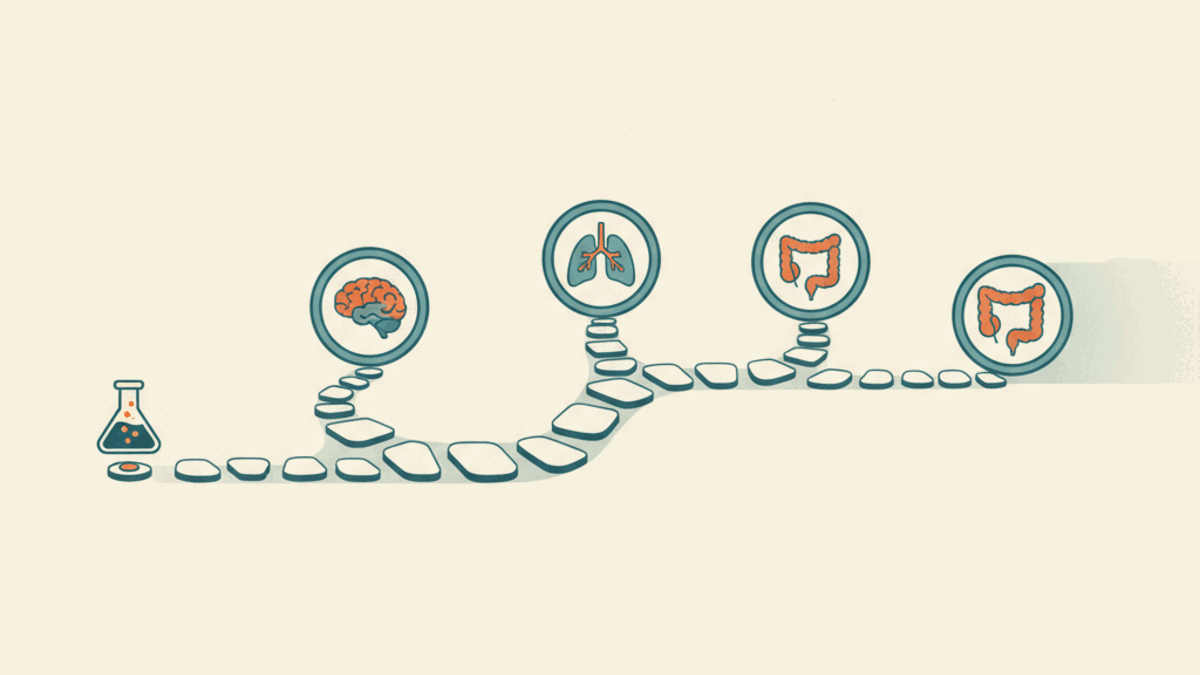
Brenipatide imitates two hormones that the gut releases after a meal, and it does so at receptors spread across the whole body.
- The GLP-1 receptor. This is the target of the best-known class of incretin drugs, the gut-hormone medicines used in type 2 diabetes and obesity. Brenipatide switches it on, according to the US substance register and the US cancer institute's drug thesaurus [8], [10].
- The GIP receptor. GIP is the second incretin hormone. Brenipatide activates this receptor as well, which places it in the same dual class as tirzepatide [8], [10].
- Why a gut hormone for the mind and the lungs. Lilly's poster points out that both receptors occur in the pancreas, gut, heart, lungs, kidneys, liver, fat tissue and brain. It argues that such drugs might therefore be useful both in the brain and in the rest of the body. This is a rationale, not a result [2].
- What is not published. How strongly brenipatide acts at each receptor, the balance between the two, and whether it reaches the brain in meaningful amounts are all undisclosed. No preclinical data are public at all [16].
The backbone of brenipatide matches that of retatrutide at 35 of its 39 positions, on a comparison of the one-letter sequences. Retatrutide also switches on the glucagon receptor; the registers list only GIP and GLP-1 as targets for brenipatide [9], [7].
What the trials found
Eighteen trials are registered, all sponsored by Lilly: six in phase 1, eight in phase 2 and four in phase 3. They range from a first single-dose study in Japan in 2020 to phase 3 trials that began in 2025 and 2026. Only one has shared any results, as a poster [4], [2].
The phase 1 study behind the poster
Phase 1 RCT The multiple-dose study NCT06606106 randomised 212 volunteers across three parts. Part A enrolled people with overweight or obesity, with a body mass index of 27.0 to 45.0. Parts B and C enrolled people of normal weight, with a body mass index of 22.0 to 26.9; part C included only Japanese and Chinese participants [2], [17].
Phase 1 RCT Participants received weekly injections up to day 78 and were followed for 8 more weeks. For every two people on placebo, 16 got brenipatide in parts A and B and 6 in part C [2].
Phase 1 RCT Part A tested five dose levels in six groups of 16 people on brenipatide, and part B four levels in four groups; the highest level was used only in part A. A fourth part is not yet reported [2], [17].
How long it stays in the body
Phase 1 RCT On average, half of the drug was cleared from the blood in 9.08 to 12.5 days. The longer value came with the highest dose level, according to a trade press report [2], [18].
Phase 1 RCT Blood levels rose in proportion to the amount given and were similar across ethnic groups. On weekly injections they settled at a stable level, with the highest concentration only 1.35 to 1.59 times the lowest. The authors conclude that the data support once-weekly use [2].
Body weight, as a marker only
Phase 1 RCT Weight served as a sign that the drug was working in the body, used to choose amounts for later trials. It was not a treatment goal. The poster shows it only as a graph, without a table, spread or statistical tests, so the figures below are approximate readings [2].
- Part A, overweight or obesity. At the highest dose level, weight fell by roughly 11 per cent by day 78 and about 11.5 per cent by days 85 to 92. During dosing, placebo stayed between about 0 and plus 1 per cent [2].
- Part B, normal weight. At the highest level tested in this part, weight fell by roughly 12 per cent; at the next level down, by about 10.5 to 11 per cent. Placebo moved between about plus 0.3 and plus 2 per cent [2].
- After the last injection. Weight rose again. By day 134 the part B group at the highest level was about 7.5 per cent below its starting weight [2].
Normal-weight volunteers lost at least as large a share of their weight as those with obesity. For psychiatric patients, most of whom are not overweight, that is a safety question rather than a benefit [2].
In the conditions it is meant for
No result There are no data in alcohol, opioid or tobacco use disorder, depression, bipolar disorder, schizophrenia, irritable bowel syndrome, asthma or COPD. The phase 1 study did not include anyone with these conditions, and none of the phase 2 or phase 3 trials has reported [4], [3].
What is still unknown
- Whether it works in any target condition. The first main results, for depression and alcohol use disorder, are expected in early 2028 [5].
- The results of the other phase 1 studies. The first single-dose study ended in 2021; studies in kidney impairment, liver impairment and on injection site have produced nothing public, and neither has a second study in people with overweight or obesity that is still running [19], [20], [21], [11], [4].
- Longer exposure. No data cover more than about 12 weeks of treatment [2].
- Immune reactions and special groups. Nothing is public on antibodies against the drug, pregnancy, breastfeeding, children or older people [2].
- Psychiatric safety. There are no data on mood or suicidal thoughts from patients with the target conditions [4], [3].
Side effects and safety
All safety data come from the interim phase 1 results: 184 people on brenipatide and 28 on placebo. There was no serious adverse event and no death. The small placebo group makes every comparison uncertain [2].
- At least one side effect. Reported by 106 of 184 people, or 57.6 per cent, on brenipatide, against 12 of 28, or 42.9 per cent, on placebo. Most were mild: 105 people had at least one mild event, 7 a moderate one and 3 a severe one, all of the severe ones in part A [2].
- Stopping because of side effects. 4 of 184 people, or 2.2 per cent, against none on placebo [2].
- Stomach and bowel. 25.0 per cent in both groups. Nausea affected 12.0 against 10.7 per cent, vomiting 4.9 against 3.6 per cent and diarrhoea 11.4 against 3.6 per cent. All but two moderate episodes of nausea were mild, and none led to stopping [2].
- Altered skin sensation. Dysaesthesia affected 28 of 184, or 15.2 per cent, against none on placebo. All cases but one were mild, all resolved during treatment or after the last injection, and one led to stopping [2].
- More events in normal-weight volunteers. At least one side effect was reported by 36.5 per cent in part A, 76.6 per cent in part B and 91.7 per cent in part C [2].
Interim results of NCT06606106, parts A to C combined, 184 people on brenipatide and 28 on placebo, weekly injections up to day 78. The placebo group is small. Source [2].
The skin-sensation signal was far more common in the normal-weight groups: 3.1 per cent in part A, against 23.4 per cent in part B and 41.7 per cent in part C. Stomach and bowel complaints followed the same pattern, at 14.6, 35.9 and 37.5 per cent. The poster offers no explanation [2].
Interim results of NCT06606106. Part A: overweight or obesity, 96 people on brenipatide. Part B: normal weight, 64. Part C: normal weight, Japanese and Chinese participants, 24. Nobody on placebo reported it. Source [2].
Because the target conditions are not tied to body weight, this matters. Many future patients will not be overweight, and it was the normal-weight volunteers who had the most side effects [2].
No regulator has assessed brenipatide, so there is no approved product information, no list of contraindications and no official warnings. The phase 1 study excluded people with raised calcitonin, a thyroid blood marker, and people who had had weight-loss surgery; exclusion rules of a study are not contraindications [17].
Why this page lists no doses
This page gives no amounts for brenipatide in any unit, and no escalation schedules. The substance is investigational and approved nowhere, so its use outside a clinical trial has no lawful setting, and no authority has ever judged what amount a person can tolerate [1], [22].
Where dose levels appear above, they are named only by their rank, because the figures belong to the results they explain. The phase 3 trials use amounts chosen from data that have not yet been peer reviewed [2].
The US medicines agency's warning page on unapproved GLP-1 drugs does not name brenipatide, and no warning letter or recall mentions it. Anything offered under this name outside a trial could not come from the sponsor's trial supply, and nothing would confirm what it contains [23], [22].
Development and approval status
Brenipatide is approved in no market in the world. Lilly's pipeline, last updated on 5 August 2026, lists it in phase 3 for alcohol use disorder and major depression, and in phase 2 for seven more conditions [1].
From a first human study to phase 3 without phase 2
- 2020First human studyA single-dose study in 40 healthy volunteers in Japan starts in December, ref [19]
- 2024Multiple-dose study beginsNCT06606106 starts in September at five American sites, ref [17]
- 2025A name and the first phase 3 trialsThe WHO proposes the name brenipatide; RENEW-ALC-1 and -2 in alcohol use disorder start in October, followed by the first phase 2 trials, refs [7], [24], [4]
- 2026Depression enters phase 3RENEW-MDD-1 starts in February, alongside phase 2 trials in schizophrenia and opioid use disorder, refs [25], [26]
- Sep 2026First human data shownPoster P-175 at Psych Congress reports interim phase 1 results, ref [2]
- 2028First main results expectedLilly expects results from RENEW-MDD-1 and RENEW-ALC-1 in early 2028, ref [5]
- 2020: the first human study, a single dose in 40 healthy volunteers in Japan [19].
- 2024: the multiple-dose study behind the poster begins [17].
- 2025: the WHO proposes the name, and two phase 3 trials in alcohol use disorder start with about 1,100 participants each; phase 2 trials in asthma, smoking relapse and bipolar disorder follow [7], [24], [27], [4].
- 2026: phase 3 in major depression starts, and phase 2 trials in schizophrenia, opioid use disorder, irritable bowel syndrome and COPD begin [25], [28], [4].
- 2028: the first main phase 3 results are expected [5].
In alcohol use disorder and depression, Lilly went straight from phase 1 to phase 3 without an earlier phase 2 trial. A company representative confirmed this to the trade press [18].
The trial programme
| Trial | Condition | Phase | Planned n | Main measure |
|---|---|---|---|---|
| RENEW-ALC-1 and -2 | Alcohol use disorder | 3 | 1,100 each | Change in drinking pattern at week 56 |
| RENEW-MDD-1 and -2 | Major depression, added to standard care | 3 | 1,000 each | Time to relapse |
| RENEW-Bipolar-1 | Bipolar disorder, added to standard care | 2 | 400 | Time to relapse |
| RENEW-Scz-1 | Schizophrenia, added to standard care | 2 | 450 | Weight change at week 52, body mass index 25 or more |
| RENEW-Op-1 | Opioid use disorder in early remission | 2 | 465 | Share of drug-free weeks, weeks 13 to 24 |
| RENEW-Smk-1 | Relapse after quitting smoking | 2 | 222 | Continuous abstinence, weeks 1 to 24 |
| RENEW-IBS-D and IBS-C | Irritable bowel syndrome | 2 | 531 and 342 | Combined symptom response, weeks 9 to 16 |
| RENEW-Asthma | Uncontrolled asthma | 2 | 531 | Yearly rate of attacks over 52 weeks |
| RENEW-COPD | COPD | 2 | 606 | Lung function (FEV1) at week 36 |
Sources for the table: [24], [27], [25], [29], [30], [31], [32], [33], [34], [35], [36], [37].
| Market | Status | Since or note |
|---|---|---|
| United States | Unapproved | Investigational only |
| European Union | Unapproved | No assessment report |
| Germany | Unapproved | Trials only |
| United Kingdom | Unapproved | No listing |
| Australia | Unapproved | Not scheduled |
| Canada | Unapproved | No product entry |
| Switzerland | Unapproved | None found |
Each of these entries rests on a register search run on 26 September 2026 next to a control substance, tirzepatide, that the same search did find. A blank result therefore means absence rather than a broken query. The German entry follows from the European one, because this drug class is approved centrally [22], [38], [39], [40], [41], [42].
The US substance code and the European substance listing are identifiers, not approvals. The wider legal picture is under are peptides legal and FDA-approved peptides [8].
Anti-doping
Brenipatide is prohibited at all times, in and out of competition. It is not named on the 2026 prohibited list, but falls under class S0, which covers any pharmacological substance with no current approval by any government health authority, including drugs under clinical development [6].
That is a different position from approved relatives. Tirzepatide and semaglutide are not banned; they are in the 2026 monitoring programme, which tracks use without prohibiting it. Brenipatide is not in that programme. If it were ever approved, its classification would change [43], [6].
Substances in class S0 count as specified substances, which affects how a sanction is measured but not the ban. The annex to the German anti-doping act names no GIP or GLP-1 receptor agonist; there, medicines law applies instead [44]. The full picture is at peptides banned in sport.
Compared with related peptides
| Substance | Receptors | Developed for | Status | Ref |
|---|---|---|---|---|
| Brenipatide | GIP and GLP-1 | Addiction, psychiatric disorders, bowel, asthma, COPD | Phase 3, approved nowhere | [1] |
| Tirzepatide | GIP and GLP-1 | Type 2 diabetes, obesity | Approved medicine | — |
| VK2735 | GIP and GLP-1 | Obesity | Phase 3, approved nowhere | — |
| Enicepatide | GIP and GLP-1 | Obesity | Phase 3, approved nowhere | — |
| Retatrutide | GIP, GLP-1 and glucagon | Obesity | Phase 3, approved nowhere | — |
| Survodutide | Glucagon and GLP-1 | Obesity, liver disease | Phase 3, approved nowhere | — |
| Mazdutide | Glucagon and GLP-1 | Obesity, type 2 diabetes | Approved in China | — |
Brenipatide shares its receptor pair with tirzepatide, VK2735 and enicepatide. What sets it apart is the choice of diseases: all its trials in patients concern conditions outside metabolism. Weight appears as a marker in the early studies, as a possible side effect, and as the main measure of the schizophrenia trial in participants with a body mass index of 25 or more [1], [4].
A comparison of results is not possible. Brenipatide has less than 12 weeks of treatment data from one phase 1 poster, while its neighbours have large published trials. Placing a weight figure read off a graph next to phase 3 results would mislead [2].
Common misconceptions
- "Brenipatide is injected once a month." The phase 1 poster describes weekly injections and a half-life of 9.08 to 12.5 days, and its authors conclude the data support once-weekly use. The monthly claim appears in one review and on websites, backed by no primary data [2], [16].
- "It is the next weight-loss drug, a new tirzepatide." Obesity is not among its development targets. Weight was measured in phase 1 only to guide the choice of amounts for later trials [1], [2].
- "It works against alcohol dependence or depression." No trial in any target condition has reported. The early study included only healthy volunteers and people with overweight or obesity [4].
- "It is retatrutide without the glucagon part." The backbones match at 35 of 39 positions, but nobody has published how brenipatide behaves at the glucagon receptor. The official name list gives only GIP and GLP-1 as targets [9], [7].
- "It acts on glucagon and GIP receptors." One 2026 review describes it that way, but the name list, the US substance register and the cancer institute's thesaurus all give GIP and GLP-1 [16], [7], [10].
- "The alcohol trials measure abstinence." Their main measure is a change in the drinking pattern, recorded day by day, not abstinence [24].
Frequently asked questions
What is brenipatide?
Brenipatide is an experimental injectable peptide from Eli Lilly, code LY3537031. It activates two receptors for gut hormones, GIP and GLP-1, the same pair that tirzepatide targets. Lilly is testing it for addiction, depression, schizophrenia, bipolar disorder, irritable bowel syndrome, asthma and COPD. It is approved in no country.
Is brenipatide a weight-loss drug?
No. Obesity and type 2 diabetes do not appear among its development targets in Lilly's pipeline of 5 August 2026. In the early trial, body weight was measured only as a sign that the drug was active, to help pick the amounts for later trials. One small phase 1 study in people with overweight is still running.
Does brenipatide work for alcohol use disorder or depression?
Nobody knows yet. No trial of brenipatide in any of its target conditions has reported results, and the early study enrolled only healthy volunteers and people with overweight or obesity. The first large results, for depression and alcohol use disorder, are expected in early 2028.
How often is brenipatide injected in the trials?
Once a week, under the skin. The phase 1 poster describes weekly administration and a half-life of 9.08 to 12.5 days, and its authors conclude that the data support once-weekly use in later trials. Claims of a monthly injection circulate online, but no primary source backs them.
What side effects did brenipatide cause in the first trials?
In the interim results of the multiple-dose study, 57.6 per cent of people on brenipatide reported at least one side effect, against 42.9 per cent on placebo. Stomach and bowel complaints occurred equally often in both groups, at 25.0 per cent. The unusual finding was an altered skin sensation, reported by 15.2 per cent on brenipatide and nobody on placebo.
What is the skin-sensation signal seen with brenipatide?
The poster calls it dysaesthesia: an unpleasant change in how the skin feels, often burning or tingling. It affected 28 of 184 people on brenipatide and none of 28 on placebo. It was much more frequent in normal-weight volunteers, all but one case were mild, all resolved, and one person stopped because of it. The cause is unknown.
Is brenipatide approved anywhere?
No. Register searches on 26 September 2026 found no approval in the United States, the European Union, Germany, the United Kingdom, Australia, Canada or Switzerland, and none is known in China or Japan. Lilly lists the substance in phase 2 and phase 3, not under regulatory review.
Is brenipatide the same as tirzepatide or retatrutide?
No. Brenipatide shares tirzepatide's receptor pair, GIP and GLP-1, but it is a different molecule developed for different diseases. Its backbone matches retatrutide at 35 of 39 positions, yet retatrutide also acts on the glucagon receptor, and whether brenipatide does anything at that receptor has never been published.
Is brenipatide banned in sport?
Yes, at all times, in and out of competition. Brenipatide is not named on the 2026 prohibited list, but it falls under class S0, which covers any substance under clinical development that no government health authority has approved. Approved relatives such as tirzepatide are only monitored, not banned.
Sources
- Eli Lilly and Company. Clinical development pipeline, as of 5 August 2026: brenipatide in phase 3 for alcohol use disorder and major depressive disorder, in phase 2 for asthma, bipolar disorder, irritable bowel syndrome with constipation and with diarrhoea, opioid use disorder, schizophrenia and tobacco use disorder. https://www.lilly.com/science/research-development/pipeline
- Goldsmith P, Garhyan P, Yang S, Mimura H, Bergamini B, Lydon A, de Vries D, Vaz A, Prezioso A (2026). Brenipatide, a GIP/GLP-1 Receptor Agonist: Clinical Data Supporting Dose Selection for Substance Use, Psychiatric and Immunologic Disorders. Poster P-175, Psych Congress 2026, New Orleans, 15 to 19 September 2026. Eli Lilly and Company. Conference poster, not peer reviewed; weight results shown as a graph only. https://assets.ctfassets.net/mpejy6umgthp/1DBu0eLHcS9NjjpujOaamF/f0d57d38b14a73d659c3504020088e79/Brenipatide_a_GIP_GLP-1_Receptor_Agonist_DV-041369-MDD.pdf
- NCBI PubMed, E-utilities search for brenipatide, LY3537031 and LY-3537031 on 26 September 2026: no records.
- ClinicalTrials.gov, API v2, queried 26 September 2026: 18 records under the code LY3537031 (six phase 1, eight phase 2, four phase 3) and 13 under the name brenipatide, all sponsored by Eli Lilly and Company, none with posted results. https://clinicaltrials.gov/api/v2/studies?query.term=LY3537031
- McKenzie H (2026). Lilly presents early data supporting GLP-1/GIP candidate's potential in depression, alcohol use disorder. BioSpace, 22 September 2026. States that the first main results of RENEW-MDD-1 and RENEW-ALC-1 are expected in early 2028. https://www.biospace.com/drug-development/lilly-presents-early-data-supporting-glp-1-gip-candidates-potential-in-depression-alcohol-use-disorder
- World Anti-Doping Agency. The 2026 Prohibited List, class S0 (non-approved substances), read in full on 26 September 2026; no match for brenipatide, LY3537031 or incretin receptor agonists as a group. https://www.wada-ama.org/en/resources/world-anti-doping-code-and-international-standards/prohibited-list
- World Health Organization (2025). International Nonproprietary Names for Pharmaceutical Substances, Proposed INN List 134: brenipatide, pp. 1156-1157. WHO Drug Information 39(4). Formula C228H354N46O72; described as a "gastric inhibitory polypeptide (GIP) and glucagon-like peptide 1 (GLP-1) receptor agonist, antidiabetic"; the list states that such descriptors rest largely on information supplied by the manufacturer. https://cdn.who.int/media/docs/default-source/international-nonproprietary-names-(inn)/pl134.pdf
- FDA/NCATS Global Substance Registration System. Brenipatide, UNII C3939LZT6J, queried 26 September 2026: sequence, modifications, CAS 2408921-49-1, calculated mass 4891.54, targets GIP and GLP-1 receptors (agonist). https://gsrs.ncats.nih.gov/api/v1/substances(759639ef-97c3-4baa-8cc3-86dd0b599eb6)?view=full
- FDA/NCATS Global Substance Registration System. Retatrutide (UNII NOP2Y096GV) and tirzepatide (UNII OYN3CCI6QE), queried 26 September 2026; own comparison of the one-letter backbones: 35 of 39 positions identical with retatrutide, 32 of 39 with tirzepatide; the same fatty-acid side-chain fragment (UNII NVV1P9GCY2) is listed for tirzepatide. https://gsrs.ncats.nih.gov/api/v1/substances/search?q=retatrutide
- National Cancer Institute. NCI Thesaurus C223275, Brenipatide, classified as a dual GIP/GLP-1 receptor agonist. https://api-evsrest.nci.nih.gov/api/v1/concept/ncit/C223275?include=full
- Eli Lilly and Company. NCT07202871, injection-site relative bioavailability and single intravenous dose, 47 participants, Singapore, completed 17 July 2026. https://clinicaltrials.gov/study/NCT07202871
- NCBI PubChem, PUG-REST, queried 26 September 2026: no compound record for brenipatide or LY3537031; substance record SID 518139661 only. https://pubchem.ncbi.nlm.nih.gov/rest/pug/substance/sid/518139661/JSON
- EMBL-EBI ChEMBL, molecule search for brenipatide and LY3537031 on 26 September 2026: no entry. https://www.ebi.ac.uk/chembl/api/data/molecule/search.json?q=brenipatide
- Wikidata. Q137841098, brenipatide, listing CAS 2408921-49-1 and UNII C3939LZT6J; no DrugBank identifier. https://www.wikidata.org/wiki/Q137841098
- WHO Collaborating Centre for Drug Statistics Methodology. ATC/DDD Index 2026, search for brenipatide on 26 September 2026: no match, against A10BX16 for the control substance tirzepatide. https://atcddd.fhi.no/atc_ddd_index/?name=brenipatide
- Neumann J, Kirchhefer U, Hofmann B, Gergs U (2026). Acute Contractile Effects of Glucagon-like-Peptide-1 Receptor Agonists in the Human Heart. Pharmaceutics. PMID 42076099. Review; states that no public preclinical data on brenipatide were found; its description of monthly dosing and of glucagon and GIP receptor action is not supported by primary data.
- Eli Lilly and Company. NCT06606106 (J2S-MC-GZMD), multiple-ascending-dose study of LY3537031 in participants with overweight or obesity and in healthy volunteers, parts A to D, started 5 September 2024, five US sites. https://clinicaltrials.gov/study/NCT06606106
- Philippidis A (2026). Lilly's GIP/GLP-1 Candidate Brenipatide Shows Early Clinical Promise in Substance, Psych Disorders. Genetic Engineering & Biotechnology News, 19 September 2026. Trade press report on the poster. https://www.genengnews.com/topics/translational-medicine/lillys-gip-glp-1-candidate-brenipatide-shows-early-clinical-promise-in-substance-psych-disorders/
- Eli Lilly and Company. NCT04648865, single-ascending-dose study of LY3537031 in 40 healthy participants, Japan, December 2020 to June 2021, completed, no results posted. https://clinicaltrials.gov/study/NCT04648865
- Eli Lilly and Company. NCT07165015, single-dose pharmacokinetic study in renal impairment, 31 participants, completed 16 April 2026. https://clinicaltrials.gov/study/NCT07165015
- Eli Lilly and Company. NCT07165002, single-dose pharmacokinetic study in hepatic impairment, recruiting. https://clinicaltrials.gov/study/NCT07165002
- US Food and Drug Administration. openFDA approvals, label and enforcement endpoints, queried 26 September 2026: no record for brenipatide, against records for the control substance tirzepatide in all three; DailyMed also returned no label. https://api.fda.gov/drug/drugsfda.json?search=openfda.generic_name:brenipatide
- US Food and Drug Administration. "FDA's Concerns with Unapproved GLP-1 Drugs Used for Weight Loss", content current as of 1 September 2026, retrieved 26 September 2026: brenipatide is not named. https://www.fda.gov/drugs/drug-alerts-and-statements/fdas-concerns-unapproved-glp-1-drugs-used-weight-loss
- Eli Lilly and Company. NCT07219966, RENEW-ALC-1, phase 3 in moderate to severe alcohol use disorder, 1,100 planned, started 15 October 2025; primary measure change in drinking pattern by timeline follow-back to week 56. https://clinicaltrials.gov/study/NCT07219966
- Eli Lilly and Company. NCT07412756, RENEW-MDD-1, phase 3 in major depression added to standard care, 1,000 planned, started 9 February 2026; primary measure time to relapse. https://clinicaltrials.gov/study/NCT07412756
- Eli Lilly and Company. Form 10-Q for the quarter ended 31 March 2026, filed 30 April 2026, SEC EDGAR: "A Phase 3 trial was initiated for brenipatide for major depressive disorder." https://www.sec.gov/Archives/edgar/data/59478/000005947826000045/lly-20260331.htm
- Eli Lilly and Company. NCT07219953, RENEW-ALC-2, phase 3 in alcohol use disorder, 1,100 planned, started 16 October 2025. https://clinicaltrials.gov/study/NCT07219953
- Eli Lilly and Company. Form 10-Q for the quarter ended 30 June 2026, filed 5 August 2026, SEC EDGAR. https://www.sec.gov/Archives/edgar/data/59478/000005947826000081/lly-20260630.htm
- Eli Lilly and Company. NCT07775300, RENEW-MDD-2, phase 3 in major depression, 1,000 planned, not yet recruiting. https://clinicaltrials.gov/study/NCT07775300
- Eli Lilly and Company. NCT07286175, RENEW-Bipolar-1, phase 2, 400 planned; primary measure time to relapse. https://clinicaltrials.gov/study/NCT07286175
- Eli Lilly and Company. NCT07410507, RENEW-Scz-1, phase 2 in schizophrenia, 450 planned; primary measure per cent change in body weight at week 52 in participants with a body mass index of 25.0 or more. https://clinicaltrials.gov/study/NCT07410507
- Eli Lilly and Company. NCT07420283, RENEW-Op-1, phase 2 in opioid use disorder in early remission, 465 planned. https://clinicaltrials.gov/study/NCT07420283
- Eli Lilly and Company. NCT07223840, RENEW-Smk-1, phase 2, relapse prevention after quitting smoking, 222 planned. https://clinicaltrials.gov/study/NCT07223840
- Eli Lilly and Company. NCT07545759, RENEW-IBS-D, phase 2 in irritable bowel syndrome with diarrhoea, 531 planned. https://clinicaltrials.gov/study/NCT07545759
- Eli Lilly and Company. NCT07545772, RENEW-IBS-C, phase 2 in irritable bowel syndrome with constipation, 342 planned. https://clinicaltrials.gov/study/NCT07545772
- Eli Lilly and Company. NCT07219173, RENEW-Asthma, phase 2, 531 planned; primary measure annualised rate of asthma exacerbations over 52 weeks. https://clinicaltrials.gov/study/NCT07219173
- Eli Lilly and Company. NCT07759245, RENEW-COPD, phase 2, 606 planned, started 7 August 2026; primary measure change in pre-bronchodilator FEV1 to week 36. https://clinicaltrials.gov/study/NCT07759245
- European Medicines Agency. Dataset of European public assessment reports, downloaded and searched 26 September 2026: no entry for brenipatide or LY3537031, against an entry for tirzepatide. https://www.ema.europa.eu/system/files/documents/other/medicines_output_european_public_assessment_reports_en.xlsx
- Electronic Medicines Compendium, United Kingdom, searched 26 September 2026: no result for brenipatide, against 6 results for tirzepatide. https://www.medicines.org.uk/emc/search?q=brenipatide
- Federal Register of Legislation, Australia. Therapeutic Goods (Poisons Standard, June 2026) Instrument 2026, F2026L00633, full text searched 26 September 2026: no match for brenipatide or LY3537031, against entries for tirzepatide and semaglutide. The register of therapeutic goods was unreachable that day. https://www.legislation.gov.au/F2026L00633/asmade/2026-05-28/text/original/epub/OEBPS/document_1/document_1.html
- Health Canada. Drug Product Database, active ingredient endpoint, queried 26 September 2026: empty result for brenipatide, against records for tirzepatide. https://health-products.canada.ca/api/drug/activeingredient/?ingredientname=brenipatide&type=json
- Swissmedic. Extended list of authorised medicines (HAM), searched 26 September 2026: no match for brenipatide or LY3537031, against 19 entries for tirzepatide. https://www.swissmedic.ch/dam/swissmedic/de/dokumente/internetlisten/erweiterte_ham_ind.xlsx.download.xlsx/Erweiterte_Arzneimittelliste%20HAM.xlsx
- World Anti-Doping Agency. The 2026 Monitoring Program, item 6: markers of semaglutide and tirzepatide, in and out of competition; brenipatide is not named. https://www.nada.at/files/doc/Listen/Monitoring-Program-2026.pdf
- Annex to section 2(3) of the German anti-doping act (AntiDopG), BGBl. 2023 I no. 67, read in full on 26 September 2026: no entry for brenipatide or for GIP, GLP-1 or incretin receptor agonists. https://www.gesetze-im-internet.de/antidopg/anlage.html
Cite this page
The facts on this page were checked on 26 September 2026, and every register behind the status table was queried that day. The picture could change quickly once the phase 1 study is published in full or the first phase 2 trials report.
myPeptides Research & Editing. (2026). Brenipatide: what the trials show, status and safety. Version 1.0, 26 September 2026. myPeptides Peptide Register. Retrieved from https://mypep.app/peptides/brenipatide
How pages in this register are compiled and graded is described under methodology; the full register is at peptides.
| Version | Date | Change |
|---|---|---|
| 1.0 | 2026-09-26 | Initial publication |
Last verified: 26 September 2026. Next review: on publication of any brenipatide trial result, on any approval decision, or on any change to the anti-doping classification.