

What peptides are FDA approved?
Quick answer first. A real list of peptide drugs has FDA approval. Insulin. The GLP-1 medicines like semaglutide. Bone drugs, hormone drugs, a few you've probably never heard of. They went through trials and sit in pharmacies.
A much longer list of "peptides" does not. BPC-157, TB-500, CJC-1295, the names you see in supplement forums and on gray-market vials. Not approved. Not for human use. Same broad word, completely different world.
That gap is the whole point of this page.
Why this question matters
"Approved" isn't a marketing word. It's a status with teeth.
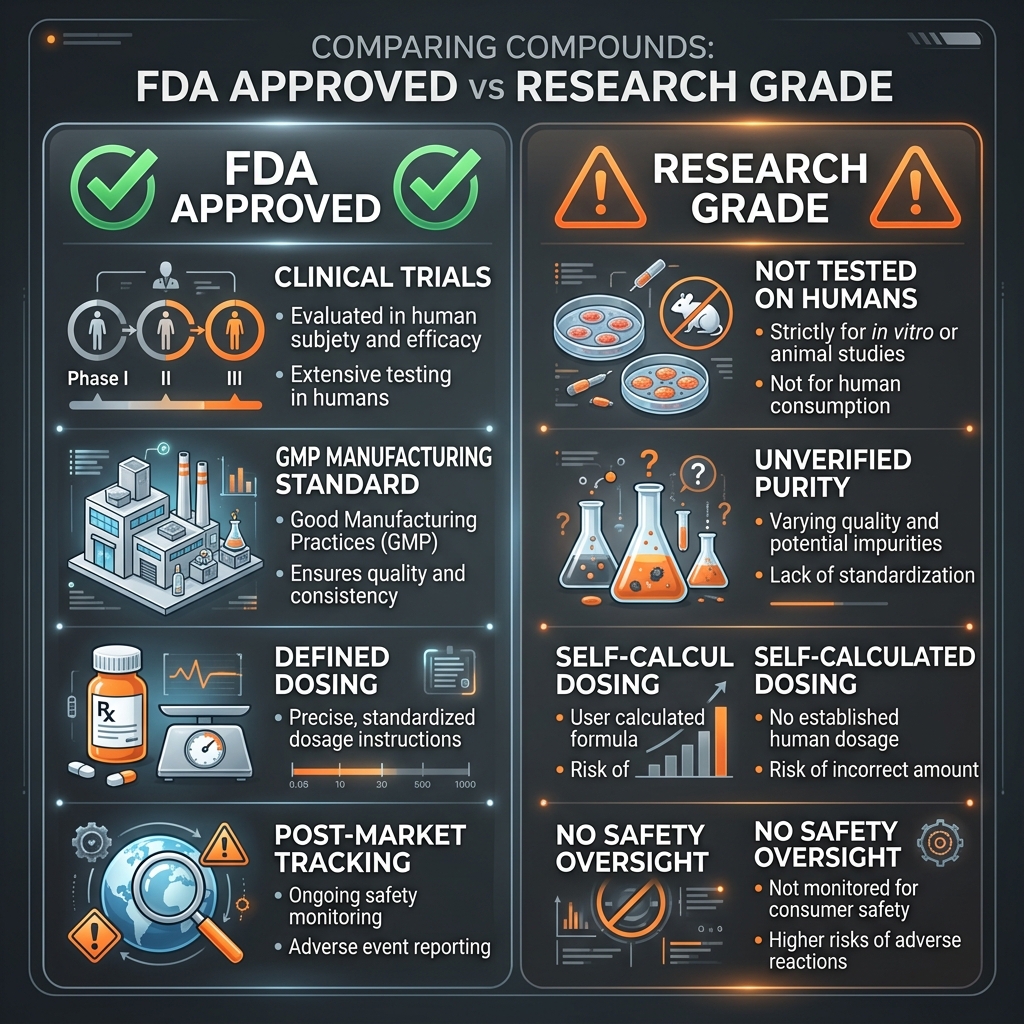
An FDA-approved peptide has been tested in clinical trials. It's made under controlled manufacturing, so what's in the vial matches the label. The purity is checked. The dose is defined. It's prescription-only, which means a licensed prescriber stands between you and the drug. And there's ongoing safety monitoring after launch.
"Research-grade" or gray-market peptides have none of that. No trials that cleared a regulator. No guaranteed purity. No approved dose. The label often reads "for research use only, not for human consumption," and that line is a liability shield for the seller, not a safety rating for you.
That's the actual safety and trust difference. It's not about the molecule being exotic. It's about whether anyone verified what's in the bottle.
For the bigger legal picture, see are peptides legal. If you're still fuzzy on the basics, here's what peptides are.
The FDA-approved peptide list
These are peptide (and peptide-class) drugs with FDA approval. Brand names in parentheses, one line each on what they treat.
- Insulin: blood sugar control in diabetes. The original peptide drug, in use for a century.
- Semaglutide (Ozempic, Wegovy, Rybelsus): type 2 diabetes and chronic weight management. A GLP-1 receptor agonist.
- Tirzepatide (Mounjaro, Zepbound): type 2 diabetes and obesity. Strictly speaking it's a peptidic incretin mimetic that hits two receptors (GIP and GLP-1), but it belongs in the same family.
- Liraglutide (Victoza, Saxenda): type 2 diabetes (Victoza) and weight management (Saxenda). An earlier GLP-1 drug.
- Teriparatide (Forteo): osteoporosis. A fragment of parathyroid hormone that builds bone.
- Octreotide (Sandostatin): acromegaly and certain hormone-secreting tumors.
- Leuprolide (Lupron): prostate cancer, endometriosis, and other hormone-driven conditions.
- Goserelin (Zoladex): prostate and breast cancer, endometriosis.
- Desmopressin (DDAVP): diabetes insipidus and bedwetting. A vasopressin analog.
- Calcitonin-salmon (Miacalcin): osteoporosis and high blood calcium.
- Glucagon: emergency treatment for severe low blood sugar.
- Oxytocin (Pitocin): to start or strengthen labor.
- Tesamorelin (Egrifta): excess abdominal fat in HIV-associated lipodystrophy.
That's not every approved peptide ever. New ones clear the FDA over time, and some older agents get pulled or replaced. But it covers the ones people actually search for, plus the GLP-1 drugs driving most of the current interest.
Want the GLP-1 details specifically? We keep GLP-1 references on the weight and diabetes side. For everything we track, there's the full peptide list.
What is NOT FDA approved
Here's where most confusion comes from. A pile of popular "peptides" have no FDA approval at all. They're sold as research chemicals, and none are approved for use in humans.
- BPC-157: marketed for healing and recovery. Not approved. Research chemical.
- TB-500 (thymosin beta-4 fragment): same recovery claims, same status. Not approved.
- CJC-1295: a growth-hormone-releasing peptide. Not approved.
- Ipamorelin: another GH secretagogue. Not approved.
- GHRP peptides (GHRP-2, GHRP-6): growth-hormone-releasing peptides. Not approved.
- Melanotan II: the tanning peptide. Not approved, and flagged by regulators.
- MOTS-c: a mitochondrial peptide getting research buzz. Not approved.
- Epitalon: pitched for longevity. Not approved.
Notice the pattern. These show up in forums, on coaching plans, and on vials stamped "not for human use." That phrase is doing a lot of quiet work. It lets a seller move the compound legally as a lab reagent while you read it as a wink. It isn't one. It's the opposite.
None of these went through human trials a regulator signed off on. So there's no approved dose, no purity guarantee, no oversight if something goes wrong. You're trusting a label and a supplier. That's the deal, whether or not anyone says it out loud.
What approval actually buys you
Strip away the jargon and "FDA approved" means four concrete things happened.
Clinical trials. Real studies in real people, reviewed by a regulator, before the drug reached anyone's medicine cabinet.
Controlled manufacturing. The stuff is made to a standard. Batch after batch, the contents match the label, and contaminants stay below set limits.
A defined dose. You know how much to take, how often, and what's too much. That number came from data, not a forum post.
Pharmacovigilance. After approval, side effects get tracked and reported. If a pattern shows up, the label changes or the drug gets pulled.
Gray-market peptides skip every one of those steps. That's not a small gap. It's the entire difference between a medicine and a chemical someone is willing to ship you.
So when you ask "what peptides are FDA approved," you're really asking a more useful question underneath: which of these has anyone actually verified? The list above is the answer. Everything outside it, no matter how popular, hasn't crossed that line.
A note before you go
This is educational, not medical advice. Approval status and approved indications change over time, sometimes fast. A peptide that's approved today might gain or lose indications tomorrow, and new drugs clear the FDA every year. Always check the current FDA labeling and talk to a licensed prescriber before acting on anything here. We don't sell, source, or recommend buying any of these compounds. We just explain where the line sits.