

Are peptides legal?
Short version: it depends. That sounds like a dodge. It isn't. "Are peptides legal" is one question wearing the clothes of several, and they have different answers.
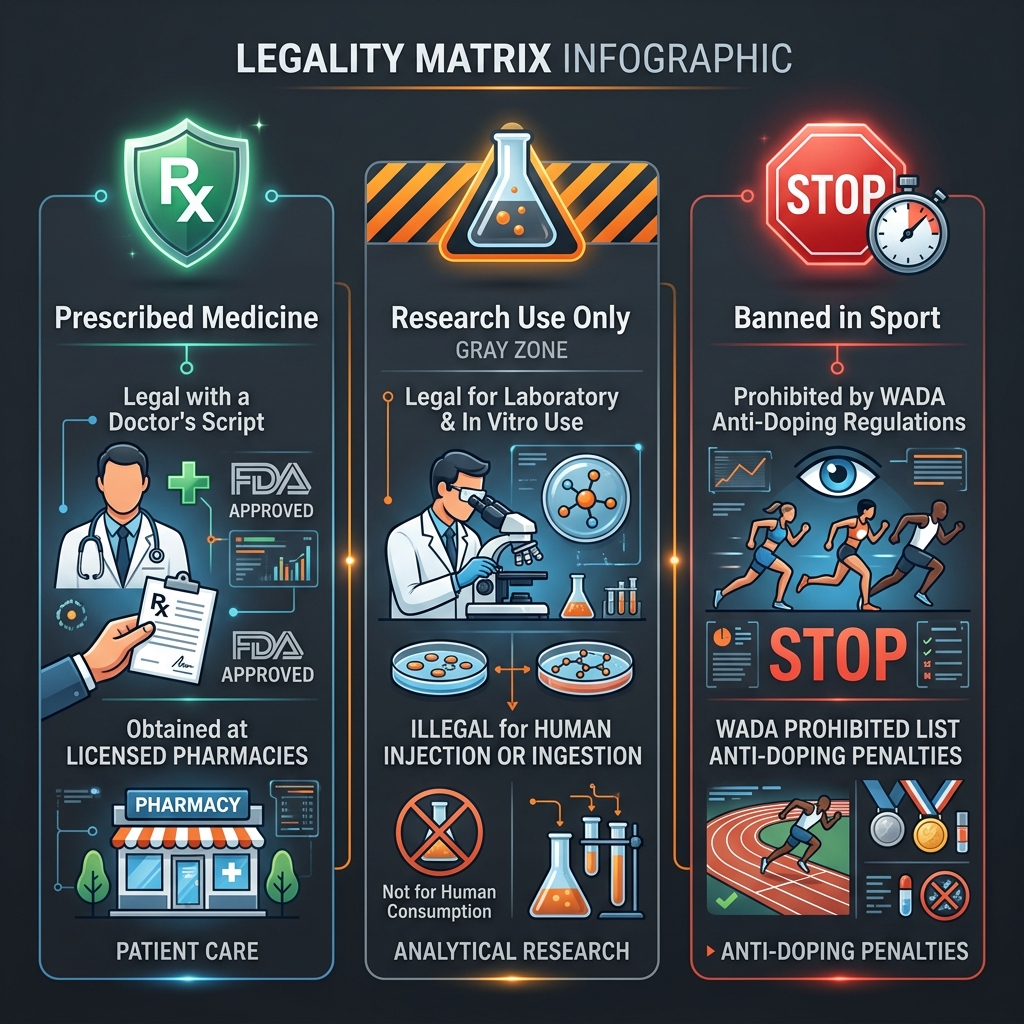
A peptide can be a prescription medicine your doctor hands you. It can be a vial labeled "research chemical, not for human use." It can be a substance that's banned in sport and tightly controlled as a drug. Same word. Three very different legal worlds. Lump them together and you'll get the wrong answer every time.
So let's split them apart.
Layer 1: approved medicines
Plenty of peptides are fully approved drugs. Insulin is a peptide. So are the GLP-1 medicines everyone's been talking about, like semaglutide and tirzepatide. These went through trials, got regulatory approval, and sit on pharmacy shelves.
Are they legal? Yes. With one catch. They're prescription-only. Legal here means a licensed prescriber wrote you a script and you're using the drug the way it was approved for, under medical supervision. That's the whole condition.
Buy the same molecule from a stranger online, no prescription, and you've stepped outside that. The molecule didn't change. Your legal footing did. Approved-and-prescribed is the clean path. Everything else around these drugs gets murkier fast.
If you want the list of which ones cleared the bar, we keep a page on which peptides are FDA approved. For the weight and diabetes side specifically, here are our GLP-1 references.
Layer 2: the "research chemical" gray zone
This is where most of the confusion lives.
Walk through the corners of the internet that sell peptides and you'll see the same phrase over and over: "for research use only," "not for human consumption." BPC-157. TB-500. Various growth-hormone fragments. Sold by the vial, often cheap, usually with that disclaimer stamped on the label.
Here's the trap. Selling a compound for genuine laboratory research can be legal in a lot of places. That's a real, regulated activity. But "legal to sell as a research chemical" is not the same sentence as "legal or safe to put in a human body." Those are two different claims, and the label quietly leans on the first to imply the second.
Most of these peptides have never been approved for human use. No human trials that cleared a regulator. No approved dose. No quality control you can count on. Injecting one isn't an approved medical treatment. Depending on where you live, it can range from off-label use a doctor might supervise, to something with no legal cover at all.
And the "not for human use" label cuts the other way too. It's often there to keep the seller on the right side of drug law, not to protect you. It's a liability shield, not a safety rating.
So when someone asks "are peptides legal to buy," the honest reply is: buying might be legal where you are, sure. That tells you almost nothing about whether using it is legal, approved, or wise.
Layer 3: controlled and banned
Then there's the layer where the answer is closer to a flat no.
In sport, a long list of peptides is simply banned. The World Anti-Doping Agency prohibits growth-hormone secretagogues, GHRPs, IGF-1 and its analogs, and others. Compete under those rules and using these isn't a gray area. It's a positive test and a ban, whether or not the substance is legal to possess where you live.
Some peptides are also controlled as medicines or restricted substances at the national level, so possessing or supplying them without authorization can break the law. Which ones, and how hard, varies by country.
The country picture, roughly
This part shifts depending on where you're standing, so treat what follows as a rough map, not turn-by-turn directions.
In the US, peptide drugs fall under the FDA and the Federal Food, Drug, and Cosmetic Act. Approved peptides are prescription medicines. Unapproved ones get sold under that "not for human use" research framing, which keeps the sale legal-ish while leaving human use unapproved.
In the EU and Germany, medicines law (Arzneimittelrecht) governs anything sold or used as a drug. Selling an unapproved peptide as a medicine, or for human use, runs into that law quickly.
The UK regulates medicines through its own framework, with prescription-only categories that catch many of these compounds.
Australia tends to be stricter than most. A number of peptides are prescription-only or outright prohibited imports, and personal importation can land you in trouble.
That's the broad shape. The details differ by country and they change. A peptide that's sold freely in one place can be a controlled medicine across the border, and a rule that held last year can be rewritten this year. Don't assume what's true in one country travels.
So where does that leave you?
If you zoom out, the pattern's simple even if the law isn't.
A peptide approved for your condition, prescribed by a qualified doctor, used the way it was approved, monitored along the way. That's the path that's both legal and reasonably safe, wherever you are. Everything outside it trades that certainty for risk, legal risk, health risk, or both.
The "research chemical" route looks cheap and easy. What you give up is the approval, the quality control, and any clear legal standing for using it. That's a real cost, even when it doesn't show up on the invoice.
For what these molecules actually are and why the category is so broad, see what peptides are.
We'll say this plainly: we don't sell peptides and we don't connect you with anyone who does. This is an information project. We're not in that chain, and we're not steering you toward a vendor.
A real disclaimer
This is general information, not legal or medical advice. Laws differ by country and change often. Check your local regulations and talk to a qualified professional.