

Syringe filters for reconstituted peptide solutions
Two different things get discussed under the one word "filtering": equipment, and a claim about safety that the equipment does not support. The equipment side is well defined — filter documentation for aqueous protein solutions describes a 0.22 µm sterilizing-grade membrane, a hydrophilic material such as PES, a small-diameter housing and a Luer-lock connector, supplied sterile and single-use. That specification describes hardware which retains bacteria and particulate matter and nothing else; whether a filtration step is appropriate at all is a separate question, and one for a pharmacist or physician.
What sterilizing filtration means
A syringe filter is a small polymer housing with a membrane sealed inside it. Liquid pushed through passes the membrane; anything larger than the pore rating remains on the upstream side.
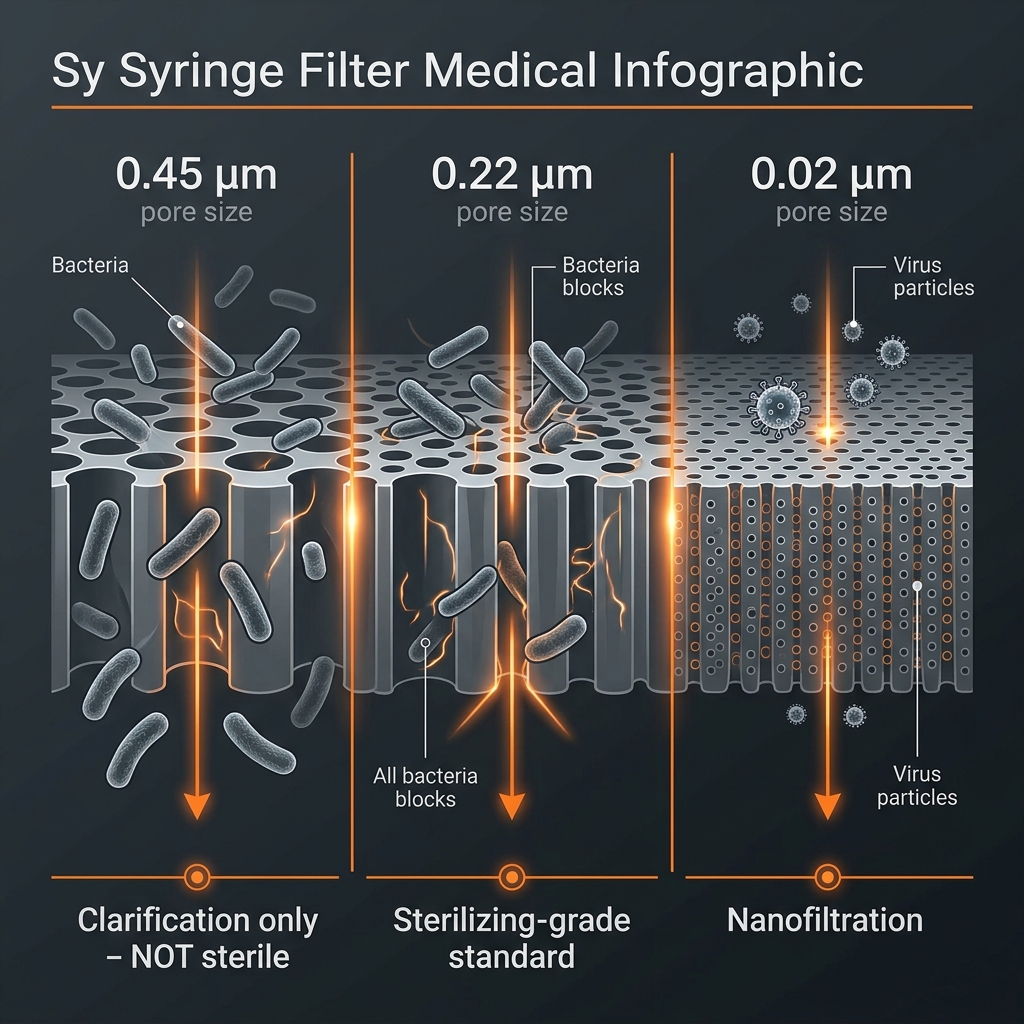
"Sterilizing-grade" is a defined technical classification, not a marketing adjective. Under ASTM F838, a membrane earns it by retaining a defined bacterial challenge applied per square centimetre of filter area: Brevundimonas diminuta, at roughly 0.3 µm one of the smallest culturable bacteria. That test is why 0.22 µm became the international convention for sterilizing aqueous solutions: at that rating, bacteria, yeasts and moulds are retained.
Both 0.2 µm and 0.22 µm appear on packaging for the same classification — a labelling convention inherited from different manufacturers decades ago, not a difference in retention.
Pore ratings and what each one retains
| Pore rating | Classification | Rated to retain |
|---|---|---|
| 0.45 µm | Clarifying, not sterilizing | Larger particulates and debris. B. diminuta passes in quantity — the finding that moved the sterilizing convention to the finer rating |
| 0.22 µm (= 0.2 µm) | Sterilizing-grade (ASTM F838) | Bacteria, yeasts, moulds |
| 0.1 µm | Mycoplasma-rated | Mycoplasma, in addition to bacteria |
| 0.02 µm (20 nm) | Virus-retentive nanofilter | Viral particles |
The 0.45 µm rating is the one most often misread. Filter documentation places it as a clarifying or pre-filtration step, and its failure against small bacteria is exactly what made 0.22 µm the sterilizing convention. The finer ratings answer questions of their own — a sterilizing membrane is bacteria-tight, not tight against everything.
Membrane material and peptide adsorption
Material matters as much as pore rating, for a reason unrelated to sieving: peptides adsorb onto some membrane surfaces and are lost from solution there.
| Membrane | Protein binding | Notes |
|---|---|---|
| PES (polyethersulfone) | Very low | Naturally hydrophilic, high flow rate; the material most commonly specified for protein and peptide solutions |
| PVDF, hydrophilic-treated | Low | Only the treated grade wets with water; untreated PVDF is hydrophobic |
| CA / RC (cellulose acetate, regenerated cellulose) | Low | Hydrophilic, low-binding |
| Nylon | High | Binds peptides strongly; documented recovery losses |
| PTFE | Not applicable to water | Hydrophobic; specified for solvents and gases |
Whether an aqueous solution passes at all is decided by hydrophilic versus hydrophobic. A reconstituted peptide is dissolved in water, so the membrane has to be hydrophilic; a hydrophobic membrane will not wet with water unless primed with alcohol first, which introduces solvent residue into a step whose purpose is the opposite.
One recurring confusion in the material names: cellulose nitrate binds protein strongly, while cellulose acetate and regenerated cellulose are low-binding. The word "cellulose" alone says nothing about binding behaviour.
Housing diameter, hold-up volume and connector
Hold-up volume — the liquid retained by housing and membrane when the plunger reaches the end of travel — scales with housing diameter. Manufacturer datasheets pair smaller housings with smaller sample volumes: a 4 mm housing is listed for volumes around 1 mL, a 13 mm housing for roughly 1–10 mL. The hold-up volume of a 13 mm device is on the order of tens of microlitres; a 25 mm device retains considerably more, in some designs above 1 mL — a large proportion of a container holding 1–2 mL in total.
Two further specifications are structural rather than matters of preference. The Luer-lock is the threaded connector; the Luer-slip is a push fit, and plunger pressure can separate a slip joint mid-stroke. Sterilizing filters are supplied individually sealed and terminally sterilized, by gamma irradiation or ethylene oxide — a sterile filtrate presupposes a sterile filter. Single use belongs to the same specification: a used membrane is wet, loaded with retained material and no longer sterile.
What filtration does not remove
This is where the capability of a membrane filter is routinely overstated. A 0.22 µm membrane is a size-exclusion barrier for bacteria and particulates, and that is the whole of its function.
- Endotoxins (pyrogens) pass through. They are lipopolysaccharide fragments of bacterial cell walls, far smaller than the pore and heat-stable, and they pass 0.22 µm and 0.1 µm membranes alike. Dead bacteria retained on the membrane are themselves an endotoxin source.
- Viruses pass through. Viral particles are roughly an order of magnitude smaller than bacteria; retention requires a 20 nm nanofilter.
- Dissolved contaminants pass through. Heavy metals, solvent residues and degradation products move with the solvent. Identity and purity are questions for HPLC and mass spectrometry, not for a filter.
- Sterile, pyrogen-free and pure are three different properties. A clear, filtered solution can satisfy the first and fail the other two, and its appearance will not indicate which.
The most useful thing to know about a membrane filter is therefore what it cannot compensate for: nothing about the origin, identity, purity or handling history of a solution is changed by passing it through one.
Can filtration make matters worse?
It can. Every additional manipulation of a closed system is another opportunity for contamination to enter, and there is no published evidence that filtration outside a pharmacy setting nets out as a reduction in risk; the outcome is dominated by the aseptic technique around the step rather than by the membrane. Filters are also not perfectly inert — extractables and leachables are a recognised topic in the pharmaceutical literature, minor next to the handling question.
Where peptide is lost
Loss is not a sieving effect: a peptide molecule measures a few nanometres across against a 220 nm pore and passes freely. Two mechanisms account for what disappears. Membrane adsorption binds peptide to the membrane surface until the available sites saturate, which is why the first fraction through carries the largest proportional loss; with low-binding membranes such as PES, the losses described in the method literature are small. Hold-up volume is the retained volume described above, which stays in the device.
Both effects are described in laboratory method literature, which lists membrane pre-wetting and displacement of the hold-up volume among the standard sample-preparation measures of the analytical laboratory — procedures belonging to that setting and to its equipment, not part of this description. What the two mechanisms explain is the shape of the loss rather than a way around it: the hold-up volume is fixed and the adsorption sites are finite, so both claim a larger share of the starting material as the volume gets smaller and the concentration lower.
Cloudiness in a previously clear solution
Cloudiness that develops hours or days after reconstitution in a solution that was clear is described in pharmaceutical practice as an indicator of microbial growth or of the peptide coming out of solution. Neither is a filtration problem, and the standard handling of a preparation whose integrity is in question is discarding it rather than clarifying it: passing a cloudy solution through a membrane removes the visual evidence while leaving endotoxin and degradation products in the filtrate. In the filtration literature, the stated purpose of a clarifying step is particulate matter of known non-microbial origin, such as undissolved solid shortly after mixing. Cloudiness that appears only when several peptides are combined in one syringe has a different, chemical explanation, covered in mixing peptides in one syringe.
How the operation is described in the standards
Sterile filtration is a defined pharmaceutical operation with published conventions — USP General Chapter <797>, the corresponding pharmacopoeial chapters in Europe, and the FDA guidance on aseptic processing. Those texts describe it as taking place in a controlled-air environment, performed by personnel with documented aseptic technique training, which is why they treat sterilizing filtration as a pharmacy or manufacturing activity.
What those chapters regulate is the frame rather than the hand movements, and validated filter integrity is part of that frame: a sterilizing filter used in production is expected to be verified by a physical test — bubble point or diffusive flow — which presupposes its own equipment, acceptance criteria and documentation. None of that apparatus exists outside the setting it was written for.
On the technique the same standards record findings rather than a sequence. Closure disinfection, contact surfaces and air quality determine the outcome at least as much as the membrane does, and excessive differential pressure across a membrane is a documented cause of filter failure. The consistent element across these texts is the assignment itself: an operation defined for trained personnel in a controlled environment, of which the filter specification is only one part.
Specification summary
| Specification | Value stated in filter documentation |
|---|---|
| Pore rating | 0.22 µm, equivalently labelled 0.2 µm; classified sterilizing-grade under ASTM F838 |
| Membrane | Hydrophilic PES, with hydrophilic PVDF, CA and RC listed as further low-binding materials |
| Housing diameter | 13 mm is listed for sample volumes of roughly 1–10 mL; hold-up volume rises with diameter |
| Connector | Luer-lock is the threaded fitting; a Luer-slip joint is a push fit that can separate under plunger pressure |
| Supply form | Individually sealed, gamma- or EO-sterilized, labelled single use |
Those are the values that recur across filter documentation for aqueous protein and peptide solutions. They describe a piece of hardware and its rated performance — not an indication for using one, which is a question for a pharmacist or physician rather than for a specification table.
Common questions
Which pore size counts as sterilizing-grade?
The 0.22 µm rating is the one classified as sterilizing-grade for aqueous solutions, validated by bacterial retention testing under ASTM F838. A 0.45 µm membrane clarifies a liquid but is not rated to retain the test organism and is described in the literature as a pre-filter.
Is 0.2 µm different from 0.22 µm?
No. The two figures are historical labelling conventions used by different manufacturers for the same sterilizing-grade rating. Retention performance is defined by the same test, not by the printed number.
Which membrane materials bind peptides least?
Polyethersulfone (PES), hydrophilic-treated PVDF, cellulose acetate and regenerated cellulose are classified as low protein binding. Nylon binds peptides strongly, and PTFE is hydrophobic, so neither is specified for aqueous peptide solutions.
Does sterile filtration remove endotoxins?
No. Endotoxins are bacterial cell-wall fragments far smaller than a 0.22 µm pore and pass through it. Sterility, freedom from pyrogens and chemical purity are three separate properties, and a membrane filter addresses only the first.
What volume of liquid stays behind in a syringe filter?
The retained hold-up volume scales with housing diameter. A 13 mm housing typically holds back a few tens of microlitres, while a 25 mm housing can retain substantially more — a significant fraction of a container holding only a millilitre or two.
Can a syringe filter be used more than once?
No. Sterilizing filters are supplied individually sealed for single use. A used membrane is wet, loaded with retained material and no longer sterile, and it presents a growth surface rather than a barrier.
Sources
- ASTM F838, Standard Test Method for Determining Bacterial Retention of Membrane Filters Utilized for Liquid Filtration.
- United States Pharmacopeia, General Chapter <797>, Pharmaceutical Compounding — Sterile Preparations.
- European Pharmacopoeia 5.1.1, Methods of preparation of sterile products.
- U.S. Food and Drug Administration, Sterile Drug Products Produced by Aseptic Processing — Current Good Manufacturing Practice (2004).
- PDA Technical Report No. 26, Sterilizing Filtration of Liquids.
- Product datasheets published by manufacturers of sterilizing-grade syringe filters, for housing diameter, hold-up volume and stated sample-volume ranges.
The part that matters
This page is general information — not medical advice, not a usage recommendation, and not instructions to carry anything out. A sterilizing membrane is a size-exclusion barrier for bacteria and particulates, and the properties people most want it to guarantee — freedom from pyrogens, identity, purity, the reliability of a source — lie outside what any filter can address. Related reference pages: reconstitution, bacteriostatic and sterile water, injection safety basics, and the unit converter.