
Ovagen: what the studies show, status and safety
Summary
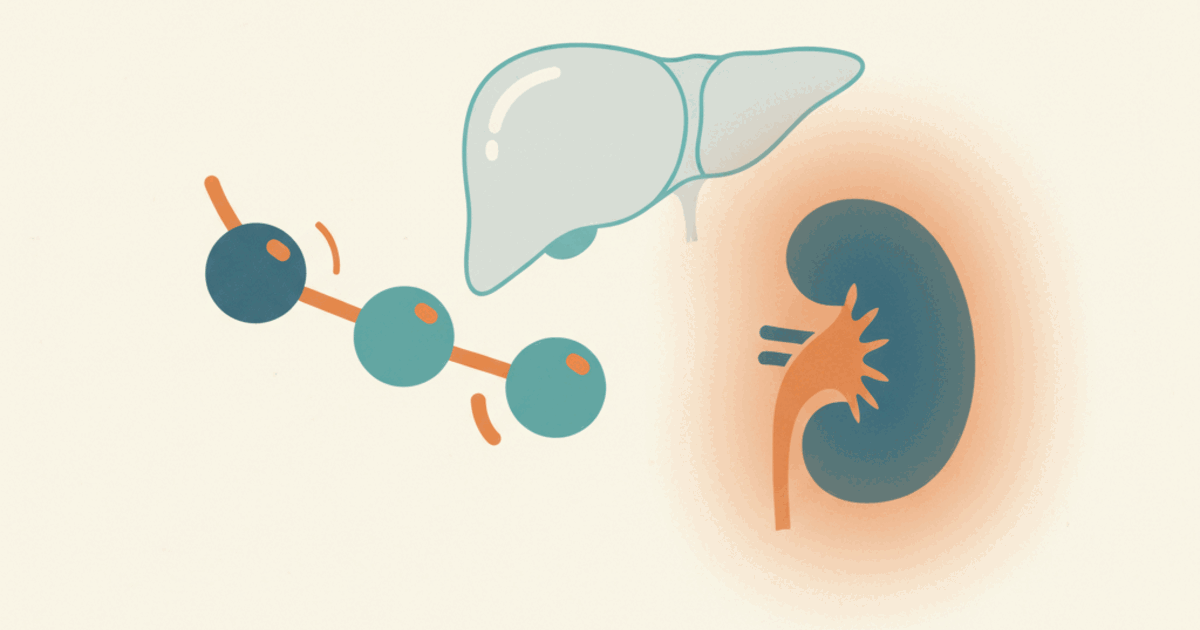
Ovagen is a synthetic chain of three amino acids, Glu-Asp-Leu, made at a St Petersburg institute. It is sold as a liver and digestive peptide, but every reviewed experiment published on it was done on kidneys. Not one reviewed study has tested it on liver or gut tissue, and not one study in people has ever been registered. It is approved as a medicine nowhere, including Russia, where it is sold only as a capsule food supplement. The same trade name belongs to an approved veterinary hormone and to a homeopathic product.
Key findings at a glance
- It has three parts, not four. The chemical record describes Glu-Asp-Leu, formula C15H25N3O8, mass 375.37 g/mol. The patent that created the substance claims the same three-part chain [1], [2].
- The four-part sequence in circulation leads nowhere. His-Glu-Asp-Gly returns nothing in the chemical database, under any spelling, and nothing in the medical literature. The abbreviation HEDG belongs to a chemically damaged DNA building block, not to a peptide [3].
- Every reviewed experiment is about kidneys. Six published papers examine kidney cells, kidney tissue and rats with damaged kidneys. Liver and gut tissue appear in none of them [4], [5].
- The liver label is backed by a patent, not a study. In the group's own 2022 table the row reads "Ovagen (EDL) −28.27 Nephroprotector Hepatoprotector", and the reference behind the second word is the patent application [2], [6].
- A journal review backs a liver claim with a kidney paper. The 2021 review of the same group lists the peptide as "regulation of renal cells' function, hepatoprotection, DNA binding". One kidney cell culture study is cited for that whole line [7], [8].
- Zero registered studies in people. A query of the ClinicalTrials.gov registry returned a total count of zero. No reviewed paper describes giving the peptide to a person [9].
- The one well-documented animal result is a kidney result. In rats given a kidney-damaging antibiotic, blood creatinine fell from 182.73 ± 15.08 to 68.27 ± 2.31 µmol/l under the peptide, with seven animals per group [5].
- Three different things share the name. Canada has an approved veterinary medicine called Ovagen containing a sheep hormone, and the single American entry is a homeopathic product [10], [11].
What it is
Ovagen is a laboratory-made peptide of three amino acids, sold as capsules in Russia and as a research chemical in the West. It comes from the St Petersburg Institute of Bioregulation and Gerontology, the group around Vladimir Khavinson, and is presented as a peptide for the liver and the digestive tract [12].
The group calls molecules of this kind cytogens: short synthetic chains said to carry the active core of an animal organ extract. That is a house term of the institute, and it appears neither in a pharmacopoeia nor in any regulator's classification [12], [13].
The patent behind the substance was filed on 30 May 2006 by a St Petersburg company, with Khavinson as first named inventor. Its title promises a peptide that stimulates the regeneration of liver tissue, and its main claim names H-Glu-Asp-Leu-OH [2].
Quick facts
| Field | Value | Ref |
|---|---|---|
| Chain | Glu-Asp-Leu, three amino acids | [1], [2] |
| Formula and mass | C15H25N3O8, 375.37 g/mol | [1], [4] |
| Structure key | InChIKey JVSBYEDSSRZQGV-GUBZILKMSA-N | [1] |
| Code in the literature | T-35, also written EDL | [8] |
| Chemical record | PubChem CID 444128, ChEBI 137252, MeSH concept 2008491 | [1], [4], [14] |
| CAS registry number | None held by any database checked; the number printed by sellers belongs to a sheep hormone | [1], [4], [10] |
| Code with the American regulator | None | [13] |
| Entry in the open knowledge base | None under this name | [15] |
| How long it lasts in the body | No published value, for any route | [16] |
| Registered studies in people | None | [9] |
| Approval status | Approved nowhere, for anything | [17], [13] |
| Sold as | Capsules as a food supplement in Russia, 20 mg vials of powder in the West | [17], [18] |
| Originating group | St Petersburg Institute of Bioregulation and Gerontology | [2], [12] |
How it works
Nobody knows. No receptor has been identified for this peptide, no binding has been measured, and no experiment has shown that it enters a cell at all.
The explanation offered by the originating group runs in three steps. The peptide would be carried into the cell by a transport protein, would reach the nucleus, and would attach to particular stretches of DNA and change which genes are read. Each step is worth looking at separately.
- Getting into the cell. Two computer docking papers from the same group model that step. Neither measures transport, and no uptake experiment for this peptide exists [6], [19].
- Attaching to DNA. One model favours a run of alternating A and T bases in the narrow groove of the double helix [20]. A second, from the same group, instead assigns the peptide the stretch written "ctcc" [21]. Both are calculations.
- Acting on kidney cells. In ageing kidney cell cultures the peptide was tied to one enzyme, the gelatinase MMP-14. Markers of cell renewal responded to the organ extract and to a sister peptide instead [8].
- Steadying kidney tissue under stress. In rats, antioxidant enzyme activity rose and a marker of fat damage fell after kidney injury [5]. That describes what changed, not how.
The docking numbers deserve care, because the same group published two different sets. In 2022 the peptide scored −28.27 at the transporter LAT1, sixth of 28 peptides in the table. In 2023 the same peptide at the same transporter scored −35.03, fourth of 26 [6], [19].
That is a gap of 6.76 units for one molecule at one carrier. The 2023 paper explains it in a footnote with different shapes of the transporter and a more thorough docking method [19]. The same paper puts the peptide at −17.37 at LAT2, rank 24 of 26, and at −20.48 at PEPT1.
At the second peptide carrier, PEPT2, the score came out at +13.48, rank 25 of 26. A positive value is the opposite of a favourable fit, and the authors add that the available structure of that carrier does not allow a reliable judgement anyway [19].
A size problem sits underneath all of this. Three amino acids carry very little information, far too little to single out one gene in a whole genome. Glutamic acid, aspartic acid and leucine also circulate freely in blood as ordinary amino acids.
What the studies found
Six reviewed papers, all about kidneys, plus computer models and two examples in a patent application. Every one comes from the originating group or from a laboratory co-authoring with it, and no outside group has repeated any of it [16].
Counts as of 16 September 2026. The six reviewed papers are the primary experimental work on the peptide; the registry query returned a total of zero. Sources [5], [9], [22], [8], [23], [24], [20], [16].
Kidneys, damaged by an antibiotic
Animal data Rats received the antibiotic gentamicin for six days, which damages the kidneys, and 3 µg/kg of the peptide into the abdominal cavity after each dose. Seven animals made up each group [5].
Against untreated animals, urine output rose from 2.21 ± 0.50 to 3.80 ± 0.62 ml (p<0.05). Blood creatinine fell from 182.73 ± 15.08 to 68.27 ± 2.31 µmol/l (p<0.001), and creatinine clearance rose from 14.88 ± 3.61 to 43.03 ± 7.63 µl/min (p<0.01) [5].
Protein loss in urine fell from 0.20 ± 0.03 to 0.116 ± 0.03 mg/2 h (p<0.01). Healthy animals sat at 4.83 ± 0.13 ml, 55.63 ± 5.98 µmol/l, 56.49 ± 6.34 µl/min and 0.088 ± 0.015 mg/2 h. The treated animals did not quite reach that range [5].
Kidneys, cut off from blood supply
Animal data In the second series of the same paper, both kidney stalks were clamped for 60 minutes and released for 24 hours. The peptide was given for three days beforehand, so this is a preventive design rather than a treatment [5].
Urine output rose from 2.11 ± 0.14 to 3.97 ± 0.34 ml (p<0.01) and blood creatinine fell from 138.57 ± 9.60 to 78.39 ± 3.58 µmol/l (p<0.05). Clearance rose from 17.85 ± 1.57 to 40.26 ± 4.64 µl/min (p<0.01), and protein loss fell from 0.082 ± 0.05 to 0.031 ± 0.003 mg/2 h (p<0.01). Sham-operated animals sat at 4.12 ± 0.10 ml, 65.24 ± 6.08 µmol/l, 66.40 ± 8.05 µl/min and 0.016 ± 0.001 mg/2 h [5].
Animal data Tissue enzymes moved in the same direction. In the antibiotic model catalase activity rose by 74 per cent and glutathione peroxidase by 65 per cent, while malondialdehyde fell by 41 per cent. In the clamping model the three figures were 51 per cent, 59 per cent and 25 per cent. The energy enzyme succinate dehydrogenase stayed at control level in the antibiotic model and rose 5.4-fold in the clamping model [5].
A second toxic kidney model
Animal data In 42 rats across six equal groups with toxic acute kidney failure, the peptide doubled urine output against untreated animals and raised creatinine output 1.7-fold. Protein loss fell 2.6-fold, sodium output fell 4.3-fold and sodium reabsorption rose 2.2-fold [22].
The paper compares four preparations and singles this peptide out, calling its protective effect on the kidney potent. It reports factors rather than absolute values in its summary, and it notes that the animal amounts were back-calculated from figures intended for people using a species factor [22].
Kidney cells in a dish
Cell data In ageing kidney cell cultures, the enzyme MMP-14 was named as the target of this peptide. The renewal markers Ki-67 and p53 responded to the organ extract and to the sister peptide AED instead, not to this one [8].
Cell data In kidney tissue explants from young and old rats, the peptide raised cell growth and lowered cell death. It did so, in the authors' own words, to a lesser degree than the organ extract [23]. In a further culture study it raised cell growth, lowered the ageing markers p16, p21 and p53 and raised SIRT-6 [20].
Where it did less, or nothing
Animal data In old rats it raised urine output 1.2 to 1.4-fold, distal sodium transport 1.2 to 1.3-fold and sodium output 1.6-fold. The fall in urine protein of 1.5 to 2.8-fold belonged to the organ extract and to AED, not to this peptide [24].
The pattern repeats across the series. In two of the three culture papers the whole organ extract outperformed the synthetic peptide [8], [23]. That cuts against the idea behind these substances, which is that the short chain carries the active core of the extract.
The liver claim
No reviewed paper has ever tested this peptide on liver or gut tissue [16]. What exists sits in the 2006 patent application, and a patent example is written by the applicant, reviewed by nobody and published in no journal.
Example 2 of that application reports 27 rat liver fragments in culture and a 28 per cent rise in an area index on the third day at 10 ng/ml. Example 3 reports 18 rats after removal of two thirds of the liver, with twice the number of dividing cells at 96 hours [2].
Those two paragraphs are the entire liver record. The reviews of the same group then carry the label onward. The 2022 table backs the word hepatoprotector with that patent [2], [6]. The 2021 review backs "hepatoprotection" with a kidney cell culture paper [7], [8].
The chain continues inside the primary literature. The 2017 kidney paper opens by stating that the peptide stimulates growth of organ cultures of kidney and liver. The two references given for it are a Russian kidney review and the same kidney cell paper [5], [8].
For the digestive tract, which stands beside the liver on the Russian product label, there is no source at all. No paper, and not even a patent example [12], [16].
What is still unknown
- Whether anything happens in a liver or a gut, in any species.
- How much reaches the blood by mouth or by injection, and how quickly it breaks down.
- Whether the peptide enters a cell at all, which no experiment has tested.
- What it does over months, at any amount, in anyone.
Side effects and safety
No side effect profile exists. That is not the same as being well tolerated: it means nobody has ever collected one. There is no study with safety measurements, no case report and no entry in the American adverse event database [9], [13].
Two statements of safety do circulate, and both need naming for what they are.
- The patent statement. Example 5 of the application reports that a single dose more than 5,000 times the intended amount caused no toxic reactions in animals. It names no species, no number of animals, no observation period and no measurements [2].
- The journal statement. The 2017 kidney paper writes that the peptide is non-toxic and causes no allergic reactions, and cites a patent for it [5]. So the only safety sentence in the reviewed literature rests on an unreviewed document.
- The seller statement. A Russian retail page states that the product is well tolerated with no side effects, no complications, no contraindications and no dependence. Nothing is offered in support [17].
One observation does come from an animal experiment. In the old-rat study, raised antioxidant enzyme activity and the tissue findings together were read as an absence of kidney damage [24]. That is one organ in one rodent experiment.
What is missing
- No study in people, registered or published, and therefore no human safety data of any kind.
- No measurement of uptake, distribution, breakdown or clearance, for any route.
- No figure for how much survives the gut, although the Russian product is a capsule.
- No data on immune reactions, long-term use, interactions, pregnancy, breastfeeding, children, or reduced liver or kidney function.
- No pharmacopoeia monograph, so there is no official standard against which traded material could be measured [18].
The injectable form carries risks separate from the substance. Vials sold as research material are made under no pharmaceutical quality system, so sterility, endotoxin content and actual peptide content are unknown [18]. Mixing and injecting non-sterile material brings the usual risks of abscess, vein inflammation and blood-borne infection.
Doses used in studies
These are the doses used in the cited studies, listed for reference. They are not a recommendation.
Every line in the table comes from a rat or from tissue in a dish, and none of them can be carried over to a person.
No line for people appears in this table. The only account of use in people anywhere is an example inside the patent application. It was never published, never registered, never randomised and never blinded, and its figures contradict each other [2].
| Study | Model | Amount | Route | Duration | Ref |
|---|---|---|---|---|---|
| Zamorskii 2017, series I | Rats, kidney damage from an antibiotic | 3 µg/kg | Into the abdominal cavity | 6 days | [5] |
| Zamorskii 2017, series II | Rats, kidneys cut off from blood supply | 3 µg/kg | Into the abdominal cavity | 3 days beforehand | [5] |
| Zamorskii 2015 | Rats, toxic acute kidney failure | 3 µg/kg; comparison arms 300 µg/kg organ extract, 3 µg/kg AED, 7 µg/kg AEDG | Into the abdominal cavity | 4 days before and 3 days after | [22] |
| Patent example 2, not a study | Rat liver fragments in culture | 1, 10 and 100 ng/ml | Added to the culture fluid | 3 days | [2] |
| Patent example 3, not a study | Rats, after removal of two thirds of the liver | 0.1 µg per animal in 0.5 ml saline | Injection | Two administrations | [2] |
| Patent example 4, not a study | Rats, experimental liver scarring | 0.5 µg per animal in 0.5 ml saline | Injection | Courses of 5 days | [2] |
An amount given to a rat cannot be converted into an amount for a person, and a concentration in culture fluid still less so. The Russian capsule does not help either. Its 0.215 g refers to the whole capsule content including the cellulose carrier, and no page checked states how much peptide is in it [17].
Injection schedules for people do circulate on trade-adjacent pages. They rest on no study, they contradict the only figures the patent family ever documented, and they are reproduced nowhere on this page [25].
Development and approval status
A patent, six papers, no development programme
- 2006Patent application filed in Russia for a liver regeneration peptideClaims H-Glu-Asp-Leu-OH; published 2007, ref [2]
- 2014First appearance in the literature, in kidney cell culturesCode written T-35, ref [8]
- 2015-2018Kidney work in rats and tissue culturesSame group and co-authors throughout, refs [22], [23], [24]
- 2017The most complete animal study, on kidneysTwo damage models, seven rats per group, ref [5]
- 2022-2023Two computer transport models with different results for the same peptideLAT1 scores of -28.27 and -35.03, refs [6], [19]
- February 2023Russia registers a capsule food supplementRegistration RU.77.99.88.003.R.000288.02.23, ref [17]
- 16 September 2026Registers checkedNo approval anywhere, no registered study, no regulator code, refs [9], [13]
There is no development programme behind Ovagen. No sponsor has filed anything, no phase of testing has begun and nothing is pending. What exists is a patent from 2006, a thin line of laboratory papers from one institute, and a capsule sold as a food supplement [2], [9].
| Market | Status | Note | Ref |
|---|---|---|---|
| United States | Not approved | No substance record and no code; never put forward for pharmacy compounding | [13], [26] |
| European Union | Not approved | No authorisation and no trial; the agency's own site refused the query on the day of checking | [27] |
| Germany | Not approved | An unlicensed injectable preparation may not be placed on the market | [27] |
| United Kingdom | Not approved | The register returned only a page shell, so the check rests on every other register | [28] |
| Australia | Not approved | Absent from the Poisons Standard, which is not permission | [29] |
| Canada | Not approved | The approved medicine of this name is a veterinary hormone product, not this peptide | [10] |
| Switzerland | Not approved | No authorisation identified; the register was unreachable on the day of checking | [27] |
| Russia | Not approved | Registered in February 2023 as a capsule food supplement, which is not a medicine licence | [17], [30] |
Three rows need care. The Australian entry means the substance was never scheduled, not that it may be used [29]. The Canadian entry is the one most often misread: the approved product carries the same name and a different active ingredient [10].
The Russian row matters most, because it is the one sellers lean on. A food supplement registration records a product, not a proof that it works, and the page itself carries the notice that it is not a medicine. No injectable form is approved in Russia either [17], [30].
American enforcement gives the setting rather than a verdict. Regulators sent a series of warning letters to peptide sellers through 2026, none of which names this substance [31].
Anti-doping
Ovagen is banned at all times, in and out of competition. Category S0 of the 2026 Prohibited List covers "any pharmacological substance which is not addressed by any of the subsequent sections of the List and with no current approval by any governmental regulatory health authority for human therapeutic use" [32].
The name does not appear on the list, and that is not a gap. This category is written openly to catch substances no authority has approved, and the peptide is licensed nowhere [32]. A food supplement registration is not an approval for human therapeutic use, so the Russian capsule does not change this.
Everything in category S0 counts as a specified substance, which affects the penalty rather than the ban [32]. German anti-doping law reads differently: its annex names banned substances one by one, has no catch-all heading, and does not cover this peptide [33].
No published test exists for detecting it in a sample. Further detail is in the overview of peptides banned in sport.
Compared with related peptides
Eight of the 28 peptides in table 2 of the 2022 transport model by the originating group. A more negative value means a better calculated fit, and the same authors call a score below minus 15 the sign of likely transport. Ovagen ranks sixth of 28 in the full table. Source [6].
| Peptide | Relation to Ovagen | What the checks behind this page found |
|---|---|---|
| Ovagen | — | Glu-Asp-Leu, 375.37 g/mol; six reviewed papers, all on kidneys, no study in people [1], [5], [16] |
| Livagen | One amino acid longer, from the same laboratory, also labelled for the liver | Lys-Glu-Asp-Ala from an earlier patent; absent from the Russian catalogue, where the liver place belongs to Ovagen [6], [12] |
| Chonluten | Differs by a single amino acid, EDG against EDL | Sold in the same Russian catalogue for lung tissue; scored −30.30 in the same table [6], [12] |
| Pinealon | Differs by a single amino acid, EDR against EDL | Labelled a nerve protector in the same table, scored −30.29 [6] |
| Cartalax | Sister peptide AED, tested beside Ovagen in three kidney papers | Outperformed Ovagen on protein loss in old rats and on renewal markers in culture [8], [24] |
| Epitalon | Four-part peptide of the same series, AEDG | Used as a comparison arm in the kidney work; scored −20.38 in the same table [6], [22] |
The comparison is not about strength. It shows a family of near-identical short chains, each assigned to a different organ, whose labels rest on the same kind of table entry rather than on organ-specific experiments.
One sequence difference of a single amino acid separates Ovagen from Chonluten and from Pinealon. Product descriptions swap them regularly, and the docking table of the originating group is the only place where all three are compared at once [6].
The most useful row is Cartalax. It is the peptide tested side by side with Ovagen in three of the kidney papers, and in two of those it did more, not less [8], [24].
Common misconceptions
- "Ovagen is His-Glu-Asp-Gly." That four-part sequence returns nothing in the chemical database, nothing in the medical literature, and it appears in neither the patent nor the Russian label. The documented chain is the three-part Glu-Asp-Leu [1], [2], [3].
- "Its CAS number is 9046-70-2." That number identifies follicle-stimulating hormone from sheep, the ingredient of the veterinary product of the same name. No database checked holds a registry number for the peptide [1], [10].
- "Ovagen is an approved medicine, because a drug register lists it." Canada's approved Ovagen is a veterinary hormone product, and the single American entry is homeopathic drops. Neither contains this peptide [10], [11].
- "Ovagen is the liver peptide of this series." It holds the liver place in the Russian catalogue, which is a marketing assignment. Every reviewed experiment on it was done on kidneys [12], [16].
- "Reviews call it a hepatoprotector, so the liver claim is published." In the 2022 table that word is backed by the patent application, and in the 2021 review the liver claim is backed by a kidney cell culture paper [2], [6], [7].
- "Papers about EDL are papers about this peptide." In medical literature EDL usually means a leg muscle, the extensor digitorum longus. A search for EDL with liver returns 43 records, none of them about this peptide; the one liver hit is about a dandelion leaf extract [16].
- "The patent example with patients is a clinical study." A patent example is written by the applicant to show industrial applicability. There is no publication, no registration, no ethics record and no study name behind it, and its own figures contradict each other [2], [9].
- "It is sold in Russia, so it has been approved there." It is registered there as a capsule food supplement, a category that involves no test of whether a substance works. The injectable form has no licence in Russia either [17], [30].
- "The docking scores measure how strongly it binds." They are scores from a calculation, not measured affinities. The same group published −28.27 and −35.03 for the same peptide at the same carrier one year apart [6], [19].
- "It is not on the doping list, so it is allowed." It is not named, but category S0 catches every substance no authority has approved for people. That is precisely its situation [32].
Frequently asked questions
What is the actual sequence of Ovagen?
Three amino acids: glutamic acid, aspartic acid and leucine, written Glu-Asp-Leu or EDL. The chemical record gives the formula C15H25N3O8 and a mass of 375.37 g/mol. The four-part sequence His-Glu-Asp-Gly that circulates in listings cannot be traced to any chemical database, any paper or the patent that defines the substance.
Has Ovagen ever been tested in people?
Not in any reviewed study. A search of the ClinicalTrials.gov registry returned no entry at all, and no published paper describes giving it to a person. The only account of use in people sits inside a patent application written by the applicants themselves. It has no registration, no comparison arm worth the name and no publication behind it.
Does Ovagen work on the liver?
Nobody has tested that in a reviewed study. Every published experiment on this peptide used kidney tissue, kidney cells or whole rats with damaged kidneys. The liver claim comes from two examples in the 2006 patent application. The two reviews that call the peptide a hepatoprotector cite that patent and a kidney cell study as their evidence.
Is Ovagen approved as a medicine anywhere?
No, in no country. There is no marketing authorisation in the United States, the European Union, Germany, the United Kingdom, Australia, Canada, Switzerland or Russia. Russia registered a capsule food supplement in February 2023, which is not a medicine licence and involves no test of whether the substance works. The injectable form sold in the West is licensed nowhere.
Why do medicine registers list Ovagen if it is not approved?
Because the name belongs to other products. Canada has an approved veterinary medicine called Ovagen whose active ingredient is a hormone from sheep pituitaries, used to induce multiple ovulation in farm animals. The single American entry is a homeopathic drop product. Neither has anything in common with the three-part peptide.
What does the CAS number given for Ovagen refer to?
The number 9046-70-2, printed by many sellers, identifies follicle-stimulating hormone from sheep, the ingredient of the veterinary product of the same name. It does not describe a peptide of three amino acids. No chemical database checked for this page holds a registry number for Glu-Asp-Leu at all.
Is Ovagen banned in sport?
Yes, at all times, in and out of competition. Category S0 of the 2026 Prohibited List covers any drug-like substance that no health authority has approved for use in people. Ovagen is not printed on the list by name, and that absence is not a loophole. A Russian food supplement registration does not count as an approval here.
What are the side effects of Ovagen?
Nobody knows, because nobody has collected them. There is no study with safety measurements, no report of a person taking it and no entry in the American adverse event database. The claim that it causes no side effects comes from a seller and from a patent, neither of which is a safety record.
How is Ovagen different from Livagen?
They are different molecules from the same laboratory. Ovagen is the three-part Glu-Asp-Leu, patented in 2006, and it holds the liver place in the Russian catalogue of this series. Livagen is the four-part Lys-Glu-Asp-Ala from an earlier patent, and it appears in that catalogue not at all.
Why does this page list animal amounts for Ovagen but no human dose?
Because no human dose exists in any reviewed study. The figures that can be cited are amounts given to rats, such as 3 micrograms per kilogram into the abdominal cavity, and concentrations added to culture fluid. None of them can be converted into an amount for a person, and no measurement of uptake or breakdown exists for any route.
Sources
- PubChem. Compound CID 444128, glutamyl-aspartyl-leucine, C15H25N3O8, 375.37 g/mol, exact mass 375.16416, InChIKey JVSBYEDSSRZQGV-GUBZILKMSA-N, XLogP −3.6, topological polar surface area 196 Ų. The synonym list holds no registry number. Retrieved 16 September 2026. https://pubchem.ncbi.nlm.nih.gov/compound/444128
- Khavinson VKh, Grigoriev EI, Malinin VV, Ryzhak GA (2007). Peptide substance stimulating liver tissue regeneration, pharmaceutical composition on its base and the method of its application. Patent WO2007139430A1, applicant Sia Peptides OOO, filed 30 May 2006, published 6 December 2007; Russian parallel RU2297239C1, published 20 April 2007; Eurasian parallel EA 010156, 30 June 2008. Read in full 16 September 2026: main claim H-Glu-Asp-Leu-OH, synthesis in example 1 with a stated purity of 98.15 per cent, liver examples 2 to 4, toxicity statement in example 5, and an account of use in people in example 6 that is unpublished, unregistered and internally inconsistent in its figures. The formula printed in the patent, C15H25N3O7, is arithmetically impossible at the mass it gives and is contradicted by both chemical databases. https://patents.google.com/patent/WO2007139430A1/en
- PubChem name resolution and literature check, 16 September 2026. Queries for "Ovagen", "His-Glu-Asp-Gly", "H-His-Glu-Asp-Gly-OH", "HEDG peptide", "histidyl-glutamyl-aspartyl-glycine", "EDL peptide" and "H-Glu-Asp-Leu-OH" each returned not-found. PubMed returned no record for "His-Glu-Asp-Gly". The only MeSH match for HEDG, UID 67054529, is O6-(2-hydroxyethyl)-2'-deoxyguanosine, a DNA adduct and not a peptide.
- ChEBI, entry CHEBI:137252 "Glu-Asp-Leu", defined as a tripeptide, C15H25N3O8, average mass 375.378, monoisotopic mass 375.16416, cross-reference ChemSpider 16570420. No registry number held. Retrieved 16 September 2026. https://www.ebi.ac.uk/chebi/searchId.do?chebiId=CHEBI:137252
- Zamorskii II, Shchudrova TS, Linkova NS, Nichik TE, Khavinson VKh (2017). Nephroprotective effect of EDL peptide at acute injury of kidneys of different genesis. Bulletin of Experimental Biology and Medicine 163(3):389-393. PMID 28744634. DOI 10.1007/s10517-017-3811-1. Full text and both tables read 16 September 2026: 42 outbred rats of 150 to 200 g, seven per group, peptide 3 µg/kg into the abdominal cavity, significance against the damaged group from p<0.05 to p<0.001. The introduction states that the peptide is non-toxic and causes no allergic reactions and cites a patent for it, and it states growth of kidney and liver organ cultures citing a Russian kidney review and the paper listed here as number 8.
- Khavinson V, Linkova N, Kozhevnikova E, Dyatlova A, Petukhov M (2022). Transport of biologically active ultrashort peptides using POT and LAT carriers. International Journal of Molecular Sciences 23(14):7733. PMID 35887081. PMCID PMC9323678. DOI 10.3390/ijms23147733. Table 2 read in full: "Ovagen (EDL) −28.27 Nephroprotector Hepatoprotector", rank 6 of 28, alongside Vesilut (ED) −34.32, Chonluten (EDG) −30.30, Pinealon (EDR) −30.29, Cardiogen (AEDR) −29.81, Cartalax (AED) −26.65, Livagen (KEDA) −22.01, Epitalon (AEDG) −20.38, Bronchogen (AEDL) −17.26 and Fuaget (DL) −16.01. Table 1 places known ligands of that carrier between −19.67 and −15.00, and the threshold below −15.00 is the authors' own. The reference given for the hepatoprotector label is the patent listed here as number 2; the reference for the nephroprotector label is the paper listed here as number 5.
- Khavinson V, Popovich I, Linkova N, Mironova E, Ilina A (2021). Peptide regulation of gene expression: a systematic review. Molecules 26(22):7053. PMID 34834147. PMCID PMC8619776. DOI 10.3390/molecules26227053. The summary table carries the line "4 EDL, Ovagen — regulation of renal cells' function, hepatoprotection, DNA binding" with a single reference, which resolves to the kidney cell culture paper listed here as number 8.
- Khavinson VKh, Linkova NS, Polyakova VO, Durnova AO, Nichik TE, Kvetnoi IM (2014). Peptides regulate expression of signaling molecules in kidney cell cultures during in vitro aging. Bulletin of Experimental Biology and Medicine 157(2):261-264. PMID 24958378. DOI 10.1007/s10517-014-2540-y. Writes the codes as "short peptides T-31 (AED) and T-35 (EDL)" and names the gelatinase MMP-14 as the target of T-35, while the renewal markers responded to the organ extract and to T-31.
- ClinicalTrials.gov, API v2. Query for "ovagen" returned a total count of zero on 16 September 2026. A control query for an approved medicine returned a three-figure count, so the interface was working. Searches for the sequence and for the peptide code return only unrelated records, most of them about a leg muscle. https://clinicaltrials.gov/api/v2/studies
- Health Canada, Drug Product Database API, 16 September 2026. Brand name query "ovagen" returns exactly one record: drug code 82325, DIN 02337673, class veterinary, company ICPbio Reproduction, status approved since 18 November 2009, last updated 26 June 2026. The active ingredient query returns ovine follicle stimulating hormone, 17.6 mg per vial. A control query returns a known approved product. The registry number 9046-70-2 identifies that sheep hormone. https://health-products.canada.ca/api/drug/drugproduct/
- US register checks, 16 September 2026. The openFDA drug label interface returns exactly one record for "ovagen", the homeopathic product R18 Ovagen from Apex Energetics. DailyMed confirms the same single record, version 2, published 10 January 2024, database state 15 September 2026. A query on the substance name glutamyl-aspartyl-leucine returns not found. The adverse event interface returns no record for this substance. https://api.fda.gov/drug/label.json
- St Petersburg Institute of Bioregulation and Gerontology, catalogue page for this peptide series, retrieved 16 September 2026. Lists exactly seven products: Vezugen (vessels), Pinealon (brain cells), Cartalax (cartilage), Cristagen (immune system), Ovagen (liver and digestive tract), Chonluten (lung and bronchial lining) and Vizulingval (retina). https://gerontology.ru/cytogens
- US Food and Drug Administration, Global Substance Registration System, 16 September 2026. Exact name queries for "OVAGEN" and for "GLUTAMYL-ASPARTYL-LEUCINE" each returned a total of zero, while a control query for an approved medicine returned five records. Without a substance record there is no regulator code. https://gsrs.ncats.nih.gov
- US National Library of Medicine, MeSH supplementary concept record UID 2008491, "glutamyl-aspartyl-leucine", mapped to oligopeptides, entry term Glu-Asp-Leu. The record holds no registry number field, and the trade name Ovagen is not an entry term. Retrieved 16 September 2026.
- Wikidata, entity search for "Ovagen" on 16 September 2026 returned an empty result list. An item exists for the compound itself, labelled with its chemical name and described as a chemical compound, and it carries neither the trade name nor the peptide code as an alias. https://www.wikidata.org
- Literature searches, PubMed and Europe PMC, 16 September 2026. A search combining the originating author with the peptide code returns ten records in total, of which six are experimental papers and the remainder are models and reviews. A search for the peptide code with liver returns 43 records, none of them about this peptide; the one liver-protective hit concerns an extract of dandelion leaves. Under the trade name, the literature is dominated by the veterinary hormone product.
- Russian trade pages for Ovagen, retrieved 16 September 2026. Sixty capsules of 0.215 g total mass; composition given as a peptide complex of leucine, glutamic acid and aspartic acid with cellulose as carrier; maker named on the label; supplement registration RU.77.99.88.003.R.000288.02.23 dated 7 February 2023; the mandatory notice that the product is not a medicine; and a tolerability claim offered without any supporting material. The peptide content per capsule is stated nowhere. Trade records, cited as evidence of what is sold and claimed. Not linked.
- Western research-chemical listings, retrieved 16 September 2026. Freeze-dried powder in 20 mg vials, sequence given as Glu-Asp-Leu, formula C15H25N3O8, mass 375.37 to 375.4 g/mol, purity stated by the seller at 99 per cent or above, storage at minus 20 degrees, and the registry number of the sheep hormone printed as if it were the peptide. One page notes correctly that the concentration cannot be checked at 280 nm, which follows from the sequence. All marked research use only while sold as an injectable presentation. Trade records, cited as evidence of what is sold. Not linked.
- Khavinson VK, Linkova NS, Rudskoy AI, Petukhov MG (2023). Feasibility of transport of 26 biologically active ultrashort peptides via LAT and PEPT family transporters. Biomolecules 13(3):552. PMID 36979488. PMCID PMC10046148. DOI 10.3390/biom13030552. Tables read in full 16 September 2026: LAT1 −35.03 and rank 4 of 26, LAT2 −17.37 and rank 24 of 26, PEPT1 −20.48 and rank 10 of 26, PEPT2 +13.48 and rank 25 of 26. The footnote to table 1 explains the difference from the 2022 calculation by different shapes of the carrier and a more thorough docking method, and the discussion states that the available structure of PEPT2 does not allow a reliable judgement.
- Khavinson VKh, Tarnovskaia SI, Linkova NS, Polyakova VO, Durnova AO, Nichik TE, Kvetnoi IM, Dyakonov MM, Iakutseni PP (2014). Tripeptides slow down aging process in renal cell culture. Advances in Gerontology 27(4):651-656. PMID 25946838. In Russian, English abstract read 16 September 2026. Reports raised cell growth, lowered p16, p21 and p53 and raised SIRT-6, and models both peptides binding a run of alternating A and T bases in the minor groove.
- Khavinson VKh, Linkova NS, Tarnovskaya SI (2016). Short peptides regulate gene expression. Bulletin of Experimental Biology and Medicine 162(2):288-292. PMID 27909961. DOI 10.1007/s10517-016-3596-7. Assigns EDL the stretch written "ctcc", which is a different target from the one modelled in the paper listed here as number 20.
- Zamorskii II, Shchudrova TS, Linkova NS, Nichik TE, Khavinson VKh (2015). Peptides restore functional state of the kidneys during toxin-induced acute renal failure — the published title names the toxic agent, which is not reproduced here. Bulletin of Experimental Biology and Medicine 159(6):736-739. PMID 26515176. DOI 10.1007/s10517-015-3062-y. Full text read 16 September 2026: 42 outbred rats of 120 to 200 g in six equal groups, peptide 3 µg/kg into the abdominal cavity against an organ extract at 300 µg/kg, AED at 3 µg/kg and AEDG at 7 µg/kg. The paper records that the animal amounts were calculated from figures intended for people using a species factor.
- Chalisova NI, Linkova NS, Nichik TE, Ryzhak AP, Dudkov AV, Ryzhak GA (2015). Peptide regulation of cell renewal processes in kidney tissue cultures from young and old animals. Bulletin of Experimental Biology and Medicine 159(1):124-127. PMID 26033601. DOI 10.1007/s10517-015-2906-9. States that the short peptides stimulate growth and reduce cell death "to a lesser degree than the polypeptide complex".
- Zamorskii II, Shchudrova TS, Zeleniuk VG, Linkova NS, Nichik TE, Khavinson VK (2018). The influence of peptides on the morphofunctional state of old rats kidneys. Advances in Gerontology 31(4):498-504. PMID 30607912. In Russian, English abstract read 16 September 2026. The fall in urine protein of 1.5 to 2.8-fold is attributed to the organ extract and to AED, and a fall in filtration rate of 21 per cent to AEDG.
- Trade-adjacent page listing injection schedules for Ovagen, retrieved 16 September 2026. Nothing on it appears in any published source, and its figures sit far outside the only presentation the patent family ever documented. Cited only as evidence that such schedules circulate; contents not reproduced here. Not linked.
- US Food and Drug Administration. Bulk drug substances nominated for use in compounding under section 503A, state of 14 May 2026. Checked in full text 16 September 2026 for the trade name, the peptide code and the amino acid names: no match in any of the three categories. Control: two short peptide entries do appear in the same list, so the category is not closed to peptides. https://www.fda.gov/media/94155/download
- European, German and Swiss register checks, 16 September 2026. No authorisation, no application and no registered trial was identified. The European Medicines Agency site answered the search request with an anti-robot refusal and the Swiss register was unreachable, so both findings rest on the absence of any entry in every other register checked and on the absence of any clinical development. German law adds a second question for the capsule form: a synthetic tripeptide without a meaningful history of consumption in Europe before 15 May 1997 would count as a novel food and would need its own authorisation, and none was found.
- MHRA Products, products.mhra.gov.uk, searches for the trade name and a control term on 16 September 2026. Both returned byte-identical page shells of 122,696 characters, so the register could not be read; recorded as an unverified gap rather than a nil result.
- Therapeutic Goods (Poisons Standard — June 2026) Instrument 2026. Full text checked 16 September 2026 for the trade name, the sequence and the amino acid names: no match, and no general heading for peptides exists. Control: two short peptides are listed there by name, so short peptides are covered individually when they are covered at all.
- Russian state medicines register, grls.rosminzdrav.ru, 16 September 2026. The site answers, but it is an interactive application that could not be queried programmatically, so no check for a medicine registration number was possible. The supplement registration number cited on this page comes from trade pages rather than from an official register.
- US Food and Drug Administration, warning letters issued to peptide sellers during 2026, checked 16 September 2026. None of them names this substance; the enforcement concerns other peptides sold in the same way. https://www.fda.gov/inspections-compliance-enforcement-and-criminal-investigations/warning-letters
- World Anti-Doping Agency. The 2026 Prohibited List, in force from 1 January 2026, section S0. Full-text checks for "ovagen", "glu-asp", "leucine" and "bioregulator" returned no match, and everything in the category counts as a specified substance. Retrieved 16 September 2026. https://www.wada-ama.org/en/prohibited-list
- German Anti-Doping Act, annex to section 2 paragraph 3, published as BGBl. 2023 I No. 67. Full text checked 16 September 2026: neither the trade name nor the sequence appears, the peptide hormone section lists its substances by name, and the closing sentence extends only to salts, esters and derivatives of those named substances. https://www.gesetze-im-internet.de/antidopg/anlage.html
Cite this page
The register checks and literature searches behind this page were run on 16 September 2026. For a substance whose reputation rests on an organ nobody has studied it in, the date on which those searches came back empty is part of the finding.
myPeptides Research & Editing. (2026). Ovagen: what the studies show, status and safety. Version 1.0, 16 September 2026. myPeptides Peptide Register. Retrieved from https://mypep.app/peptides/ovagen
How pages in this register are compiled and graded is described under methodology; the full register is at peptides.
| Version | Date | Change |
|---|---|---|
| 1.0 | 2026-09-16 | Initial publication |
Last verified: 16 September 2026. Next review: on the appearance of any experiment in liver or gut tissue, any study in people, any independent replication, or any change in the anti-doping classification.