
IGF-1 LR3: what the studies show, status and safety
Summary
IGF-1 LR3 is a laboratory reagent, not a medicine. It is a rebuilt version of the human growth factor IGF-1, made in Adelaide in 1992 so that researchers could bypass the blood proteins that normally keep IGF-1 in check. No country has ever approved it, and no clinical trial of it has ever been registered. Its best-documented effect in animals is a long, deep fall in blood sugar, and the same infusion that saved muscle protein in rats slowed growth in pigs.
Key findings at a glance
- Never studied in people. A search of the international trials register returned no registered study of IGF-1 LR3. The same search for the approved relative mecasermin returned 37 entries, so the empty result is real [1]. Anti-doping chemists put it plainly: the substance and its relatives "were never approved for use in humans" [2].
- The company that sells it rules out human use. Its statement is unambiguous: the reagent "is not approved or permitted for use in any human application" [3].
- The long half-life claim points the wrong way. Grey-market pages put it at 20 to 30 hours [4]. The only measurements say the opposite. Rats cleared IGF-1 LR3 at 9.84 ± 0.28 ml/min per kg against 0.90 ± 0.05 for natural IGF-1, roughly ten times faster [5].
- It slowed growth in pigs. A four-day infusion in finisher pigs reduced daily weight gain and feed intake. Average growth hormone fell by 23 per cent and the area under the growth hormone peaks by 60 per cent [6].
- In rats it did the opposite. There the same substance was about 2.5 times more potent than natural IGF-1 at reversing weight loss, so the animal findings contradict one another from species to species [7].
- Blood sugar fell further and for longer. In pigs and marmoset monkeys the cumulative fall over four hours was four to eight times larger than with natural IGF-1 [8].
- Sport and criminal law both name the class. Class S2.3 of the 2026 prohibited list covers "Insulin-like growth factor 1 (IGF-1, mecasermin) and its analogues", banned at all times [9]. German law lists "IGF-1 Analoga" as a line of its own [10] and sets the criminally relevant quantity for the group at 3 mg [11].
- Vials sold as a prescription injection were recalled. In 2019 the American medicines authority classified the recall of two compounded IGF-1 LR3 batches as Class II. The stated reason was "Lack of sterility assurance" [12].
What it is
IGF-1 LR3 is a single chain of 83 amino acid building blocks, grown in bacteria, and it is built from two parts. At the front sits a tail of 13 building blocks, of which the first eleven are the opening stretch of pig growth hormone; a two-part link follows them. Behind that comes the complete human IGF-1 sequence, with one change: the building block at position three is arginine instead of glutamic acid [13], [14].
The name records both changes. "Long" is the added tail, "R3" the swap at position three. Neither part was designed with a person in mind. The original paper notes that the tail helped the protein fold correctly in bacteria and gave high yields of active material [13], and the two-part link behind it is a leftover of manufacturing, the site at which the larger fusion protein was cut apart [15].
That was the whole point. A group at the CSIRO Division of Human Nutrition in Adelaide wanted usable quantities of active IGF-1 variants in order to study the IGF binding proteins [13], [15]. The molecule left the laboratory as a cell-culture additive and never entered a medicines pathway.
Quick facts
| Field | Value | Ref |
|---|---|---|
| Names in use | Long R3 IGF-I, LongR3 IGF-I, LongR3IGF-I, LR3IGF-I, Long-(Arg3)insulin-like growth factor-I | [14] |
| Class | Recombinant protein, not a short peptide; agonist at the type-1 IGF receptor | [14], [13] |
| Structure | 83 building blocks in one chain, three disulfide bridges, made in Escherichia coli | [14], [15] |
| Formula and mass | C400H623N111O115S9, 9,120 g/mol as a calculated value | [14] |
| Half-life in people | Never measured. In rats it left the plasma about ten times faster than natural IGF-1 | [5] |
| Status | Cell-culture and laboratory reagent; approved as a medicine nowhere | [3], [1] |
| Described by | Francis and colleagues, CSIRO and the Cooperative Research Centre for Tissue Growth and Repair, Adelaide, 1992 | [13] |
| CAS registry number | 143045-27-6 in the FDA substance register, 946870-92-4 in Wikidata | [14], [16] |
| UNII | M9L22Y19H9 | [14] |
| RxNorm code | 1809244, an ingredient concept with no product attached to it | [17] |
| PubChem | No compound record; two substance records filed by reagent dealers | [18] |
| ATC code | None. H01AC03 belongs to mecasermin, which is a different substance | [19] |
No pharmacopoeia carries a monograph for it, so no official purity or storage standard exists. In the United States that absence has a legal consequence, which the section explaining why this page lists no amounts sets out [20].
How it works
IGF-1 LR3 acts on the same receptor as natural IGF-1. What sets it apart is not the receptor but the blood proteins it no longer meets.
- It switches on the type-1 IGF receptor. That receptor drives cell growth, protein building and glucose uptake. In one liver cell line the IGFs worked through the insulin receptor instead, and the variants kept the same relative strength there [13].
- Its extra strength comes from escaping the binding proteins. In cell lines that release those proteins, potency ran in this order: LongArg3-IGF-I and Des(1-3)IGF-I first, then LongGly3-IGF-I, then Long-IGF-I, then natural IGF-I [13].
- Without those proteins the advantage disappears. In chicken embryo fibroblasts, which release no detectable binding proteins, LongArg3-IGF-I was less potent than natural IGF-1 [13].
- At the receptor itself it is weaker. The parallel Adelaide paper found the variants bound "slightly less well than IGF-I to the type-1 receptor" [15]. In rats IGF-1 LR3 bound that receptor three times worse and still acted about 2.5 times more strongly [7].
- How much that matters depends on the species. Binding of the variants to plasma binding proteins fell in the order sheep, human, pig and chicken, then rat [21]. The rat, where the strongest anabolic effects were measured, is the species with the weakest binding of all.
One boundary is worth drawing now. Mecasermin is unchanged human IGF-1, so it keeps the binding-protein regulation that IGF-1 LR3 was built to avoid [22].
What the trials found
There are no trials. Everything below comes from animals or from cells in a dish, and most of it was published in the 1990s.
No human data on IGF-1 LR3
No human data The trials register holds nothing. Searches for "Long R3 IGF-I", "IGF-1 LR3" and "LongR3" each returned zero studies, while the control search for mecasermin returned 37 [1]. Targeted literature searches for human volunteers or patients also returned nothing.
The French anti-doping laboratory states the same finding in the introduction to its detection method: IGF-I and the analogues LongR3-IGF-I, Des(1-3)-IGF-I and R3-IGF-I "were never approved for use in humans" [2].
Muscle protein and nitrogen in rats
Animal data Rats made catabolic with dexamethasone lost 19 g in seven days, while pair-fed controls gained 18 g. At the highest tested dose level of natural IGF-1 the loss turned into a gain of 6 g, and IGF-1 LR3 was about 2.5 times more potent than IGF-1 [7].
Muscle breakdown fell as well. At that same highest tested dose level of natural IGF-1, excretion of 3-methylhistidine, a marker of muscle protein breakdown, dropped from 83.5 ± 4.2 to 65.1 ± 2.2 micromoles per kilogram over seven days. The pair-fed controls sat at 54.9 ± 1.2 [7].
Two details complicate the anabolic reading. Gut weight rose by up to 45 per cent, and the carcass share of body weight stayed low, so the gain was nitrogen rather than fat [7].
Animal data Normal growing female rats were treated for 14 days. At the highest tested dose level of natural IGF-1, weight gain, nitrogen retention and feed conversion rose by 18 to 26 per cent. IGF-1 LR3 matched that with a sixth of the quantity of natural IGF-1 [23].
The mechanism did not follow. Muscle protein synthesis and myofibrillar breakdown both rose only slightly, so the measured turnover rates could not explain the better nitrogen retention. Human growth hormone did not stimulate growth in this model at all [23].
The gut grew more than the animal
Animal data Over three days IGF-1 LR3, but not natural IGF-1, raised body weight and the wet weight of small and large intestine by 20 per cent. That happened independently of how much the animals ate [24].
The tissue itself changed with it. The crypts, the small glands set into the lining of the gut, grew 13 per cent longer in the duodenum and 22 per cent longer in the ileum. A measure of how many cells were dividing, the thymidine labelling index, rose by up to 14 per cent under both peptides, although in the colon that rise was too small to separate from chance [24].
The obvious explanation, that simply more of the substance reaches the gut, does not hold. Delivery into gut tissue favoured IGF-1 LR3 only by about two to one [25], and in perfused lamb intestine the net transfer of the three peptides was near identical, even though up to nine times more free peptide was on offer [26].
Growth in pigs went the other way
Animal data This is the single finding that most clearly contradicts the anabolic story. A four-day infusion in finisher pigs reduced average daily weight gain and feed intake, and it lowered insulin, the animals' own IGF-1 and IGFBP-3, the carrier protein that holds most of the IGF-1 in blood [6].
The animals' own hormone axis was pushed down with it. Average growth hormone fell by 23 per cent and the area under the growth hormone peaks by 60 per cent, and giving pig growth hormone alongside did not cancel that. Plasma glucose stayed unchanged [6].
Animal data In artificially reared newborn piglets the effect depended entirely on feeding. With milk restricted there was no effect on daily gain or slaughter weight [27].
With milk freely available, daily gain rose in the second nine days only, 457 against 386 g per day (p < 0.01). Natural IGF-1 did not manage that, at 413 against 386 g per day, a difference too small to separate from chance (p = 0.15). Milk intake rose as well, from 2,905 to 3,407 g per day (p < 0.01) [27].
Blood sugar fell further and for longer
Animal data This is the best-documented effect of the substance and at the same time its main risk. The largest fall in blood glucose was 4.8 mmol/l in pigs, 3.7 mmol/l in awake marmoset monkeys and 2.5 mmol/l in anaesthetised ones [8].
Maximum fall in plasma glucose with the IGF-1 variants, measured over four hours in pigs and in marmoset monkeys. Source [8].
Duration mattered more than depth. The variants were two to three times more potent than natural IGF-1, and the cumulative fall over four hours was four to eight times larger. Even at dose levels chosen to produce the same low point, the cumulative effect stayed about twice as large [8].
Of all the variants tested, only IGF-1 LR3 also lowered plasma amino acids more than natural IGF-1, and that effect grew at the higher dose level [8].
Sheep skin: an effect that vanished
Animal data Six castrated Romney sheep received the substance into the skin of one flank and salt solution into the other, with six further animals as controls. After four hours blood flow and oxygen uptake had risen (each p < 0.05), along with the uptake of the amino acids valine and phenylalanine [28].
Within the same first day the substance pulled other values down. Plasma amino acids fell, and after 24 hours blood oxygen and blood sugar were significantly lower as well (each p < 0.05). By 48 hours every one of these measurements had fallen back to its starting value. After 21 days of infusion there was no effect on the division rate of wool follicle bulb cells, on bulb diameter or on wool production. The authors read that as the receptor being switched down [28].
The animals' own hormone levels moved as well. Plasma IGF-1 fell significantly up to day 7 and rose again significantly between days 7 and 21, with plasma insulin following the same pattern [28].
Organ growth without body growth in guinea pigs
Animal data After a seven-day infusion, no treatment significantly changed body weight gain, feed intake, feed conversion or carcass composition, with p < 0.05 as the cut-off. IGF-1 LR3 did significantly raise the weight of adrenals, intestine, kidneys and spleen measured against body weight, while the animal as a whole did not grow [29].
The hormone readings moved the other way. The same infusion lowered plasma IGF-1, IGF-II and the IGF binding proteins, and natural IGF-1 raised adrenal weight only at its higher tested dose level [29].
How long it stays in the blood
Animal data The one quantitative measurement is also the one that settles the half-life question. It reports the metabolic clearance rate, the volume of blood cleared of the substance each minute, so a higher figure means faster removal. In virgin rats that rate was 9.84 ± 0.28 ml/min per kg for IGF-1 LR3 against 0.90 ± 0.05 for natural IGF-1. In pregnant rats it was 9.19 ± 0.15 against 2.88 ± 0.12 [5].
Metabolic clearance rate after an injection into a vein in virgin rats. A higher value means faster removal from the blood. Source [5].
The reason is the same one that makes it work in a dish. It circulated mostly as free peptide rather than bound to carrier proteins, and its plasma held a larger share of small breakdown fragments [5]. In rats with chronic kidney failure total clearance rose significantly further [30].
After a single injection into muscle in rats, unchanged LongR3-IGF-I could no longer be detected after four hours, while the related analogues Des(1-3)-IGF-I and R3-IGF-I remained measurable for 24 hours [2].
What the substance is actually sold to do
Cell culture Two serum-free hamster ovary cell lines were compared under production conditions. One of them needed either insulin or LongR3 in order to grow at all, and both needed a growth factor to perform well. LongR3 preserved the viability of both lines better than insulin [31].
That is the market it was built for. The company selling it claims it is "200 times more potent and two times more stable in cell culture than insulin", and describes it as a cGMP-grade recombinant protein made in E. coli [32], [3].
What is still unknown about IGF-1 LR3
- No human data of any kind: no pharmacokinetics, no pharmacodynamics, no safety, no immunogenicity [1].
- No study of the route used outside laboratories. The animal work used continuous infusion through implanted pumps or injections into a vein, plus one injection into muscle for analytical purposes [5], [2].
- No immunogenicity measurement at all. That gap stands out, because the tail of the molecule is a pig sequence and therefore foreign to a human immune system [13].
- No carcinogenicity, reproductive toxicity or long-term toxicity study to regulatory standard [1].
- No data on interaction with insulin or with glucose-lowering medicines, although a fall in blood sugar is the leading effect [8].
- No stability or storage figure from a primary source. Dealer catalogues carry such figures; this page does not repeat them [14].
- The two registered CAS numbers contradict each other and could not be reconciled [14], [16].
Side effects and safety
There are no safety data on IGF-1 LR3 in people. No human study, no pharmacovigilance record and no published case report could be found [1], [2]. What follows therefore has three separate sources: animal pharmacology, the label of the approved relative, and the state of the material actually in circulation.
Four signals come out of the animal work.
- A fall in blood sugar that outlasts the substance. It was two to three times deeper than with natural IGF-1, and four to eight times larger over four hours. Because the substance leaves the plasma about ten times faster, the blood level says nothing about how long the effect lasts [8], [5].
- Suppression of the body's own growth hormone axis. Growth hormone peak area fell by 60 per cent in pigs. The animals' own IGF-1 fell in sheep up to day 7 and in newborn piglets [6], [28], [27].
- Loss of effect within two days. In the sheep model every measurable metabolic effect was back at baseline after 48 hours. After 21 days nothing had changed in the target tissue [28].
- Selective organ growth. Adrenals, intestine, kidneys and spleen grew in guinea pigs while the animal did not. Rat gut weight rose by up to 45 per cent, with longer crypts [29], [7], [24].
The next three points belong to mecasermin, the approved relative, and not to this substance. They are listed because they show what is normally known about an IGF-1 medicine before it reaches a person.
- A tumour contraindication. The American label states that "INCRELEX is contraindicated in pediatric patients with malignant neoplasia or a history of malignancy". It also records that "Several cases of malignant neoplasia have been observed in pediatric patients treated with INCRELEX" [33].
- Severe low blood sugar. The label warns that "Severe hypoglycemia leading to hypoglycemic seizures has been observed with INCRELEX treatment". Across 71 patients followed for an average of 3.9 years, 274 patient-years in total, low blood sugar occurred in 30 of them, or 42 per cent. Five had at least one severe episode that needed help and treatment, and four had hypoglycaemic seizures or lost consciousness [33].
- A long warning list. The label also covers anaphylaxis with hospital admission, raised pressure inside the skull and enlargement of tonsils and adenoids. Slipped hip growth plate, worsening of existing scoliosis and thymus enlargement are listed too [33].
The tumour question has a wider background. It concerns the body's own IGF-1 levels, not the taking of an analogue, and it is an association rather than a proven cause.
Pooled individual data from 17 prospective and two cross-sectional studies covered up to 10,554 prostate cancer cases and 13,618 controls. Men in the top fifth of natural IGF-1 levels had roughly 29 per cent higher odds of prostate cancer than men in the bottom fifth (odds ratio 1.29, 95 per cent confidence interval 1.16 to 1.43), and the trend across the fifths was unlikely to be chance (Ptrend at or below 0.005). Once the other measured proteins were accounted for, IGF-1 was the only one still linked to risk [34].
The material in circulation is a separate problem. Analysts at the French anti-doping agency examined black-market products and reported "abundant signs of lower quality, oxidized peptide forms were found in black market products" [2].
Those oxidation products were common enough that the detection method has to measure them alongside the intact substance [2]. The 2019 American recall gave "Lack of sterility assurance" as its reason for an injectable product [12].
Why this page lists no doses
This page carries no amounts, and the reason is that IGF-1 LR3 has been in circulation as a prescription injection. Two recall records from 2019 quote the labels of the recalled goods. Those quoted strings are label text from an enforcement file, never a usage amount: "IGF-1 LR3, 620 mcg injection, Rx Only" and "IGF-1-LR3, 3 mg injection, Rx Only", 59 vials per batch, distributed across the United States [12].
Australia is stricter still. Its current Poisons Standard places insulin-like growth factors in Schedule 4, which means prescription-only, and additionally in Appendix D, clause 5, headed "Poisons for which possession without authority is illegal" [35]. Amounts therefore have no place on this page.
The compounding that produced those vials also had no legal basis. A bulk substance may only be compounded in the United States if it has a pharmacopoeia monograph, is part of an approved medicine or appears on the relevant list. IGF-1 LR3 meets none of the three and was never even nominated [20], [36].
Usage schemes do circulate, and they concede their own foundation. One such page states that no human clinical trial has validated a dosing range for IGF-1 LR3, and then offers one anyway [4].
Development and approval status
The development history is short, because there was never a development programme. A reagent was described in 1992, tested in animals for about a decade, and then found a second life on the grey market.
IGF-1 LR3 timeline
- 1992Described in Adelaide as a research reagentTwo papers from the same CSIRO group, refs [13], [15]
- 1992 to 1997The animal experiments that still carry the pageRats, pigs, guinea pigs, sheep and marmosets, refs [7], [6], [8]
- 2000Published as a cell-culture additive for biomanufacturingTwo serum-free hamster ovary lines, ref [31]
- 30 August 2005Mecasermin is approved in the United States, a different substanceIncrelex, ref [22]
- 2007Mecasermin approved in the European Union; the Iplex application is withdrawnRefs [19], [37]
- 17 December 2018A Florida compounding pharmacy begins recalling IGF-1 LR3 vials labelled Rx OnlyTwo batches of 59 vials, sold nationwide, ref [12]
- 2019The recall is classified Class II for lack of sterility assuranceTwo recall numbers, closed in 2021, ref [12]
- 2021A validated doping-control method for the analogues is publishedImmunopurification and high-resolution mass spectrometry, ref [2]
- 2023German law names IGF-1 analogues and sets the criminal quantityAnti-doping schedule and quantity regulation, refs [10], [11]
- 2026Prohibited list and Australian Poisons Standard both cover the classRefs [9], [35]
One line of that chronology continues to this day. The reagent is still sold under a registered trade name as a cell-culture additive, by the company that states in writing that it is not permitted for human use [3], [32]. Nothing resembling a medicines pathway ever ran alongside it: no registered study, and no application for approval in any of the seven markets checked here [1], [38].
| Market | Status | Note | Ref |
|---|---|---|---|
| United States | Not approved | Compounded vials recalled in 2019 | [12], [20] |
| European Union | Not approved | Substance dictionary entry only | [38] |
| Germany | Not approved | Named in the anti-doping schedule | [10], [11] |
| United Kingdom | Not approved | Not a controlled drug | [39] |
| Australia | Prescription-only | Possession without authority illegal | [35] |
| Canada | Not approved | Absent from the product database | [40] |
| Switzerland | Not approved | Whole IGF-1 class unapproved | [41] |
Status was checked on 15 September 2026. For the United States, the European Union, Canada, Switzerland and Australia the finding rests on full-text or database checks with working control queries [38], [40], [41], [35]. The British product register could not be queried on that date, so the United Kingdom entry rests on the worldwide absence of any approval [39].
Three database entries look like approvals and are not. A homeopathic over-the-counter product lists the substance among its ingredients at dilutions of 12x to 400x. That is the only reason an American product record exists [42].
The other two follow from it. That listing produced the RxNorm ingredient concept, which has no product attached [17]. The European entry is a dictionary record for substance identification [38].
The enforcement pattern around research peptides is worth knowing. In a 2026 warning letter the American authority rejected the research-use disclaimer outright. It wrote that "evidence obtained from your website establishes that your products are intended to be drugs for human use" [43].
No warning letter naming IGF-1 LR3 itself was found. The full-text search of that database was unavailable on the day of checking, so this is a negative finding rather than proof [43].
The published literature has a gap of its own. A 2026 review of unapproved peptides in sports medicine covers a dozen substances and does not discuss IGF-1 LR3 at all [44]. Dealers offer it openly as a research reagent all the same [45], [46].
Anti-doping
IGF-1 LR3 is prohibited at all times, in and out of competition. Class S2.3 of the 2026 prohibited list covers "Insulin-like growth factor 1 (IGF-1, mecasermin) and its analogues", and the class heading states that "All prohibited substances in this class are non-Specified Substances" [9].
That classification decides the penalty. Because the substance is not a specified substance, the mitigation rules for those do not apply, and the standard sanction under article 2.1 of the code is four years [9]. Wider context sits under peptides banned in sport.
One common filing error is worth naming. Class S0 covers substances that no authority has approved, but it applies only where no later section addresses them, and S2.3 addresses IGF-1 analogues expressly [9].
German law goes further than the list in one respect. The schedule to the anti-doping act names "IGF-1 Analoga" as a line of its own. It closes with a clause that includes salts, esters, isomers, complexes and derivatives [10].
The quantity regulation then sets the criminally relevant amount for that group at 3 mg, against 60 mg for mecasermin itself. That is one of the lowest figures in the whole schedule [11].
The practical scale is small. The vial size documented in the grey market holds about a third of that amount, so three vials reach the threshold [45], [46].
Detection works, but only briefly. The validated method uses antibody purification followed by high-resolution mass spectrometry, and it identified Des(1)-LongR3-IGF-I as a new breakdown product alongside two others [2]. Earlier methods reached detection limits of 5 to 100 picograms in urine and 0.1 to 2 nanograms in plasma [47], and a simplified 2024 method includes the analogues explicitly [48].
The practical consequence is a short window. The unchanged substance was gone within four hours in rats, while a breakdown product remained detectable for about 16 hours [2]. The Swiss doping list adopts the prohibited list, which is a derivation rather than a checked provision [9].
Compared with related peptides
The honest comparison here is a legal and regulatory one, because IGF-1 LR3 has no clinical results to place beside anything. The table uses the German anti-doping schedule, which lists these substances side by side with their criminal thresholds.
| Substance | What it is | Approved as a medicine | German criminal threshold | Ref |
|---|---|---|---|---|
| IGF-1 LR3 | IGF-1 analogue with a pig growth hormone tail | Nowhere | 3 mg, as an IGF-1 analogue | [14], [11] |
| Mecasermin | Unchanged human IGF-1, 70 building blocks | United States 2005, European Union 2007, Canada 2021 | 60 mg | [22], [19], [40], [11] |
| Mecasermin rinfabate | Human IGF-1 held in a complex with its binding protein 3 | United States 2005, now discontinued; European application withdrawn | Covered as an IGF-1 analogue | [49], [37], [11] |
| Mechano growth factor | A splice variant of human IGF-1 | Nowhere | 3 mg | [11], [20] |
| TB-500 | Synthetic fragment of thymosin beta-4 | Nowhere | 100 mg | [11] |
Two things follow from that table. The threshold for IGF-1 analogues is a twentieth of the one for unchanged IGF-1, which puts this molecule among the most strictly treated entries in the schedule [11].
The two approved members of the class are both unchanged human IGF-1, once on its own and once in a complex. Neither approval says anything about the analogue [22], [49].
The clinical record of the class is also thinner than it looks. Recombinant human IGF-1 was tested in three randomised trials in motor neurone disease, with 779 participants in total [50].
Two of them combined gave a difference of −4.75 points on the Appel scale after nine months (95 per cent confidence interval −8.41 to −1.09). Taken on its own the European trial of 183 participants missed that result, at −3.30 with an interval from −8.68 to 2.08 that still includes no difference at all. The third trial, with 330 participants, found nothing. None showed a survival benefit, reactions at the injection site were more common under treatment (risk ratio 1.26, 1.04 to 1.54), and all three carried a high risk of bias [50].
Neighbouring pages cover the growth hormone side of the same axis, for HGH 191AA, tesamorelin and ipamorelin. Follistatin-344 and MOTS-c sit elsewhere in the register.
Common misconceptions
- "It is basically Increlex." Two different substances. Mecasermin is unchanged human IGF-1 with 70 building blocks, an international name and an ATC code. IGF-1 LR3 has 83 building blocks, a foreign pig sequence, no international name and no approval anywhere [22], [14].
- "Its half-life is 20 to 30 hours, so once a day is enough." That figure appears in no primary source. The measurements run the other way. Clearance from rat plasma was about ten times faster than for natural IGF-1, and after an injection into muscle the substance was gone within four hours. A long effect is not a long half-life [4], [5], [2].
- "LR3, R3, Long-IGF-I and Des(1-3)IGF-I are the same thing." Four different molecules, all made by the same Adelaide group in 1992, and they behave differently. After an injection into muscle, Des(1-3)-IGF-I and R3-IGF-I stayed measurable for 24 hours while LongR3-IGF-I lasted four [13], [2].
- "It is used to make approved medicines, so the authorities accept it." Both halves are true and unconnected. It feeds cell cultures that produce a different medicine and does not end up in the product. The same company writes that it "is not approved or permitted for use in any human application" [3], [31].
- "The FDA has a record for it, so something is approved." The only American product record naming this substance is a homeopathic stress formula, at dilutions of 12x to 400x. Practically nothing is left at that point. Homeopathic products are listed, not approved, and that listing is where the RxNorm code comes from [42], [17].
- "A pharmacy sold it as Rx Only, so it was a legal prescription drug." The label text is real, and that is exactly why it matters. The compounding was not lawful. The substance has no pharmacopoeia monograph, is not part of an approved medicine and is not on the list that would allow it. The batches were then recalled [12], [20].
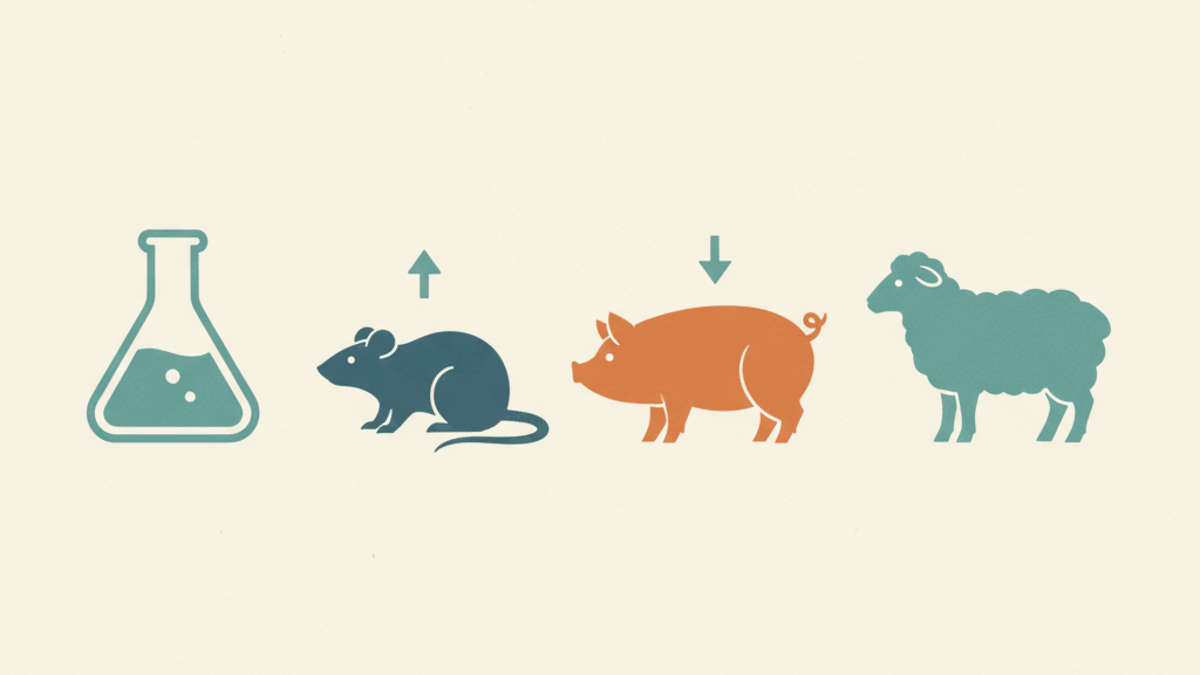
- "The animal studies prove it builds muscle." The animal studies disagree with one another. Rats gained, pigs lost daily weight gain and 60 per cent of their growth hormone peak area, guinea pigs grew organs but not bodies, and sheep showed nothing after 21 days. Binding to plasma proteins is weakest in the rat and stronger in humans, closer to sheep [7], [6], [29], [28], [21].
- "The CAS number is unambiguous." Two are in circulation. The FDA substance register holds 143045-27-6 as the primary number, and two reagent dealers use the same one, while Wikidata gives 946870-92-4 for the same object. The UNII M9L22Y19H9 is the more reliable identifier [14], [18], [16].
Frequently asked questions
Is IGF-1 LR3 approved as a medicine anywhere?
No. None of the seven markets checked for this page has approved IGF-1 LR3, and the substance has no international non-proprietary name and no ATC code. Australia goes a step further and treats insulin-like growth factors as prescription-only substances whose possession without authority is illegal. In the United States two batches sold as a compounded prescription injection were recalled in 2019.
What is IGF-1 LR3?
It is a single chain of 83 amino acid building blocks made in bacteria. At the front sits a tail of 13 building blocks, and eleven of those are the opening stretch of pig growth hormone, followed by a two-part link. Behind it comes the complete human IGF-1 sequence, in which the building block at position three is arginine instead of glutamic acid. The name records both changes: Long for the tail, R3 for the swap.
Has IGF-1 LR3 ever been tested in people?
No. A search of the international trials register returned no registered study of IGF-1 LR3, while the same search for the approved relative mecasermin returned 37 entries. No publication describes giving it to human volunteers or patients. Anti-doping chemists state in print that the substance and its relatives were never approved for use in humans.
What is the difference between IGF-1 LR3 and mecasermin?
They are two different substances. Mecasermin is unchanged human IGF-1, 70 building blocks long, sold as the prescription medicine Increlex in the United States, the European Union and Canada. IGF-1 LR3 has 83 building blocks, a foreign pig sequence at one end, no approval anywhere and no clinical study of any kind.
How long does IGF-1 LR3 stay in the body?
Nobody has measured that in a person. In rats it left the plasma about ten times faster than natural IGF-1, and after a single injection into muscle the unchanged substance could no longer be detected after four hours. The figure of 20 to 30 hours that circulates online appears in no primary source and points the wrong way.
Is IGF-1 LR3 stronger than natural IGF-1?
Only in the presence of the IGF binding proteins, and the reason is not a better grip on the receptor. In cells that release no binding proteins it was weaker than natural IGF-1, and in rats it bound the type-1 receptor three times worse. The extra effect comes from escaping the proteins that normally hold IGF-1 back.
Did the animal studies of IGF-1 LR3 show muscle growth?
In rats it saved muscle protein and improved nitrogen retention, and it was about 2.5 times more potent than natural IGF-1. The same infusion in finisher pigs reduced daily weight gain and feed intake. In guinea pigs only individual organs grew, and in sheep nothing had changed in the target tissue after 21 days.
Is IGF-1 LR3 banned in sport?
Yes, at all times, in and out of competition. Class S2.3 of the 2026 prohibited list covers insulin-like growth factor 1 and its analogues, and nothing in that class counts as a specified substance, so the standard sanction is four years. Validated detection methods exist, although the unchanged substance is only visible for a few hours.
Is IGF-1 LR3 legal to possess?
That depends on the country, and two of the markets checked treat it strictly. In Australia possession of insulin-like growth factors without authority is illegal. In Germany the anti-doping act names IGF-1 analogues, and the accompanying regulation sets the criminally relevant quantity at 3 mg, a twentieth of the figure for mecasermin itself.
What is still unknown about IGF-1 LR3?
Everything that would matter for a person. There is no human pharmacokinetic, pharmacodynamic, safety or immunogenicity measurement, no carcinogenicity or reproductive toxicity study, and no data on interaction with insulin. The immunogenicity gap stands out, because the tail of the molecule is a foreign sequence taken from pig growth hormone.
Sources
- ClinicalTrials.gov API v2. Queries query.intr="Long R3 IGF-I", "IGF-1 LR3" and "LongR3" each returned totalCount 0 on 15 September 2026; control query "mecasermin" returned 37. https://clinicaltrials.gov/api/v2/studies
- Mongongu C, Coudoré F, Domergue V, et al. (2021). Detection of LongR3-IGF-I, Des(1-3)-IGF-I, and R3-IGF-I using immunopurification and high resolution mass spectrometry for antidoping purposes. Drug Testing and Analysis 13(7):1256-1269. PMID 33587816. DOI 10.1002/dta.3016
- Repligen, frequently asked questions on LONG R3 IGF-I, read 15 September 2026. Source of "LONG R3 IGF-I is not approved or permitted for use in any human application", of the restriction to cell culture supplementation and research, and of the cGMP grade description. https://www.repligen.com/products/cell-culture-supplements/long-r3-igf-i/long-r3-igf-i-faq
- peptidedosingprotocols.com, page on IGF-1 LR3, read 15 September 2026. Cited only as evidence of the claims in circulation, including the half-life figure of approximately 20 to 30 hours and the admission that no human clinical trial has validated a dosing range. Not a source for any statement of fact about the substance.
- Bastian SE, Walton PE, Wallace JC, Ballard FJ (1993). Plasma clearance and tissue distribution of labelled insulin-like growth factor-I (IGF-I) and an analogue LR3IGF-I in pregnant rats. Journal of Endocrinology 138(2):327-336. PMID 7693845. DOI 10.1677/joe.0.1380327
- Dunaiski V, Dunshea FR, Walton PE, Goddard C (1997). Long R3 insulin-like growth factor-I reduces growth, plasma growth hormone, IGF binding protein-3 and endogenous IGF-I concentrations in pigs. Journal of Endocrinology 155(3):559-565. PMID 9488001. DOI 10.1677/joe.0.1550559
- Tomas FM, Knowles SE, Owens PC, et al. (1992). Insulin-like growth factor-I (IGF-I) and especially IGF-I variants are anabolic in dexamethasone-treated rats. Biochemical Journal 282(Pt 1):91-97. PMID 1371669. DOI 10.1042/bj2820091
- Tomas FM, Walton PE, Dunshea FR, Ballard FJ (1997). IGF-I variants which bind poorly to IGF-binding proteins show more potent and prolonged hypoglycaemic action than native IGF-I in pigs and marmoset monkeys. Journal of Endocrinology 155(2):377-386. PMID 9415072. DOI 10.1677/joe.0.1550377
- World Anti-Doping Agency. World Anti-Doping Code International Standard Prohibited List 2026, in force from 1 January 2026, section S2.3 and the S2 class heading. Full text read 15 September 2026.
- Schedule to section 2 subsection 3 of the German Act against Doping in Sport (AntiDopG), BGBl. 2023 I No. 67, pages 1 to 5, section II.3. Full text read 15 September 2026. https://www.gesetze-im-internet.de/antidopg/anlage.html
- German regulation on the not insignificant quantity of doping substances (Dopingmittel-Mengen-Verordnung), schedule, BGBl. 2023 I No. 67, pages 5 to 10. Retrieved 15 September 2026. Source of the figures of 3 mg for IGF-1 analogues, 60 mg for mecasermin, 3 mg for mechano growth factor and 100 mg for thymosin beta-4 and its derivatives. https://www.gesetze-im-internet.de/dmmv_2023/anlage.html
- openFDA drug enforcement reports, recall numbers D-0464-2019 and D-0456-2019, Promise Pharmacy LLC, Palm Harbor, Florida; Class II, reason "Lack of sterility assurance", initiated 17 December 2018, terminated 30 March 2021. Product descriptions quoted verbatim. Retrieved 15 September 2026. https://api.fda.gov/drug/enforcement.json
- Francis GL, Ross M, Ballard FJ, et al. (1992). Novel recombinant fusion protein analogues of insulin-like growth factor (IGF)-I indicate the relative importance of IGF-binding protein and receptor binding for enhanced biological potency. Journal of Molecular Endocrinology 8(3):213-223. PMID 1378742. DOI 10.1677/jme.0.0080213
- FDA Global Substance Registration System, full substance record for UNII M9L22Y19H9, "LONG-(ARG3)INSULIN-LIKE GROWTH FACTOR-I". Retrieved 15 September 2026. Source of the 83-residue sequence, formula C400H623N111O115S9, calculated mass 9,120 g/mol, CAS 143045-27-6 as primary, RXCUI 1809244 and the substance dictionary cross-references. https://gsrs.ncats.nih.gov/
- King R, Wells JR, Krieg P, et al. (1992). Production and characterization of recombinant insulin-like growth factor-I (IGF-I) and potent analogues of IGF-I, with Gly or Arg substituted for Glu3, following their expression in Escherichia coli as fusion proteins. Journal of Molecular Endocrinology 8(1):29-41. PMID 1311930. DOI 10.1677/jme.0.0080029
- Wikidata, item Q20707573, IGF-1 LR3. Retrieved 15 September 2026. Gives UNII M9L22Y19H9 but CAS 946870-92-4, which contradicts the FDA register. https://www.wikidata.org/wiki/Q20707573
- RxNav and RxNorm, RXCUI 1809244, "long-(ARG3)insulin-like growth factor-I", term type IN. Query for all related concepts on 15 September 2026 returned no clinical or branded drug concept. https://rxnav.nlm.nih.gov/
- PubChem, substance records SID 476298412 (Creative Peptides, catalogue number 10-101-261) and SID 488289282 (BOC Sciences, catalogue number BAT-010116) for "LONG R3 IGF-1 (human)". Retrieved 15 September 2026; no compound record exists. https://pubchem.ncbi.nlm.nih.gov/
- European Medicines Agency, European public assessment report for Increlex (mecasermin). Retrieved 15 September 2026. Status "Authorised", marketing authorisation holder Esteve Pharmaceuticals S.A., authorised 2 August 2007, ATC code H01AC03. https://www.ema.europa.eu/en/medicines/human/EPAR/increlex
- US Food and Drug Administration, Bulk Drug Substances Nominated for Use in Compounding Under Section 503A of the FD&C Act, version updated 14 May 2026. Full text searched 15 September 2026: no IGF entry; control entries mechano growth factor in category 3, kisspeptin-10 and ibutamoren mesylate in category 2, GHK-Cu in category 1. https://www.fda.gov/media/94155/download
- Lord AP, Bastian SE, Read LC, et al. (1994). Differences in the association of insulin-like growth factor-I (IGF-I) and IGF-I variants with rat, sheep, pig, human and chicken plasma-binding proteins. Journal of Endocrinology 140(3):475-482. PMID 7514204. DOI 10.1677/joe.0.1400475
- openFDA Drugs@FDA. BLA021839, INCRELEX (mecasermin, Ipsen Inc.), prescription, first approved 30 August 2005; BLA021884, IPLEX (mecasermin rinfabate, Insmed), first approved 12 December 2005, now discontinued. Control and negative queries run 15 September 2026. https://api.fda.gov/drug/drugsfda.json
- Tomas FM, Knowles SE, Chandler CS, et al. (1993). Anabolic effects of insulin-like growth factor-I (IGF-I) and an IGF-I variant in normal female rats. Journal of Endocrinology 137(3):413-421. PMID 8371075. DOI 10.1677/joe.0.1370413
- Steeb CB, Trahair JF, Read LC (1995). Administration of insulin-like growth factor-I (IGF-I) peptides for three days stimulates proliferation of the small intestinal epithelium in rats. Gut 37(5):630-638. PMID 8549937. DOI 10.1136/gut.37.5.630
- Shoubridge CA, Read LC (2003). Preferential intestinal delivery of longArg3 insulin-like growth factor (LR3IGF-I) over IGF-I in preweaning and adult rats. Endocrinology 144(5):1887-1893. PMID 12697696. DOI 10.1210/en.2002-220643
- Lord AP, Martin AA, Ballard FJ, Read LC (1994). Transfer of insulin-like growth factor (IGF)-I from blood to intestine: comparison with IGFs that bind poorly to IGF-binding proteins. Journal of Endocrinology 141(3):505-515. PMID 7520931. DOI 10.1677/joe.0.1410505
- Dunshea FR, Chung CS, Owens PC, et al. (2002). Insulin-like growth factor-I and analogues increase growth in artificially-reared neonatal pigs. British Journal of Nutrition 87(6):587-593. PMID 12067429. DOI 10.1079/BJNBJN2002574
- Hocking Edwards JE, Khalaf SK, Sinclaire BR, et al. (1995). Metabolic response of sheep skin to a chronic infusion of a variant of insulin-like growth factor I. Biochemical Journal 308(Pt 2):411-418. PMID 7772021. DOI 10.1042/bj3080411
- Conlon MA, Tomas FM, Owens PC, et al. (1995). Long R3 insulin-like growth factor-I (IGF-I) infusion stimulates organ growth but reduces plasma IGF-I, IGF-II and IGF binding protein concentrations in the guinea pig. Journal of Endocrinology 146(2):247-253. PMID 7561636. DOI 10.1677/joe.0.1460247
- Gillespie CM, Hazel SJ, Walton PE, Martin AA (1996). Effects of chronic renal failure on plasma clearance of insulin-like growth factor I, des-(1-3)IGF-I, and LR3IGF-I. American Journal of Physiology 271(4 Pt 1):E649-E657. PMID 8897852. DOI 10.1152/ajpendo.1996.271.4.E649
- Morris AE, Schmid J (2000). Effects of insulin and LongR(3) on serum-free Chinese hamster ovary cell cultures expressing two recombinant proteins. Biotechnology Progress 16(5):693-697. PMID 11027158. DOI 10.1021/bp0000914
- Repligen, product page for LONG R3 IGF-I, read 15 September 2026. Source of "a recombinant analog of human insulin-like growth factor-I (IGF-I) engineered for enhancement of cell culture performance" and of the claim "200 times more potent and two times more stable in cell culture than insulin". https://www.repligen.com/products/cell-culture-supplements/long-r3-igf-i
- openFDA drug labelling, INCRELEX (mecasermin injection, Ipsen Biopharmaceuticals), label effective 5 August 2025. Retrieved 15 September 2026. Source of the contraindications, the warning quotations, and the hypoglycaemia figures across 71 patients and 274 patient-years. https://api.fda.gov/drug/label.json
- Travis RC, Appleby PN, Martin RM, et al. (2016). A meta-analysis of individual participant data reveals an association between circulating levels of IGF-I and prostate cancer risk. Cancer Research 76(8):2288-2300. PMID 26921328. DOI 10.1158/0008-5472.CAN-15-1551
- Therapeutic Goods (Poisons Standard-June 2026) Instrument 2026, Australia, signed 27 May 2026. Full text searched 15 September 2026. Schedule 4 entries "INSULIN-LIKE GROWTH FACTOR I." and "INSULIN-LIKE GROWTH FACTORS except when separately specified in this Schedule."; Appendix D clause 5, "Poisons for which possession without authority is illegal", item 24 "INSULIN-LIKE GROWTH FACTORS"; separate entry "MECASERMIN Schedule 4".
- US Food and Drug Administration, Bulk Drug Substances Nominated for Use in Compounding Under Section 503B of the FD&C Act, version updated 21 March 2025. Full text searched 15 September 2026: no IGF entry. https://www.fda.gov/media/94164/download
- European Medicines Agency, page for Iplex (mecasermin rinfabate, Insmed Europe Ltd). Retrieved 15 September 2026. Status "Application withdrawn", withdrawn on 26 March 2007. https://www.ema.europa.eu/en/medicines/human/EPAR/iplex
- European Medicines Agency, full list of medicines (XLSX export), downloaded 15 September 2026. Searches for "Long R3", "LR3" and "Arg3" returned no hits; control searches for "Mecasermin", "Increlex" and "Iplex" all returned hits. The substance appears only in the agency substance management services dictionary, SMS identifier 100000181239. https://www.ema.europa.eu/en/medicines
- Misuse of Drugs Act 1971, Schedule 2 Part III (Class C drugs), read 15 September 2026. Somatotropin, somatrem, somatropin and chorionic gonadotrophin are listed; insulin-like growth factors are not. The British product register at products.mhra.gov.uk could not be queried on that date. https://www.legislation.gov.uk/ukpga/1971/38/schedule/2
- Health Canada Drug Product Database, active ingredient endpoint, queried 15 September 2026. "long r3" and "insulin-like" returned empty results; control query "mecasermin" returned drug code 99902, INCRELEX, DIN 02509733, Esteve Pharmaceuticals S.A., marketed from 1 March 2021. https://health-products.canada.ca/api/drug/activeingredient/
- Swissmedic, list of authorised packages for human medicinal products (XLSX), downloaded 15 September 2026. Searches for "Mecasermin", "Increlex", "Arg3", "LR3" and "IGF" returned no hits; control searches for "somatropinum" and "Genotropin" returned 15 and 4 hits. https://www.swissmedic.ch/
- openFDA drug labelling, "D-136 Homeopathic Stress Formula", NDC 58264-0145, Dynamic Nutritional Associates / DNA Labs Inc., structured product label set id d94be950-ce16-4c55-bbb3-af3f9c4d29d6, effective 13 January 2025. The only American product record carrying UNII M9L22Y19H9; homeopathic products are listed, not approved. Retrieved 15 September 2026.
- FDA warning letter to Gram Peptides, MARCS-CMS 721806, 31 March 2026, Center for Drug Evaluation and Research. Source of the quoted rejection of research-use labelling. Four further recent letters to peptide dealers were also read in full on 15 September 2026 and none named IGF-1 LR3; the warning letter full-text search was unavailable. https://www.fda.gov/inspections-compliance-enforcement-and-criminal-investigations/warning-letters
- Mendias CL, Awan TM (2026). Safety and efficacy of approved and unapproved peptide therapies for musculoskeletal injuries and athletic performance. Sports Medicine 56(8):1921-1935. PMID 41966639. Cited as a negative finding: the review covers twelve unapproved peptides and does not discuss IGF-1 LR3.
- American Peptides, product page for IGF-1 LR3, read 15 September 2026. Cited only as documentation of the grey market, never as a supply route or a source of fact. The page sells single vials to consumers while stating "For Laboratory & Research Use Only - Not for Human or Veterinary Use".
- USA Peptide Sciences, product page for IGF-1 LR3, read 15 September 2026. Cited only as documentation of the grey market, never as a supply route or a source of fact. The page states that the compounds are "designated strictly for laboratory research purposes only".
- Thomas A, Walpurgis K, Tretzel L, et al. (2015). Expanded test method for peptides >2 kDa employing immunoaffinity purification and LC-HRMS/MS. Drug Testing and Analysis 7(11-12):990-998. PMID 26382721. DOI 10.1002/dta.1868
- Thomas A, Walpurgis K, Thevis M (2024). Chromatographic-mass spectrometric analysis of peptidic analytes (2-10 kDa) in doping control urine samples. Journal of Mass Spectrometry 59(1):e4996. PMID 38197510. DOI 10.1002/jms.4996
- Mecasermin rinfabate: insulin-like growth factor-I/insulin-like growth factor binding protein-3, mecasermin rinfabate, rhIGF-I/rhIGFBP-3 (2005). Drugs in R&D 6(2):120-127. PMID 15777106. DOI 10.2165/00126839-200506020-00008
- Beauverd M, Mitchell JD, Wokke JH, Borasio GD (2012). Recombinant human insulin-like growth factor I (rhIGF-I) for the treatment of amyotrophic lateral sclerosis/motor neuron disease. Cochrane Database of Systematic Reviews 11:CD002064. PMID 23152212. DOI 10.1002/14651858.CD002064.pub3
Cite this page
Facts on this page were verified on 15 September 2026, and the regulatory and anti-doping documents behind the status tables were read in full on that date. IGF-1 LR3 is an unapproved substance with no clinical record, so the version and date matter as much as the content.
myPeptides Research & Editing. (2026). IGF-1 LR3: what the studies show, status and safety. Version 1.0, 15 September 2026. myPeptides Peptide Register. Retrieved from https://mypep.app/peptides/igf-1-lr3
How pages in this register are compiled and graded is described under methodology; the full register is at peptides. The legal picture across markets is summarised under are peptides legal.
| Version | Date | Change |
|---|---|---|
| 1.0 | 2026-09-15 | Initial publication |
Last verified: 15 September 2026. Next review: on any registered clinical study of IGF-1 LR3, on a change to the German quantity regulation or the Australian Poisons Standard, or on any change in the anti-doping classification.