
Are SARMs peptides?
No. SARMs (selective androgen receptor modulators) are small, non-steroidal synthetic molecules that act on the androgen receptor, the same receptor testosterone uses. Peptides are chains of amino acids. The two are regulated differently, sit in different sections of the anti-doping list, and no SARM has been approved as a medicine in the sources reviewed for this page.
Why the two get mixed up
SARMs and peptides tend to turn up in the same online shops and the same "research chemical" packaging, which makes it easy to assume they are one family. The shared setting says nothing about chemistry. A 2017 laboratory analysis of products sold online as SARMs even found that some of them contained no SARM at all, but a different compound entirely (more on that below).
This page separates the two on five questions: what the molecule is, where in the body it acts, how it is regulated in the United States and the European Union, where it sits on the WADA Prohibited List, and how much human data exists. For the chemistry of peptides in general, see what peptides are.
Two different kinds of molecule
The US National Library of Medicine defines peptides as compounds "composed of AMINO ACIDS joined together by peptide bonds", and adds that short chains of about 2 to 12 amino acids are called oligopeptides, while chains of about 13 or more are polypeptides. The peptides covered on this site follow that pattern. Ipamorelin is a chain of five building blocks, BPC-157 has 15, tesamorelin has 44, and somatropin, the laboratory-made copy of human growth hormone, has 191.
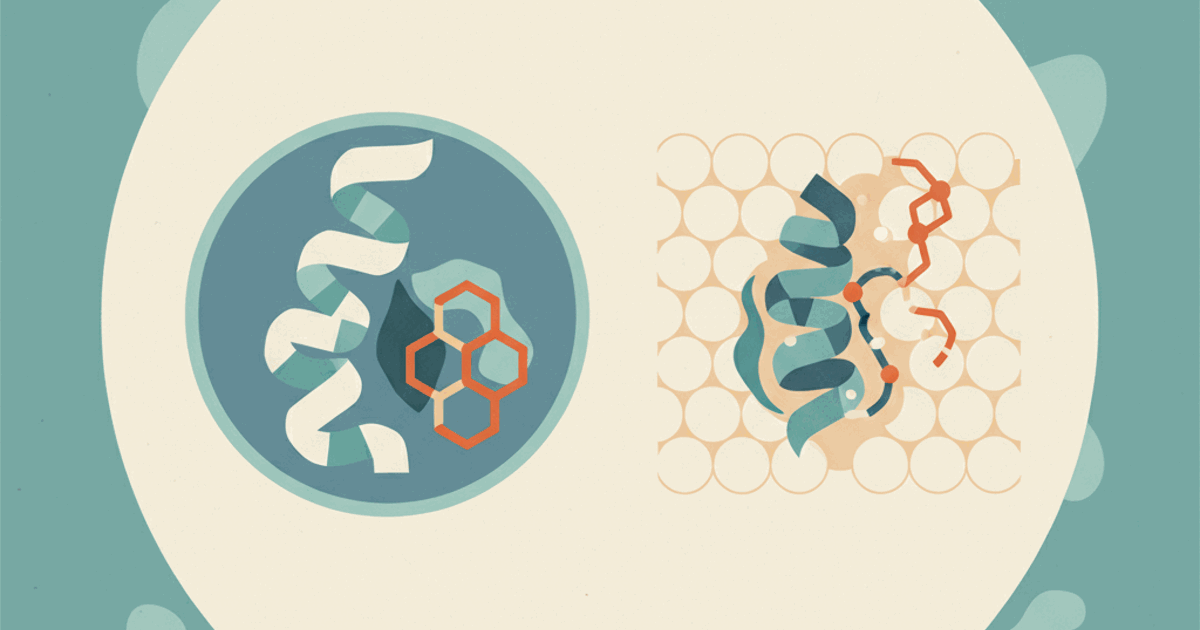
SARMs are built differently. The research literature describes them as "small-molecule compounds" and specifically as non-steroidal: they were designed to switch on the androgen receptor without carrying the four-ring steroid skeleton of testosterone. Their chemical formulas show how small they are. Enobosarm, also sold as ostarine, has the formula C19H14F3N3O3 and a molecular weight of 389.3 g/mol. LGD-4033 is C14H12F6N2O at 338.25 g/mol. For comparison, testosterone itself is C19H28O2 at 288.4 g/mol, and ipamorelin, one of the smallest peptides discussed here, is C38H49N9O5 at 711.9 g/mol. Neither SARM contains a chain of amino acids, which is the one feature every peptide has by definition.
Where they act in the body
A SARM is aimed at a single target. The first published trial of LGD-4033 describes it as a compound that "binds androgen receptor with high affinity and selectivity", and the FDA describes SARMs in general as chemical substances that "mimic the effects of testosterone and anabolic steroids". The idea behind the whole class was tissue selectivity: an effect on muscle and bone with fewer effects elsewhere, for example on the prostate. Whether that selectivity holds up in people is exactly what the safety data below call into question.
Peptides do not share a single target. The peptides most often mentioned alongside SARMs act on the growth hormone system, and they do so through receptors that have nothing to do with the androgen receptor. Tesamorelin is a full copy of the hormone that tells the pituitary gland to release growth hormone. Ipamorelin docks onto the receptor for the hunger hormone ghrelin and thereby sets off a release of growth hormone. Somatropin is growth hormone itself. BPC-157 is a laboratory-made peptide whose mechanism has been studied almost entirely in animals. The details for each are on the pages for tesamorelin, ipamorelin, somatropin and BPC-157.
SARMs and peptides side by side
The table compares SARMs as a class with four peptides that have their own reference pages here. Each row is a status statement taken from the cited documents, not a product assessment.
| SARMs (e.g. enobosarm, LGD-4033) | Somatropin (HGH) | Tesamorelin | Ipamorelin | BPC-157 | |
|---|---|---|---|---|---|
| Molecule | Small non-steroidal synthetic compound, no amino acid chain | Peptide hormone, 191 amino acids | Peptide, 44 amino acids | Peptide, 5 building blocks | Peptide, 15 amino acids |
| Target | Androgen receptor (the testosterone receptor) | Growth hormone receptor | Growth hormone releasing hormone receptor | Ghrelin receptor | No established receptor |
| United States | Not approved; FDA: cannot be legally marketed as a dietary supplement or drug; not on the DEA list of controlled substances | Prescription medicine since 16 October 1986; distribution outside approved uses is a federal offence | Prescription medicine since 10 November 2010, one indication | Not approved; FDA advisory committee voted 0 in favour, 12 against compounding (2024) | Not approved; FDA compounding category 2 (safety risks) in 2023 |
| European Union | No authorisation found in the sources reviewed | Prescription medicine | Application withdrawn in 2012 | Not approved | Not approved |
| WADA 2026 section | S1.2 Other anabolic agents | S2.2.3 | S2.2.4 | S2.2.4 | S0 Non-approved substances |
| Germany, AntiDopG annex | Group I, "Andere anabole Stoffe" | Group II, peptide hormones | Group II, peptide hormones | Group II, peptide hormones | Not in the annex groups checked here |
| Human data | Short phase 1 and phase 2 trials; case reports of liver injury | Decades of licensed use and controlled trials | Phase 3 trials for the approved use | One published trial, which missed its main goal | No published human trial result found |
Sources: WADA 2026 Prohibited List; FDA consumer update and warning letters on SARMs; DEA list of controlled substances, August 2026; AntiDopG annex; myPeptides reference pages for the four peptides and the sources cited there.

What the law says
United States
The FDA's position on SARMs is unusually direct. Its consumer update, current as of 26 April 2023, states that "SARMs cannot be legally marketed in the U.S. as a dietary supplement or drug at this time". A second FDA page, current as of 2 December 2025, calls the products sold as SARMs "unapproved drugs that FDA has not reviewed for safety and effectiveness" and notes that the agency has issued warning letters and "pursued criminal actions against distributors". USADA, the US anti-doping agency, adds that "all SARMs are for investigational purposes only" and that there are no FDA-approved SARMs available on prescription.
The "research use only" label does not change that. In a warning letter dated 12 December 2025, the FDA wrote that despite labels reading "for research use only" and "for research purposes only", the seller's own labelling and website established that the products were "intended to be drugs for human use". The letter classes them as unapproved new drugs under the Federal Food, Drug, and Cosmetic Act.
Controlled-substance law is a separate question. Federal law defines an anabolic steroid as a drug or hormonal substance "chemically and pharmacologically related to testosterone", and places anabolic steroids in Schedule III. No SARM appears in the DEA's list of controlled substances dated August 2026, although the DEA notes that the list is not comprehensive. Bills to add SARMs to Schedule III were introduced in the Senate in 2018 and again in 2019; the congressional records reviewed for this page show only their introduction. The FDA position quoted above applies regardless.
Peptides have no single legal status, because each one is assessed on its own. Somatropin is a prescription medicine, and a separate federal provision makes it an offence to distribute human growth hormone for any use other than the treatment of a disease or other recognised medical condition, where that use has been authorised through federal drug approval and is ordered by a physician. Tesamorelin is a prescription medicine with one approved use. Ipamorelin and BPC-157 are approved nowhere, and the FDA has taken restrictive positions on both in its pharmacy compounding process. More on this in are peptides legal and which peptides are FDA approved.
European Union and Germany
A 2024 review of SARM safety states that, despite clinical trials, none has been approved by the FDA "or European Medicines Agency". No national or EU authorisation for any SARM could be found in the sources reviewed for this page.
Germany's Anti-Doping Act lists SARMs by name in the first group of its annex, "Anabole Stoffe", under "Andere anabole Stoffe", with andarine, ligandrol (LGD-4033), ostarine (enobosarm), RAD-140, S-23 and YK-11 given as examples. Peptide hormones and growth hormone releasing factors form a separate second group. Acquiring or possessing more than a small quantity of a listed substance for doping in human sport is a criminal offence under that act.
What the anti-doping list says
The WADA 2026 Prohibited List draws the same line the chemistry does. SARMs sit in section S1, anabolic agents, and within it in S1.2, "Other anabolic agents", which names "selective androgen receptor modulators SARMs, e.g. andarine, enobosarm (ostarine), LGD-4033 (ligandrol), RAD140, S-23 and YK-11". Anabolic androgenic steroids such as testosterone and nandrolone sit next door in S1.1. The whole of S1 is prohibited at all times, and its substances are non-Specified Substances.
Peptide hormones have their own section, S2, "Peptide hormones, growth factors, related substances, and mimetics", also prohibited at all times. Growth hormone falls under S2.2.3, and growth hormone releasing factors, including tesamorelin and ipamorelin, under S2.2.4. BPC-157 takes a third route: it is named under S0, the section for substances with no current approval for human therapeutic use anywhere. The full structure is explained in are peptides banned in sport.
What the studies show
The human evidence on SARMs consists of short trials of individual compounds and a growing number of case reports.
- LGD-4033. The first published trial randomised 76 healthy men aged 21 to 50 to placebo or one of three dose levels for 21 days, with follow-up for 5 weeks afterwards. Lean body mass rose with dose, while fat mass did not change significantly. The compound also lowered total testosterone, sex hormone binding globulin and HDL cholesterol (the "good" cholesterol) in a dose-dependent way; the values returned to baseline after the study ended.
- Enobosarm (ostarine). A 12-week phase 2 trial in 120 healthy men over 60 and postmenopausal women found a dose-dependent increase in lean body mass. The trial was run by the company developing the compound.
- Safety across studies. A 2023 systematic review of SARM safety in healthy adults included 33 studies, 18 of them clinical trials, with 1,447 people exposed to a SARM. It found 15 case reports of drug-induced liver injury, one Achilles tendon rupture and one case of rhabdomyolysis (a breakdown of muscle tissue). A raised liver enzyme (ALT) was commonly reported in the trials, on average in 7.1 per cent of exposed participants. A 2024 review counted 20 published reports of adverse events since 2020, most of them liver injury with jaundice.
- Use outside trials. A 2025 systematic review of 72 articles estimated SARM use among athletes at 1 to 3 per cent. In its 13 case reports covering 15 people, all were men, and five of them explicitly denied "illicit drug use", which the authors read as a sign that users may believe SARMs to be legal.
The FDA's list of reported risks includes an increased risk of heart attack or stroke, liver injury and acute liver failure, psychosis, sexual dysfunction, infertility, miscarriage and testicular shrinkage. Long-term controlled data on any SARM could not be found in the sources reviewed for this page.
For peptides the evidence differs from one substance to the next, which is why it is kept on the individual reference pages. Somatropin and tesamorelin have controlled trials and licensed labels behind them. Ipamorelin has one published controlled trial in people, which missed its main goal. For BPC-157, no published result from a human trial could be found in the sources reviewed for the reference page.
What is actually in products sold as SARMs
A 2017 study in JAMA bought 44 products marketed as SARMs online and analysed them with methods approved for anti-doping laboratories. Only 23 of them (52 per cent) contained a SARM at all. Another 17 (39 per cent) contained a different unapproved drug, among them the growth hormone secretagogue ibutamoren (MK-677). Four products (9 per cent) contained no active compound, 11 (25 per cent) contained substances not named on the label, and the amount on the label matched the contents in only 18 of the 44 (41 per cent).
USADA warns of the same problem, noting "a high risk of these black market products being contaminated with other substances". The label on a product sold as a SARM is therefore weak evidence of what it contains.
Common questions
Are SARMs peptides?
No. A peptide is a chain of amino acids joined by peptide bonds, while SARMs such as enobosarm (ostarine) and LGD-4033 are small, non-steroidal synthetic molecules that contain no amino acid chain at all. The two are also filed in different sections of the WADA 2026 Prohibited List: SARMs under S1.2, other anabolic agents, and peptide hormones under S2.
Are SARMs steroids?
Not chemically. SARMs are described in the research literature as non-steroidal compounds, so they lack the four-ring steroid skeleton of testosterone. They do, however, act on the same androgen receptor as testosterone, and the FDA describes them as substances that mimic the effects of testosterone and anabolic steroids. The WADA 2026 list places both in its anabolic agents class, S1.
Are SARMs legal in the United States?
No SARM is approved by the FDA, and the agency states that SARMs cannot be legally marketed in the U.S. as a dietary supplement or drug. Labels such as "for research use only" did not change that assessment in the warning letters reviewed for this page. SARMs do not appear in the DEA's August 2026 list of controlled substances, where anabolic steroids sit in Schedule III; bills introduced in 2018 and 2019 would have added SARMs to that schedule.
Are any SARMs FDA approved?
No. The FDA describes products sold as SARMs as unapproved drugs that it has not reviewed for safety and effectiveness, and USADA states that all SARMs are for investigational purposes only. A 2024 review likewise reports that none has been approved by the FDA or the European Medicines Agency, although several have been tested in clinical trials.
Are SARMs banned by WADA?
Yes. The WADA 2026 Prohibited List names selective androgen receptor modulators under S1.2, other anabolic agents, with andarine, enobosarm (ostarine), LGD-4033 (ligandrol), RAD140, S-23 and YK-11 as examples. The class is prohibited at all times, in and out of competition, and its substances are non-Specified Substances.
Is MK-677 a SARM or a peptide?
Neither, strictly speaking. Ibutamoren (MK-677) is listed by WADA among growth hormone secretagogues under S2.2.4, not among the SARMs in S1.2, and the US National Library of Medicine files it under indoles and spiro compounds rather than under peptides. A 2017 laboratory analysis nevertheless found it among the other unapproved drugs in products that were sold as SARMs.
What is the difference between SARMs and peptides?
SARMs are small synthetic molecules built to act on the androgen receptor, the receptor testosterone uses. Peptides are amino acid chains, and the ones discussed on this site act on a range of other receptors, for example the growth hormone releasing hormone receptor or the ghrelin receptor. Legally, no SARM is approved anywhere in the sources reviewed here, while peptides range from long-approved prescription medicines to compounds approved nowhere.
Sources
- World Anti-Doping Agency (2025). The 2026 Prohibited List, International Standard, sections S0, S1 and S2, in force 1 January 2026. WADA. https://www.wada-ama.org/sites/default/files/2025-09/2026list_en_final_clean_september_2025.pdf
- US Food and Drug Administration (2023). FDA warns of use of selective androgen receptor modulators (SARMs) among teens, young adults. Consumer update, content current as of 26 April 2023. FDA. https://www.fda.gov/consumers/consumer-updates/fda-warns-use-selective-androgen-receptor-modulators-sarms-among-teens-young-adults
- US Food and Drug Administration (2025). Certain bodybuilding products put consumers at risk of heart attack, stroke, serious liver damage and more. Content current as of 2 December 2025. FDA. https://www.fda.gov/drugs/fraudulent-products/certain-bodybuilding-products-put-consumers-risk-heart-attack-stroke-serious-liver-damage-and-more
- US Food and Drug Administration (2025). Warning letter 719257 to Dynamic Health Group dba SARMS America, 12 December 2025. FDA. https://www.fda.gov/inspections-compliance-enforcement-and-criminal-investigations/warning-letters/dynamic-health-group-dba-sarms-america-719257-12122025
- United States Code (current). 21 U.S.C. § 802(41), definition of "anabolic steroid". Legal Information Institute. https://www.law.cornell.edu/uscode/text/21/802
- United States Code (current). 21 U.S.C. § 812, schedules of controlled substances, Schedule III (e) anabolic steroids. Legal Information Institute. https://www.law.cornell.edu/uscode/text/21/812
- Drug Enforcement Administration, Diversion Control Division (2026). Lists of scheduling actions, controlled substances, regulated chemicals, August 2026. DEA. https://www.deadiversion.usdoj.gov/schedules/orangebook/orangebook.pdf
- Congressional Research Service (2018). Bill summary, S. 2742, SARMs Control Act of 2018, introduced in Senate 24 April 2018. GovInfo. https://www.govinfo.gov/bulkdata/BILLSUM/115/s/BILLSUM-115s2742.xml
- US Congress (2019). S. 2895, SARMs Control Act of 2019, text as introduced in the Senate on 19 November 2019, section 2(b), amendment to Schedule III. GovInfo. https://www.govinfo.gov/content/pkg/BILLS-116s2895is/html/BILLS-116s2895is.htm
- US Anti-Doping Agency (undated). Selective androgen receptor modulators (SARMs): prohibited class of anabolic agents. USADA. https://www.usada.org/spirit-of-sport/selective-androgen-receptor-modulators-sarms-prohibited-class-anabolic-agents/
- Anti-Doping-Gesetz (AntiDopG) (current). Anlage (zu § 2 Absatz 3), group I.2 "Andere anabole Stoffe" and group II. Bundesministerium der Justiz. https://www.gesetze-im-internet.de/antidopg/anlage.html
- US National Library of Medicine (current). MeSH descriptor D010455, Peptides, scope note. NCBI MeSH. https://www.ncbi.nlm.nih.gov/mesh/68010455
- US National Library of Medicine (current). MeSH supplementary concept, ibutamoren mesylate, mapped to Indoles and Spiro Compounds. NCBI MeSH. https://www.ncbi.nlm.nih.gov/mesh/?term=ibutamoren
- PubChem (2026). Compound summaries: enobosarm CID 11326715 (C19H14F3N3O3, 389.3 g/mol); LGD-4033 CID 44137686 (C14H12F6N2O, 338.25 g/mol); testosterone CID 6013 (C19H28O2, 288.4 g/mol). NCBI. https://pubchem.ncbi.nlm.nih.gov/compound/11326715
- PubChem (2026). Compound summary, ipamorelin CID 9831659 (C38H49N9O5, 711.9 g/mol). NCBI. https://pubchem.ncbi.nlm.nih.gov/compound/9831659
- Basaria S, Collins L, Dillon EL, et al. (2013). The safety, pharmacokinetics, and effects of LGD-4033, a novel nonsteroidal oral, selective androgen receptor modulator, in healthy young men. J Gerontol A Biol Sci Med Sci 68(1):87-95. https://pubmed.ncbi.nlm.nih.gov/22459616/
- Dalton JT, Barnette KG, Bohl CE, et al. (2011). The selective androgen receptor modulator GTx-024 (enobosarm) improves lean body mass and physical function in healthy elderly men and postmenopausal women: results of a double-blind, placebo-controlled phase II trial. J Cachexia Sarcopenia Muscle 2(3):153-161. https://pubmed.ncbi.nlm.nih.gov/22031847/
- Vignali JD, Pak KC, Beverley HR, et al. (2023). Systematic review of safety of selective androgen receptor modulators in healthy adults: implications for recreational users. J Xenobiot 13(2):218-236. https://pubmed.ncbi.nlm.nih.gov/37218811/
- Leciejewska N, Jędrejko K, Gómez-Renaud VM, et al. (2024). Selective androgen receptor modulator use and related adverse events including drug-induced liver injury: analysis of suspected cases. Eur J Clin Pharmacol 80(2):185-202. https://pubmed.ncbi.nlm.nih.gov/38059982/
- Vasireddi N, Hahamyan HA, Gould HP, et al. (2025). Athlete selective androgen receptor modulators abuse: a systematic review. Am J Sports Med 53(4):999-1009. https://pubmed.ncbi.nlm.nih.gov/39755947/
- Van Wagoner RM, Eichner A, Bhasin S, Deuster PA, Eichner D (2017). Chemical composition and labeling of substances marketed as selective androgen receptor modulators and sold via the internet. JAMA 318(20):2004-2010. https://pubmed.ncbi.nlm.nih.gov/29183075/
- US Food and Drug Administration (2026). Drugs@FDA / openFDA, active ingredient somatropin, oldest approval 16 October 1986. FDA. https://api.fda.gov/drug/drugsfda.json?search=products.active_ingredients.name:%22SOMATROPIN%22&limit=100
- United States Code (current). 21 U.S.C. § 333(e), prohibited distribution of human growth hormone. Legal Information Institute. https://www.law.cornell.edu/uscode/text/21/333
- US Food and Drug Administration (2026). Drugs@FDA / openFDA, application 022505, tesamorelin, approval 10 November 2010. FDA. https://api.fda.gov/drug/drugsfda.json?search=openfda.generic_name:%22tesamorelin%22
- US Food and Drug Administration (2025). Pharmacy Compounding Advisory Committee, summary minutes of the meeting of 29 October 2024, ipamorelin votes. FDA. https://www.fda.gov/media/185412/download
- US Food and Drug Administration (2026). Bulk drug substances used in compounding under section 503A of the FD&C Act, including category 2 placements. FDA. https://www.fda.gov/drugs/human-drug-compounding/bulk-drug-substances-used-compounding-under-section-503a-fdc-act
Regulatory positions on SARMs are set out mostly in warnings and enforcement letters rather than in a single register, and the anti-doping list is revised every year, so any status summarised here, including on this page, points back to the current text of the FDA, the relevant national authority and the WADA Prohibited List. For anything to do with an individual's health, a qualified physician or pharmacist is the right address.