
What are peptides?
Short answer first, since that's probably what you came for: a peptide is a short chain of amino acids. That's the whole thing. Same twenty amino acids your body uses to build every protein you own, just strung into a much shorter chain.
How short? Nobody really agrees. Two counts. Once you get up around fifty, people switch to the word "protein," but that line is blurry and, frankly, half invented. Insulin has 51 and gets called both, depending on who's holding the pen.
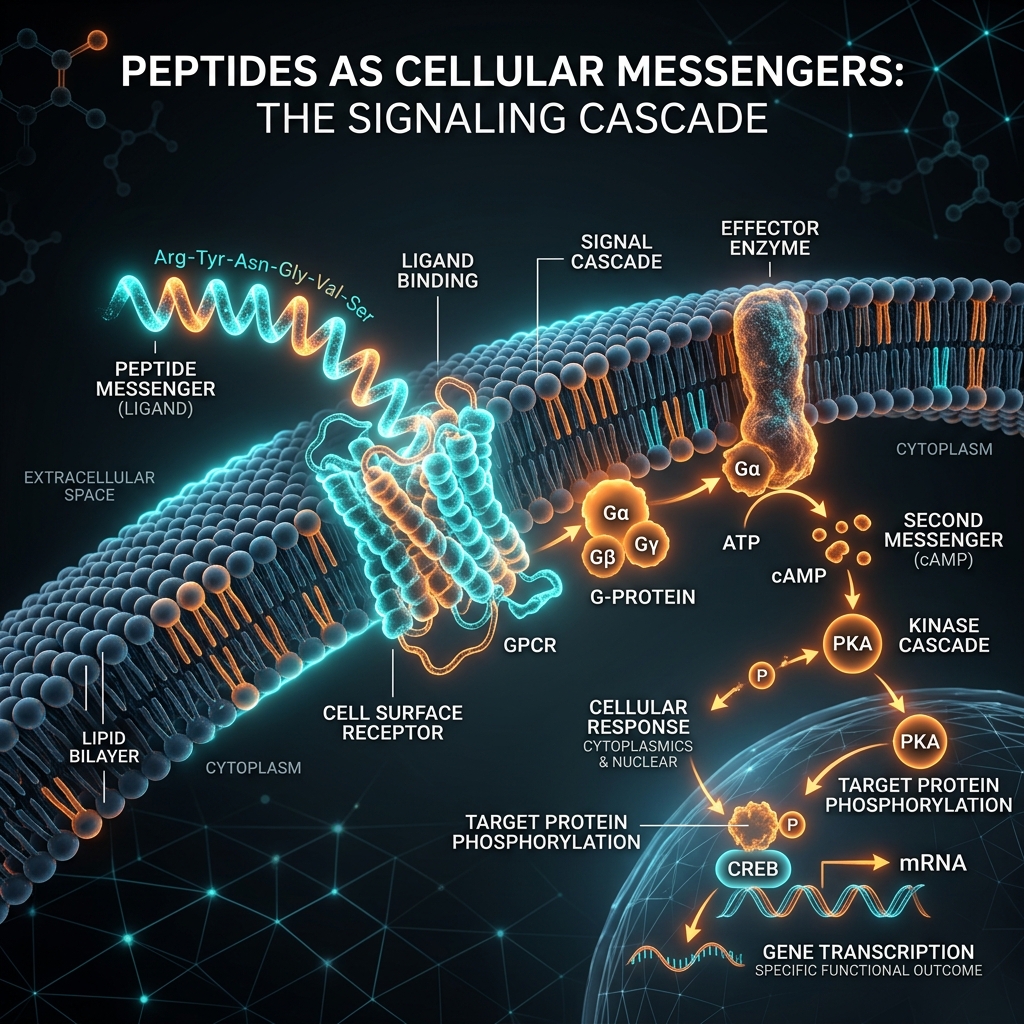
The length isn't the interesting bit anyway. What makes peptides worth a whole page is that loads of them act like little messages. They drift around and tell cells to do one specific job: make insulin, slow the gut down, fire a contraction, lay down collagen. Your body runs on these chemical memos, and peptides write a big share of them.
A little chemistry, quickly
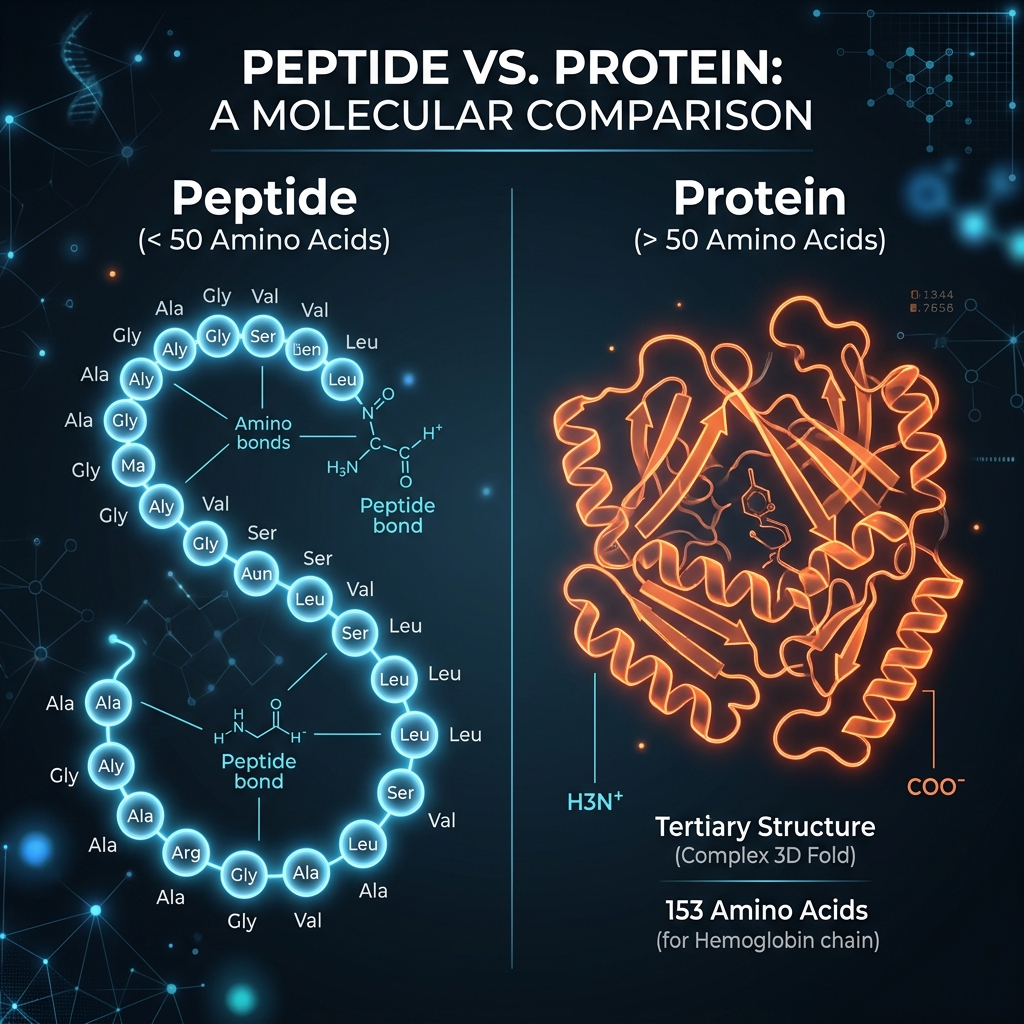
Amino acids clip together with a peptide bond. Each clip spits out one water molecule. (Condensation reaction, if you want the textbook word.) Two-link peptide or a muscle protein thirty thousand links long, doesn't matter, it's the same bond happening over and over.
The order is where the meaning lives. The sequence is the message; the length only tells you how long the message runs. Swap two amino acids and you might get a molecule that does something else entirely. Or nothing. That fussiness is the whole appeal, and also why peptides are a pain to make without wrecking them.
You're already full of them
This one trips people up, so let me just say it flat out. Peptides aren't some exotic thing you order off a forum. You're making them right now, reading this.
Insulin is the famous example: 51 amino acids, the hormone that lets your cells pull sugar out of your blood. Banting and Best isolated it in 1921, a solid century before anyone was shipping peptides in unmarked vials. Oxytocin, the one the headlines call the "cuddle hormone," is a runt next to it, just nine amino acids. Glucagon, which hauls your blood sugar back up when it crashes, has 29. And GLP-1, the gut hormone the whole Ozempic and Wegovy circus is built on, sits around 30.
So evolution was already running your appetite, your mood, your metabolism, even your sleep on these things. Long, long before the supplement aisle existed.
Peptide or protein? Where's the line?
Rule of thumb: under about 50 amino acids, peptide; over that, protein. Nobody actually enforces it, and insulin's 51 links break it on day one, so hold it loosely.
What they do is the better tell. Peptides tend to be small and fast, one clear instruction, in and out. Proteins are the big folded machines that carry the work: enzymes, antibodies, the scaffolding holding your tissues together. The peptide is the text message. The protein is the machine the message switches on.
The three peptide worlds people blend together
Search "peptides" and you'll fall into one of three completely different scenes that keep getting mashed into one. Pulling them apart saves a lot of grief.
Metabolic and hormonal peptides
The loud crowd right now. GLP-1 agonists, semaglutide and tirzepatide and the still-experimental retatrutide, copy gut hormones to flatten your appetite and steady your blood sugar. Real prescription drugs. Real trials. A real side-effect list too. If that's your rabbit hole, our GLP-1 references lay out the published dosing and the milligram-to-units math without the influencer noise.
"Research" peptides
Then there's the forum corner: BPC-157, TB-500, that whole cast people trade notes on for recovery and cranky tendons. Blunt version? Almost none of them are approved as medicine anywhere. They sell as "research chemicals." The human evidence runs from thin to nonexistent, and whatever's actually in the vial is whatever mood the supplier was in that week. We don't sell them, don't source them, won't tell you to touch them. But people clearly are, so pretending the crowd doesn't exist helps nobody.
Cosmetic and dietary peptides
The quiet ones. Collagen peptides in your protein tub, copper peptides in a serum. Hydrolysed collagen is just ordinary collagen chopped small enough to absorb easily. Milder science, milder claims, low stakes. Nobody's lying awake over their moisturiser.
Why it shows up as a powder you mix yourself
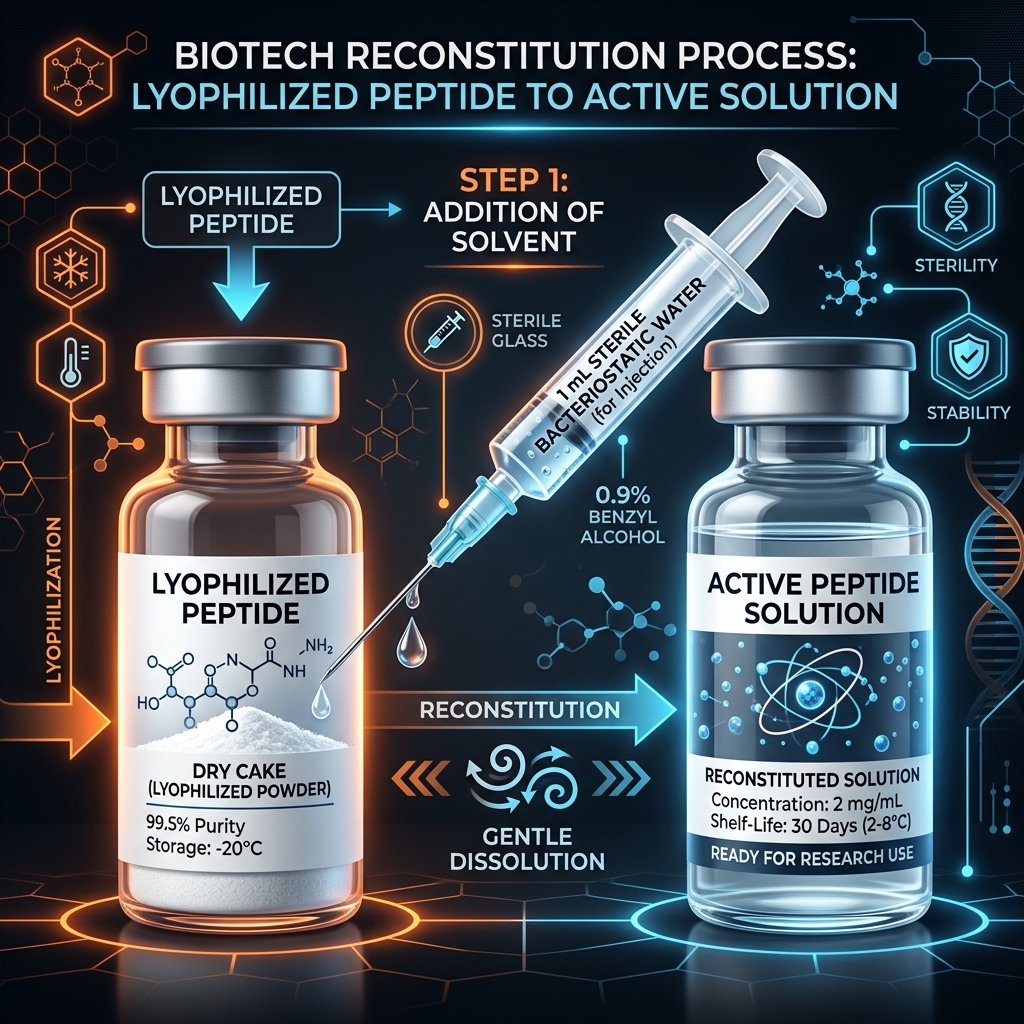
Peptides are delicate. Water, heat, time, all of it chews them up. So they ship freeze-dried, a dry powder you mix yourself with bacteriostatic water before you use it.
And here's exactly where people slip. The water you add sets the concentration. The concentration sets how many units end up on your syringe. Two millilitres into a 5 mg vial gives you 2.5 mg/mL. One millilitre gives you 5 mg/mL, the same dose squeezed into half the liquid. Fumble that ratio and your tidy "250 mcg" quietly turns into some other number. Sorting that out is the entire reason the reconstitution calculator exists, and the reconstitution guide walks the math slowly if you'd rather see it spelled out.
Half-life is basically the whole game
Two peptides can do the identical job and act nothing alike, purely because one hangs around longer. The half-life is the number for that: how long until half a dose is gone.
The spread is wild. Oxytocin? Gone in minutes. Semaglutide? About a week, roughly 165 hours, which is the only reason you can get away with injecting it weekly instead of every morning. Keep dosing before the last one clears and it stacks, climbing toward a plateau they call steady state. Want to actually watch that curve build and level off? The drug-level plotter draws it for whatever half-life and interval you feed it.
The part I'd underline twice
None of this is medical advice. It can't be. "Peptides" stretches from FDA-approved hormones that millions of people inject safely all the way to powders with zero human safety data behind them. Treating those as the same thing is how people end up hurt.
A few things I'd keep front of mind:
- Approved and gray-market are not the same animal. A drug that cleared trials under a doctor is a different universe from the same name stamped on an unlabelled vial.
- You can't see quality. The label is a claim, not a fact. Purity, strength, even whether it's the right molecule at all, any of that can be off and you'd never know by looking.
- More isn't better. These are signals, and flooding a signal usually backfires instead of speeding anything along.
- The only person who can really advise you is a clinician who's actually seen your history and your bloodwork. A web page can't. This one very much included.
We build the calculators and reference pages because people are going to run this math regardless, and doing it on a napkin is worse than doing it with clear numbers on screen. That's the lane we stay in: numbers and information, never sourcing, never a prescription.
Quick answers
Are peptides steroids? No, a totally different animal. Steroids are a four-ring lipid thing that mostly works from inside the cell, flipping genes on and off. Peptides are amino-acid chains that mostly work on the outside, latching onto receptors on the cell's surface. Different build, different mechanism, different risks.
Why inject most peptides instead of swallowing them? Your gut treats a peptide like food and digests it into scrap long before it can act as a message, so injecting just skips the demolition. A few products bolt on absorption tricks to survive the stomach (oral semaglutide is the obvious one), but they're rare exceptions.
Is a peptide the same as a protein? Same building blocks, different size of build. Short chain, peptide. Long folded chain, protein. Insulin parks right on the fence at 51 amino acids, which tells you the dividing line is more about convenience than chemistry.