
Epitalon vs Pinealon: differences, evidence and safety
Answer first
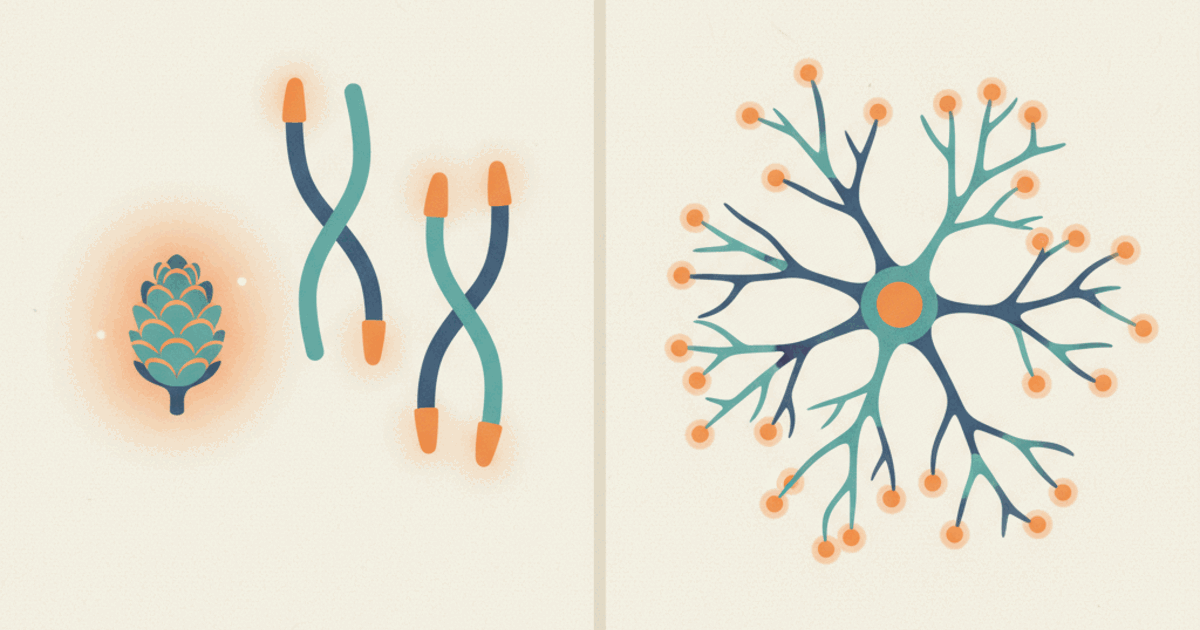
Epitalon, four amino acids, was worked out from a cattle pineal gland extract. Pinealon, three amino acids, comes from a brain cortex extract despite its name. Both come from one St Petersburg institute, and no approval or registered trial has been identified for either. In the one study testing both on pineal tissue, only Epitalon stimulated the cells.
At a glance
How they work
Both peptides come from the St Petersburg Institute of Bioregulation and Gerontology, the group around Vladimir Khavinson [1], [2]. Neither has a known receptor. Every mechanism below comes from cells, animals or models, not from people [1], [3].
Epitalon is a chain of four amino acids: alanine, glutamic acid, aspartic acid and glycine, written AEDG [4]. It was built on the bench from the amino acid make-up of epithalamin, an extract of cattle pineal glands [1].
- Switching telomerase on. Telomeres are the protective caps on the ends of chromosomes. In cells in a dish, Epitalon raised telomerase, the enzyme that rebuilds them, and the caps grew longer [5], [6].
- Nudging the pineal gland. In old monkeys it raised evening melatonin. An independent Paris laboratory perfused isolated rat pineal glands and saw no effect at all [7], [8].
- Binding to DNA. The inventors propose that the peptide docks onto the double helix and switches genes on. No confirmation from outside the group could be found in the sources reviewed for this page [9].
Pinealon is a chain of three amino acids: glutamic acid, aspartic acid and arginine, written EDR [10]. The group describes it as a component of a Russian medicine made from the brain cortex of calves [2], [11].
- Settling on DNA. Physical measurements suggest it can push part way into the wide groove of the double helix. Magnesium ions strengthen the contact [12].
- Attaching to packing proteins. It bound histones, the spools that DNA is wound on. Those histones came from wheat, a model system rather than human chromatin [13].
- Getting into the cell. A fluorescent version reached the nucleus of HeLa cells. The label changes size and water-loving character, so the plain peptide may behave differently [14].
- Serotonin in cortex cultures. In ageing brain cortex cultures, the peptide raised serotonin [15].
The core difference is where each is said to act. Epitalon is linked to the pineal gland and to telomeres. Pinealon, despite its name, is linked to nerve cells of the brain. Both rest on the same group's idea that very short peptides steer genes by binding DNA.
One physical fact weighs on that idea for Pinealon. With a calculated XLogP of −6.1, the molecule is too water-loving to cross cell membranes on its own [10].
What the studies show
Studies that tested both peptides
Head-to-head, cell data In 2011 the group grew pineal tissue from three-month-old rats in culture. Pinealon changed neither the growth marker Ki-67 nor the cell-death marker AIF. Epitalon, in the same experiment, stimulated the pineal cells [16]. No other direct test of the two on the pineal gland could be found.
Head-to-head, animal A 2008 Russian-language paper compared four short peptides in low-oxygen models: Vilon, Epitalon, Vesugen and Pinealon. The authors report the strongest effect of the four for Pinealon [17].
Head-to-head, laboratory A companion paper from 2008 tested the same short peptides on human lipoproteins and red blood cells. None showed direct antioxidant activity, and they raised the level of reactive oxygen species inside cells. They lowered the share of dead cells, except Epitalon [18].
All three papers come from one research circle and use dishes or rodents. None shows how either peptide acts in a person. No study in people that included both could be found in the sources reviewed for this page.
The pineal gland, melatonin and sleep
Randomised, small For Epitalon, the FDA found three published reports in which a person received it [1]. The single randomised, placebo-controlled study enrolled 75 healthy women aged 40 to 50, mostly night-shift workers. The 40 with low excretion of a melatonin breakdown product were split into two arms of 20 [19].
Randomised, small The women used a spray under the tongue for 20 days. In the treated arm the urine marker rose 1.7-fold and stayed flat under salt water [19]. The FDA notes that the paper does not specify blinding, no sleep endpoint was measured and no safety data were reported [1].
Animal data In old rhesus monkeys, daily injections over 10 days raised evening melatonin more than fourfold. Young animals showed no melatonin change [7]. In the Paris experiment, isolated rat pineal glands showed no change in melatonin release [8].
No data For Pinealon, no published work on melatonin or on sleep could be found in the sources reviewed for this page [16].
Epitalon: telomeres in cells
Cell data In 2003 the inventors added Epitalon to human foetal lung fibroblasts for four days. They reported telomerase activity and longer telomeres in cells that had neither before [6].
Cell data, independent In 2025 Brunel University London, with no involvement of the original group, confirmed the finding. Telomeres lengthened in normal human breast cells and fibroblasts, in step with the concentration [5].
Laboratory, not clinical A study often quoted as human proof took blood cells from 11 men and treated them in a tube. Telomere length changed significantly in 7 of them, longer in five and shorter in two [20]. The men themselves received nothing.
No telomere data for Pinealon could be found in the sources reviewed for this page.
Pinealon: nerve cells and an Alzheimer mouse model
Cell data In mouse hippocampal cultures damaged by amyloid, Pinealon raised the number of mushroom spines by 71 per cent. The comparison peptide KED managed 20 per cent [21]. This is the largest published effect for the substance, and it was seen in a dish.
Animal data In 5xFAD mice, ten per group, two months of daily injections raised spine density by 11 per cent (p = 0.039). Thin spines fell by 10 per cent (p = 0.024) [22]. Mushroom spines, the shape that matters for memory, were unchanged (p = 0.053).
Missed endpoint Electrical signal strengthening in the hippocampus, the laboratory stand-in for learning, gave no usable answer. Even the gap between diseased and healthy mice missed significance (p = 0.057) [22]. The authors write that the comparison peptide KED had the more pronounced effect.
Correction In January 2025 the journal corrected that mouse paper. Figures 5 and 8 were the same images, described once as male and once as female animals [23]. The authors state that the conclusions stand.
Animal data, independent A 2026 preprint from outside the group gave ageing mice Pinealon for eight weeks, five per group. A trend towards better working memory in a maze did not reach significance [24]. The work has not been peer-reviewed.
Lifespan in animals
Animal data Epitalon's record includes lifespan work. In female SHR mice, average lifespan did not change. Only the last tenth of survivors lived 13.3 per cent longer (p<0.01) [25]. In fruit flies the gain was 11 to 16 per cent, and it did not depend on the dose [26].
No lifespan study of Pinealon could be found in the sources reviewed for this page.
Reports in people
Uncontrolled An Epitalon report from 2002 injected the peptide behind the eye in people with retinal degeneration. It claimed a positive effect in 90 per cent of cases, but states no patient count, no dose and no control group [27].
Observational For Pinealon, five Russian reports describe people taking it. All are uncontrolled and none was registered. Each time it was given with Vesugen or other peptides [28], [29], [30].
Observational The most detailed report followed 32 people aged 41 to 83 with several chronic illnesses. The authors describe slower biological ageing without effect sizes, and note that Vesugen showed the more visible effect of the two [28].
Unsupported figure A widely quoted claim about 72 patients after head injury traces to a review, which cites a second review [31], [32]. No primary publication for it could be found in PubMed, Europe PMC or any registry [3].
Neither peptide appears in the main trials register. ClinicalTrials.gov returned zero records for Epitalon on 7 September 2026 and for Pinealon on 10 September 2026 [33], [34].
How far the numbers can be compared
The studies above differ in species, population, dose, route, endpoint and length. Their numbers cannot be set against each other to rank the two peptides.
Doses used in the studies
The doses below are simply what the cited studies gave, listed so that the results can be understood. They are not advice on how to use anything.
| Study | Substance | Model | Dose | Route | Duration | Ref |
|---|---|---|---|---|---|---|
| Ivko 2021, the only randomised study | Epitalon | 20 women aged 40 to 50, night shift | 0.5 mg per day | Spray under the tongue | 20 days | [19] |
| Khavinson 2003, first telomerase report | Epitalon | Human foetal lung fibroblasts | 50 ng/ml | Culture medium | 4 days | [6] |
| Djeridane 2003, negative result | Epitalon | Isolated rat pineal glands | 1 to 100 µM | Perfusion fluid | Single exposure | [8] |
| Goncharova 2001, monkeys | Epitalon | Female rhesus monkeys, old and young | 2 µg/kg | Into the muscle | 10 days | [7] |
| Anisimov 2003, lifespan | Epitalon | Female SHR mice, 54 per group | 1.0 µg per animal | Under the skin | 5 days a month, from 3 months of age | [25] |
| Kraskovskaya 2017, amyloid damage | Pinealon | Mouse hippocampal cells | 200 ng/ml | Added to the culture fluid | Not given in the abstract | [21] |
| Khavinson 2021, Alzheimer model | Pinealon | 5xFAD mice | 400 µg/kg | Into the abdomen | Once daily, 2 months | [22] |
| Marín-Jerez 2026, longevity screen | Pinealon | Ageing mice | 30 mg/kg per administration | Into the abdomen | Twice weekly, 8 weeks | [24] |
A concentration in a dish cannot be converted into an amount for a body. No data on how the body absorbs or clears either peptide could be found, so animal amounts cannot be scaled to a person [1], [35].
Safety
No safety profile, and no study designed to build one, could be found for either peptide in the sources reviewed for this page. The short lists below reflect missing data, not proven safety.
Epitalon
- No clinical safety studies. The FDA states that its literature search identified no clinical studies assessing the safety of Epitalon in humans [1].
- No adverse event reports on file. The FDA database held zero entries by 8 December 2025. Reporting is voluntary, so this is silence rather than reassurance [1].
- No safety data in the randomised study. Twenty treated women over 20 days, and nothing was recorded [1], [19].
- A cancer risk built into the proposed mechanism. The FDA argues that lasting telomerase activity could let cells slip past their normal limit on division [1]. In the 2025 replication, two breast cancer cell lines lengthened their telomeres by a route that is a hallmark of cancer cells [5].
- Suppressed blood formation in rats. In irradiated rats, Epitalon held back blood cell and lymphocyte formation in the spleen [36].
- Missing basics. The FDA reports no data on absorption or clearance in any species. It also lists no repeat-dose, reproductive or immune-reaction studies [1].
Pinealon
- Pro-oxidant activity in people. In the 32-person report the authors measured pro-oxidant rather than antioxidant activity [28].
- Fewer blood-forming cells. The same report found fewer CD34-positive stem cells in the blood, which the authors called "significant inhibition of hemopoiesis" [28]. Vesugen was given as well, so the finding cannot be assigned to Pinealon alone.
- Behavioural dampening in rats. After the neck arteries of old rats were clamped, the animals slept more and explored and moved less. Caspase-3, a marker of programmed cell death, rose moderately, also in sham-operated animals [37].
- No signal in the independent screen. Over eight weeks, five mice showed nothing unusual in weight, temperature, food intake, blood counts or urine [24].
- Missing basics. The monograph found no toxicology to any regulatory standard and no measurement of uptake or clearance. The American adverse event database held no entry [35].
Both records touch blood formation, in different designs that cannot be weighed against each other.
For Epitalon, the certificates of analysis the FDA found report purity only [1]. Pinealon vials sold for research are made under no pharmaceutical quality system, so sterility, endotoxin content and actual peptide content are unknown [38].
Legal status
Neither peptide is approved in the United States, the European Union, Germany, the United Kingdom, Australia or Canada [1], [35], [39]. The Epitalon checks add Japan; the Russian register gave no usable result [1]. In July 2026 the FDA proposed keeping Epitalon off the 503A compounding list [40]. Pinealon is not among the substances nominated for that list [41]. The Pinealon checks add Switzerland, and in Russia it is sold only as a food supplement [39], [42]. Both fall under category S0 of the 2026 WADA Prohibited List without being named, and are banned at all times [43], [44]. Checked on 7 September 2026 for Epitalon and 10 September 2026 for Pinealon. More at peptides banned in sport.
Used together?
The myPeptides blend directory lists no product that combines Epitalon and Pinealon. It does list Neuroxelin, a mix of four neuropeptides from Russian research. Neuroxelin contains Pinealon alongside N-acetyl Semax amidate, PE-22-28 and N-acetyl Selank amidate, but not Epitalon. Its entry records no approval, and no human trial of that mixture could be found.
No study that gave Epitalon and Pinealon together could be found in the sources reviewed for this page. The laboratory papers above tested them side by side, in separate groups [16], [17], [18]. In the Russian reports on people, Pinealon was paired with Vesugen, not with Epitalon [28], [30].
Frequently asked questions
Which is better, Epitalon or Pinealon?
The sources reviewed for this page do not answer that. The only direct comparisons are laboratory and animal work from the group that made both peptides. In rat pineal tissue only Epitalon stimulated the cells, while one Russian low-oxygen study reported the strongest effect of four peptides for Pinealon. No study in people comparing the two could be found in the sources reviewed for this page.
Is Epitalon or Pinealon safer?
That cannot be said from the published record. Neither record contains standard toxicology or any measurement of how the body handles it. Epitalon's one randomised study recorded no safety data. The one Pinealon report with laboratory values, in which Vesugen was also given, found pro-oxidant activity and fewer blood-forming cells.
What is the difference between Epitalon and Pinealon?
Epitalon is a chain of four amino acids, Ala-Glu-Asp-Gly, worked out from a cattle pineal gland extract. Pinealon is a chain of three, Glu-Asp-Arg, which its makers describe as part of a calf brain cortex preparation. The two share no sequence motif longer than a single amino acid. Epitalon is linked to telomeres and melatonin, Pinealon to nerve cells.
Can Epitalon and Pinealon be taken together?
No study of the two given together could be found in the sources reviewed for this page. The laboratory papers that included both tested them in separate groups. The myPeptides blend directory lists no product that combines them. This page gives no guidance on use.
Does Pinealon act on the pineal gland like Epitalon?
Not in the one test that checked. In rat pineal tissue culture, Pinealon left the growth marker Ki-67 and the cell-death marker AIF unchanged, while Epitalon stimulated the same cells. The name points at the pineal gland, but its makers derive the peptide from brain cortex.
Are Epitalon and Pinealon approved as medicines anywhere?
No approval has been identified for either in the United States, the European Union, Germany, the United Kingdom, Australia or Canada. In Russia, Pinealon is sold as a food supplement, which involves no test of whether it works. In July 2026 the FDA proposed keeping Epitalon off the pharmacy compounding list.
Are Epitalon and Pinealon banned in sport?
Yes, both at all times, in and out of competition. Category S0 of the 2026 Prohibited List covers drug-like substances that no health authority has approved for human therapeutic use. Neither peptide is named on the list, and that absence is not a loophole.
Is Epitalon the same as epithalamin, and where does Pinealon fit?
No. Epithalamin is an extract of cattle pineal glands, a mixture of many peptides, and Epitalon is one synthetic peptide worked out from it. The long survival studies in older people used epithalamin, not Epitalon. Pinealon is a third, separate substance with its own chemical record.
Sources
Several original titles below state a treatment effect or name a study endpoint. They are replaced by a neutral description in square brackets; authors, year, journal, volume, pages and identifiers are unchanged.
- FDA. Briefing document for the Pharmacy Compounding Advisory Committee, meeting of 23 to 24 July 2026: substance review of Epitalon (free base) and Epitalon acetate, dated 12 May 2026. Retrieved 7 September 2026. https://www.fda.gov/media/193345/download
- Khavinson VK, Linkova NS, Kozhevnikova EO, Dyatlova AS, Petukhov MG (2022). Transport of biologically active ultrashort peptides using POT and LAT carriers. International Journal of Molecular Sciences 23(14):7733. PMID 35887081. PMCID PMC9323678. DOI 10.3390/ijms23147733.
- PubMed, NCBI E-utilities, and Europe PMC, REST search, retrieved 10 September 2026. "Pinealon" returns 22 PubMed records through the substance-name mapping, two of them without any connection to the substance; Europe PMC returns 29 records, two of which are the same 2026 preprint. "Glu-Asp-Arg" returns 48 PubMed records, almost all unrelated. https://pubmed.ncbi.nlm.nih.gov/?term=pinealon
- PubChem. Compound CID 219042, "Epitalon". Formula C14H22N4O9, 390.35 g/mol, InChIKey HGHOBRRUMWJWCU-FXQIFTODSA-N, UNII O65P17785G. Retrieved 7 September 2026. https://pubchem.ncbi.nlm.nih.gov/compound/219042
- Al-Dulaimi S, Thomas R, Matta S, Roberts T (2025). Epitalon increases telomere length in human cell lines through telomerase upregulation or ALT activity. Biogerontology 26(5):178. PMID 40908429. DOI 10.1007/s10522-025-10315-x. Correction: Biogerontology 27(1):1. PMID 41240216. DOI 10.1007/s10522-025-10326-8
- Khavinson VKh, Bondarev IE, Butyugov AA (2003). Epithalon peptide induces telomerase activity and telomere elongation in human somatic cells. Bulletin of Experimental Biology and Medicine 135(6):590-592. PMID 12937682. DOI 10.1023/a:1025493705728
- Goncharova ND, Khavinson VKh, Lapin BA (2001). Regulatory effect of epithalon on production of melatonin and cortisol in old monkeys. Bulletin of Experimental Biology and Medicine. PMID 11550036. DOI 10.1023/a:1017928925177
- Djeridane Y, Khavinson VKh, Anisimov VN, Touitou Y (2003). Effect of a synthetic pineal tetrapeptide (Ala-Glu-Asp-Gly) on melatonin secretion by the pineal gland of young and old rats. Journal of Endocrinological Investigation 26. PMID 12809170. DOI 10.1007/BF03345159
- Khavinson VKh, Shataeva LK, Chernova AA (2003 onwards). Work on peptide binding to double-stranded DNA. PMID 14666197; PMID 17152370
- PubChem. Compound CID 10273502, Glu-Asp-Arg, C15H26N6O8, 418.40 g/mol, InChIKey QPRZKNOOOBWXSU-CIUDSAMLSA-N, calculated XLogP −6.1 and topological polar surface area 261 Ų, CAS 175175-23-2, synonyms including "pinealon" and "L-Glutamyl-L-aspartyl-L-arginine". Retrieved 10 September 2026. https://pubchem.ncbi.nlm.nih.gov/compound/10273502
- Kuznik BI, Davydov SO, Popravka ES, Lin'kova NS, Kozina LS, Khavinson VK (2019). Epigenetic mechanisms of peptide-driven regulation and neuroprotective protein FKBP1b. Molekuliarnaia Biologiia 53(2). PMID 31099784. DOI 10.1134/S0026898419020095. States that EDR was synthesised as one of the derivatives of a clinically approved cerebral cortex polypeptide complex from calves.
- Silanteva IA, Komolkin AV, Morozova EA, Vorontsov-Velyaminov PN, Kasyanenko NA (2019). Role of mono- and divalent ions in peptide Glu-Asp-Arg-DNA interaction. Journal of Physical Chemistry B 123(9). PMID 30762356. DOI 10.1021/acs.jpcb.8b10359.
- Fedoreyeva LI, Smirnova TA, Kolomijtseva GY, Khavinson VKh, Vanyushin BF (2013). Interaction of short peptides with FITC-labeled wheat histones and their complexes with deoxyribooligonucleotides. Biochemistry (Moscow) 78(2). PMID 23581987. DOI 10.1134/S0006297913020053. Binding measured against wheat histones H1, H2B, H3 and H4.
- Fedoreyeva LI, Kireev II, Khavinson VKh, Vanyushin BF (2011). Penetration of short fluorescence-labeled peptides into the nucleus in HeLa cells and in vitro specific interaction of the peptides with deoxyribooligonucleotides and DNA. Biochemistry (Moscow) 76(11). PMID 22117547. DOI 10.1134/S0006297911110022.
- Khavinson VKh, Lin'kova NS, Tarnovskaya SI, Umnov RS, Elashkina EV, Durnova AO (2014). Short peptides stimulate serotonin expression in cells of brain cortex. Bulletin of Experimental Biology and Medicine 157(1). PMID 24909721. DOI 10.1007/s10517-014-2496-y.
- Khavinson VKh, Linkova NS, Chalisova NI, Dudkov AV, Koncevaya EA (2011). Effect of short peptides on expression of signaling molecules in organotypic pineal cell culture. Bulletin of Experimental Biology and Medicine 152(1). PMID 22803060. DOI 10.1007/s10517-011-1473-y. Glu-Asp-Arg changed neither Ki-67 nor AIF in pineal culture; only Ala-Glu-Asp-Gly stimulated the pineal cells.
- Kozina LS (2008). Investigation of antihypoxic properties of short peptides. Advances in Gerontology 21(1). PMID 18546825. In Russian. Of Vilon, Epitalon, Vesugen and Pinealon, Pinealon showed the strongest effect in low-oxygen models; the authors attribute it to stimulation of the cell's own antioxidant enzymes rather than to radical scavenging.
- Kozina LS, Arutiunian AV, Stvolinskiĭ SL, Khavinson VKh (2008). Biological activity of regulatory peptides in model experiments in vitro. Advances in Gerontology 21(1). PMID 18546826. In Russian. The short peptides showed no direct antioxidant activity and raised the steady-state level of intracellular reactive oxygen species, while lowering the share of dead cells except for Epitalon.
- Ivko OM, Linkova NS, Ilina AR, Sharova AA, Ryzhak GA (2021). AEDG peptide regulation of the expression of human circadian rhythm genes upon accelerated aging of the pineal gland. Advances in Gerontology 11(1):53-58. Russian original PMID 33280326
- Khavinson VK, Pendina AA, Efimova OA, Tikhonov AV et al. (2019). Effect of peptide AEDG on telomere length and mitotic index of PHA-stimulated human blood lymphocytes. Bulletin of Experimental Biology and Medicine. PMID 31761987. DOI 10.1007/s10517-019-04664-0
- Kraskovskaya NA, Kukanova EO, Lin'kova NS, Popugaeva EA, Khavinson VK (2017). Study of tripeptides and neuronal spine numbers in an in vitro model of Alzheimer's disease. Bulletin of Experimental Biology and Medicine 163(4). PMID 28853087. DOI 10.1007/s10517-017-3847-2. EDR at 200 ng/ml raised mushroom spines by 71 per cent, KED by 20 per cent.
- Khavinson V, Ilina A, Kraskovskaya N, Linkova N, Kolchina N, Mironova E, Erofeev A, Petukhov M (2021). Study of the tripeptides EDR and KED in the 5xFAD mouse model of Alzheimer's disease. Pharmaceuticals 14(6):515. PMID 34071923. PMCID PMC8227791. DOI 10.3390/ph14060515.
- Khavinson V, Ilina A, Kraskovskaya N, Linkova N, Kolchina N, Mironova E, Erofeev A, Petukhov M (2025). Correction to the 2021 5xFAD mouse study listed above. Pharmaceuticals 18(1):111. PMID 39861198. PMCID PMC11769113. DOI 10.3390/ph18010111. Wording: "there was a mistake in Figures 5 and 8 as published. The mistake is that Figures 5 and 8 are the same, described differently."
- Marín-Jerez E, Rueda-Carrasco J, Meléndez-Rodríguez F, Partido-Borge P, Tapia E, Leibowitz BD, Parras A (2026). Short-term performance assay identifies functional benefits and early toxicity of longevity interventions in mice. Preprint, not peer-reviewed. Posted on bioRxiv, DOI 10.64898/2026.02.25.707674, and on Research Square, DOI 10.21203/rs.3.rs-9682683/v1. Europe PMC PPR1222244 and PPR1252867.
- Anisimov VN, Khavinson VKh, Popovich IG, Zabezhinski MA et al. (2003). Study of Epitalon on biomarkers of ageing and life span in female Swiss-derived SHR mice. Biogerontology. PMID 14501183. DOI 10.1023/a:1025114230714
- Khavinson VK, Izmaylov DM, Obukhova LK, Malinin VV (2000). Effect of epitalon on the lifespan increase in Drosophila melanogaster. Mechanisms of Ageing and Development 120(1-3):141-149. PMID 11087911. DOI 10.1016/s0047-6374(00)00217-7
- Khavinson V, Razumovsky M, Trofimova S, Grigorian R, Razumovskaya A (2002). Uncontrolled report of Epitalon given to people with retinitis pigmentosa. Neuro Endocrinology Letters 23(4):365-368. PMID 12195242
- Meshchaninov VN, Tkachenko EL, Zharkov SV, Gavrilov IV, Katyreva IuE (2015). Effect of synthetic peptides on aging of patients with chronic polymorbidity and organic brain syndrome of the central nervous system in remission. Advances in Gerontology 28(3). PMID 26390612. In Russian. 32 people, 18 men and 12 women, aged 41 to 83, given Vesugen and Pinealon together.
- Bashkireva AS, Artamonova VG (2012). Uncontrolled observation of peptides in professional truck drivers with neurotic complaints. Advances in Gerontology 25(3). PMID 23734521. In Russian. 150 male drivers, average age 43.3 ± 0.9 years, against 150 metalworkers; the peptides were not randomised or placebo-controlled.
- Myakotnykh VS, Torgashov MN, Egorin KV, Meshchaninov VN, Gavrilov VI, Borovkova TA (2016). Comparative analysis of different methods of geroprotection. Advances in Gerontology 29(2). PMID 28539017. In Russian. 110 people; the peptides Vezugen and Pinealon were compared with carbon dioxide baths, hyperbaric oxygen and massage.
- Khavinson V, Linkova N, Kozhevnikova E, Trofimova S (2020). EDR peptide: possible mechanism of gene expression and protein synthesis regulation involved in the pathogenesis of Alzheimer's disease. Molecules 26(1):159. PMID 33396470. PMCID PMC7795577. DOI 10.3390/molecules26010159.
- Umnov RS, Lin'kova NS, Khavinson VKh (2013). Review of peptide bioregulators in people of various age. Advances in Gerontology 26(4):671-678. PMID 24738258. In Russian. A review, not a primary study, and the cited support for the 72-patient claim.
- ClinicalTrials.gov API v2. Queries for "epitalon", "epithalon", "epithalamin", "AEDG" and "FOXO4-DRI"; each returned totalCount 0. Retrieved 7 September 2026. https://clinicaltrials.gov/api/v2/studies
- ClinicalTrials.gov, API v2. Queries on 10 September 2026: intervention "Pinealon" total count 0, free text "pinealon" 0, intervention "EDR peptide" 0. Intervention "Glu-Asp-Arg" returns one unrelated amino acid study (NCT05400733, Texas A&M University). Control query "semaglutide" returns 749 studies. https://clinicaltrials.gov/api/v2/studies
- United States register checks, 10 September 2026. FDA Global Substance Registration System, exact-name queries for "PINEALON" and "GLUTAMYL-ASPARTYL-ARGININE": zero records each, control query "SEMAGLUTIDE" returns five, so no substance code exists. openFDA drug label API: not found. openFDA adverse event database: not found, while the control query returns 66,161 reports. DailyMed web services v2: zero entries, database state 9 September 2026. https://gsrs.ncats.nih.gov
- Khavinson VKh, Yuzhakov VV, Kvetnoi IM, Malinin VV (2001). Immunohistochemical and morphometric analysis of effects of vilon and epithalon on functional morphology of radiosensitive organs. Bulletin of Experimental Biology and Medicine. PMID 11427924. DOI 10.1023/a:1017676104877
- Mendzheritskiĭ AM, Karantysh GV, Ivonina KO (2011). Effects of introduction of short peptides before carotid artery occlusion on behaviour and caspase-3 activity in the brain of old rats. Advances in Gerontology 24(2). PMID 21809624. In Russian.
- Western research-chemical listing for Pinealon, retrieved 10 September 2026. Freeze-dried powder in 20 mg vials, sequence given as Glu-Asp-Arg, purity stated by the seller as 99 per cent with no certificate of analysis, marked "Research Use Only". Trade record, cited as evidence of what is sold. Not linked.
- European, British, Swiss and Russian register checks, 10 September 2026. The European Medicines Agency search and its control search both returned a JavaScript shell of almost identical size, 76,899 and 77,056 bytes, with no server-rendered results. MHRA Products returned 122,696 bytes for both the search and the control. The Russian state medicines register returned only the search form for both queries, so its nil result is not usable. Swissmedic could not be queried programmatically. Recorded as unverified gaps rather than nil results; the finding of no authorisation rests on every other register checked and on the absence of any registered trial.
- FDA. Introductory briefing volume, Pharmacy Compounding Advisory Committee, 23 to 24 July 2026; items 11 and 12 propose that Epitalon free base and Epitalon acetate not be included on the 503A list; the agenda for 24 July lists emideltide, Epitalon and semax. Retrieved 7 September 2026. https://www.fda.gov/media/193342/download
- US Food and Drug Administration. Bulk drug substances nominated for use in compounding under section 503A, state of 14 May 2026. Neither Pinealon nor Glu-Asp-Arg nor EDR appears in any of the three categories. Checked in full text 10 September 2026. https://www.fda.gov/media/94155/download
- Russian trade page for Пинеалон, capsules in packs of 20 and 60 and sublingual drops of 10 ml, retrieved 10 September 2026. Gives the contents as peptide complex AC-5, an extract of brain cortex peptides, names the St Petersburg Institute of Bioregulation and Gerontology as maker and the status as a food supplement. No injectable version is offered. Trade record, cited as evidence of what is sold. Not linked.
- World Anti-Doping Agency. The 2026 Prohibited List, in force from 1 January 2026, section S0. Full-text checks of the 2025 and 2026 lists for "epitalon", "epithalon" and "AEDG" returned no match. Retrieved 7 September 2026. https://www.wada-ama.org/en/prohibited-list
- World Anti-Doping Agency. The 2026 Prohibited List, in force from 1 January 2026, section S0 "Non-approved substances". Full text checked 10 September 2026: "Pinealon", "Glu-Asp-Arg" and "glutamyl-aspartyl" return no match, so the classification follows from the general clause. https://www.wada-ama.org/en/prohibited-list