
Peptides for Dogs and BPC-157: Can You Use Peptides on Animals?
Can you use peptides on animals? Most research peptides have hardly been used on anything else. BPC-157, for example, has been studied in rats, mice and rabbits for more than 30 years, while not one controlled human trial has published a result. The catch is in the word "animals": those were laboratory rodents under laboratory conditions, not dogs with arthritis. For dogs, cats and horses there are real, approved peptide medicines, such as insulin, and there are research peptides with almost no data in those species at all. This page separates the two.
The short answer
- Approved peptide medicines for pets exist. Insulin, oxytocin and a hormone implant called deslorelin are licensed animal medicines [8] [9] [10] [12].
- BPC-157, TB-500 and GHK-Cu are approved for no animal and for no person. Their animal data come mainly from rats and mice [1] [3] [4].
- Dog data on BPC-157 exist, but they are not treatment data. Six laboratory beagles were used to measure how fast the peptide leaves the body, and a safety study included dogs. Both served the development of a human drug [3] [4].
- No dose has been studied in dogs. One of the figures that circulate online matches a dose used in rat studies; the rest go back to sellers. This page lists them with their origin, not as advice.
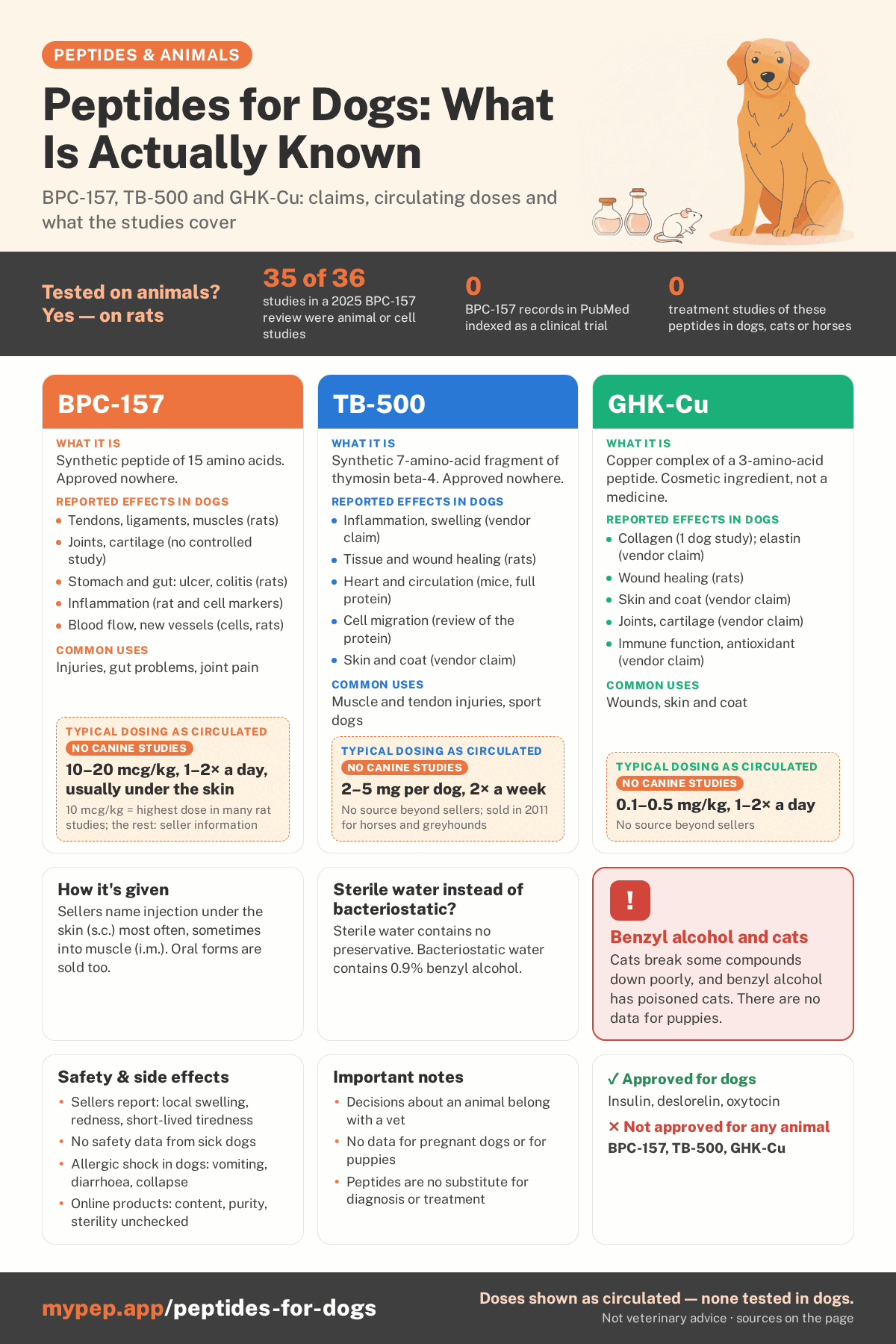
The infographic sums up this page on one image, made to be shared. Download the infographic (PNG). It shows the dose figures that circulate together with their origin; none of them comes from a study in dogs.
Tested on animals? Yes, on rats
When people ask whether peptides for dogs have been "tested on animals", the honest answer is yes, mostly on rats. A 2025 systematic review of BPC-157 in orthopaedic sports medicine screened 544 articles and kept 36 studies. Of those, 35 were preclinical, meaning animal or cell studies, and 1 involved patients [1]. A PubMed search run on 9 October 2026 found about 235 records on BPC-157. At least 110 of them are tagged as animal studies without humans, and none is indexed as a clinical trial [2].
So the ironic part is true: BPC-157 has a far longer record in animals than in people. But "tested in animals" here means rats with cut tendons or damaged stomachs, given the peptide by injection into the belly cavity or in their drinking water, under controlled conditions and with a comparison group of rats given salt water. That says nothing about a ten-year-old Labrador with a sore hip. More on the research picture is in our BPC-157 monograph.
Peptides that are approved for dogs, cats and horses
Peptides are short chains of amino acids, and several are long-established animal medicines. You can read the basics in what are peptides. The approved ones are mostly hormones that the body makes itself.
| Peptide | Approved use in animals | Where | Ref |
|---|---|---|---|
| Insulin (porcine insulin zinc suspension; protamine zinc recombinant human insulin) | Diabetes in dogs and cats | US; EU | [8] [9] [30] |
| Deslorelin implant (a GnRH agonist, a copy of a brain hormone that controls fertility) | Temporary infertility in male dogs; since 2022 also young female dogs and male cats (EU). Adrenal gland disease in ferrets (US, indexed only) | EU; US for ferrets only | [10] [11] |
| Oxytocin | Birth and milk let-down in cats, dogs, sheep, pigs, cows and horses | US; EU | [12] [31] |
| Gonadorelin | Ovarian cysts and cycle timing in cattle | US | [12] |
The US approved its second insulin for dogs in February 2019 [9]. Deslorelin works differently in the US: there it is listed only for ferrets, in a special index for minor species, and US law prohibits using an indexed drug outside its label [11] [32].
A common mix-up concerns the new arthritis pain injections. Bedinvetmab for dogs and frunevetmab for cats are monoclonal antibodies against nerve growth factor. They are large proteins, not peptides. Bedinvetmab was approved in the EU in November 2020 and in the US in May 2023, as the first monoclonal antibody the FDA approved for dogs [13] [14]. Frunevetmab was approved in the EU in February 2021 [15]. Neither has anything to do with BPC-157.
BPC-157 for dogs: what the dog data actually show
There are exactly two kinds of dog data on BPC-157, and neither tests a treatment.
How fast the body clears it. A 2022 study gave BPC-157 to six laboratory beagles, three male and three female, in several rounds [3]. The peptide disappeared fast: half of it was gone in about 5 minutes after an injection into a vein, and in 20 to 29 minutes on average after an injection into muscle. Four hours after dosing it could no longer be detected. The study's stated aim was to help bring BPC-157 into human clinical use.
A laboratory safety study. In 2020, the same research team in China published a preclinical safety study in mice, rats, rabbits and dogs [4]. Repeated doses were well tolerated in dogs, apart from a fall in creatinine, a blood marker linked to kidney function, at one dose level but not at the lower ones. It returned to normal two weeks after dosing stopped. The authors found no damage to genetic material and no harm to unborn young in their tests. This study, too, served to start a human trial.
What is missing. A search of PubMed for BPC-157 together with dogs, cats or horses found 3 records: the two studies above and one rat study that matched only because of the term "wet dog shake" [2] [3] [4]. No study has tested whether BPC-157 for dogs helps with arthritis, injuries, gut problems or anything else. For BPC-157 for cats and BPC-157 for horses, not even laboratory data were found.
So can BPC-157 be used on dogs? No regulator has approved it for any species, and the dog data do not cover treatment. Is BPC-157 safe for dogs? A tolerability finding in healthy laboratory dogs is not proof of safety in a sick or elderly pet, and a product sold online is not the material used in a laboratory study. For people, the record is thin as well: one clinical study in the 2025 review [1], and the details are in the BPC-157 monograph.
TB-500 and GHK-Cu in dogs, cats and horses
TB-500 for dogs. TB-500 is a short synthetic piece of the protein thymosin beta-4. A PubMed search for thymosin beta-4 or TB-500 with dogs, cats or horses found 19 records, and none of them tested a treatment [2]. In horses, the published work deals mostly with doping: a Hong Kong laboratory reported in 2012 that it could detect the peptide at 0.02 ng/mL in horse blood plasma and 0.01 ng/mL in urine [5]. A US racing body reported in 2013 that many of the products tested under the name contained no thymosin beta-4 at all, and most contained no protein, peptide or amino acid [6]. Our TB-500 monograph and the comparison BPC-157 vs TB-500 cover the human side.
GHK-Cu. The copper peptide GHK-Cu has one dog study in PubMed. In 1996, wounds on the paw pads of 12 English Pointer dogs were injected with different substances, including a copper peptide complex [7]. The copper peptide wounds had the most type I collagen after 14 days, but the faster healing in the first week was seen with a different substance. A faster wound closure was not shown for the copper peptide. More is in the GHK-Cu monograph.
Peptides for dogs: what sellers claim and the doses that circulate
Sellers and online protocols describe effects in dogs and quote dose ranges for BPC-157, TB-500 and GHK-Cu. This section reports them, together with their origin, so that they can be checked. Each effect is marked: either a study in rodents or cells exists n, or it is a "vendor claim, no study". The doses are reported as they circulate. They are not advice, and no study in dogs has ever determined an effective or safe dose.
BPC-157 for dogs
What it is. BPC-157 is a laboratory-made peptide of 15 amino acids. It is not approved by the US FDA [1], and no approval for animals or people was found elsewhere.
Reported or hoped-for effects in dogs:
- Tendons, ligaments and muscles: rat studies [35] [1]
- Joints and cartilage: no controlled study; one small retrospective report in people with knee pain [1]
- Stomach and gut, including ulcers, inflammatory bowel disease and gastritis: rat models of ulcers and colitis [36] [42]
- Wounds and burns: a rat study [37]
- Inflammation in general: fewer inflammation markers in rat and cell studies [1] [35]; no study of inflammation as an illness
- Blood flow and growth of new blood vessels: cell studies, a chick-membrane test and a rat study [43]
Dosing as circulated (no canine studies). The range below circulates among sellers and in online protocols. No study in dogs has ever determined an effective or safe dose. Its lower value matches the highest dose in many rat studies; the rest is seller information without a source (the next section explains the origin of the figures).
- 10 to 20 mcg per kg of body weight, once or twice a day, usually under the skin
TB-500 for dogs
What it is. TB-500 is a synthetic fragment of 7 amino acids taken from the protein thymosin beta-4. It is approved nowhere, and products sold under the name do not always contain it [6].
Reported or hoped-for effects in dogs:
- Inflammation and swelling: a review links this to a different part of the full protein, one TB-500 does not contain [45] [6]; for TB-500 itself, vendor claim, no study
- Tissue repair and wound healing: a rat study with the full-length protein [39] and one rat tendon study with material of uncertain identity [38]
- Heart and circulation: a mouse study with the full-length protein [44]; for TB-500, vendor claim, no study
- Cell migration: a review links this to the short section of the protein that TB-500 copies [45]
- Skin and coat: vendor claim, no study
Dosing as circulated (no canine studies). The range below circulates among sellers and in online protocols. No study in dogs has ever determined an effective or safe dose. No source could be traced beyond sellers. TB-500 was marketed in 2011 "for equine or greyhound use" [5]. A 2012 Belgian paper describes it as intended for veterinary use only, at 10 mg per dose; a vial seized by Belgian customs held about 10 mg [41].
- 2 to 5 mg per dog, twice a week
GHK-Cu for dogs
What it is. GHK-Cu is a copper complex of a peptide of 3 amino acids that the body makes itself. It is a listed cosmetic ingredient for creams, not an approved medicine.
Reported or hoped-for effects in dogs:
- Collagen: one dog study on paw-pad wounds found more type I collagen, not faster closure [7]; elastin: vendor claim, no study
- Wound healing: a rat study with a gel found faster closure of poorly perfused wounds [40]
- Skin and coat: vendor claim, no study in dogs
- Joints and cartilage: vendor claim, no study
- Immune function: vendor claim, no study
- Antioxidant effects: vendor claim, no study in dogs
Dosing as circulated (no canine studies). The range below circulates among sellers and in online protocols. No study in dogs has ever determined an effective or safe dose. No study found used this dose per kg of body weight, and no source could be traced beyond sellers.
- 0.1 to 0.5 mg per kg of body weight, once or twice a day
How it is given
Sellers name injection under the skin as the most common route, sometimes injection into muscle. Oral forms are sold as well, and some rat studies gave BPC-157 in drinking water [46]. Sellers describe dissolving the powder first; for cats, the water used for this raises a separate safety question, explained below.
Safety and side effects as reported by sellers
Sellers and online protocols mention local swelling or redness at the injection site and short-lived tiredness. These are seller reports, not study results. Seller texts also state that pregnant dogs and puppies are not to be given these peptides without a vet. No study covers pregnant dogs or cats, or puppies. The 2020 safety study tested for harm to unborn young only in pregnant laboratory animals [4]. None of these peptides is a substitute for a diagnosis or for an approved treatment.
Why there is no "BPC-157 for dogs dosage chart"
The ranges above are what circulates. A BPC-157 for dogs dosage chart based on studies in dogs does not exist. The circulating figures have two kinds of origin. The lower BPC-157 value, 10 mcg per kg, equals 10 µg/kg, the highest dose in many rat studies, usually given into the belly cavity [35] [36]. The same studies also gave doses a thousand times lower [35] [36]. The circulating figure carries the rat dose per kilogram over to dogs. The other figures have no traceable source beyond sellers.
Drug developers do not carry a rat dose per kilogram over unchanged to another species. The FDA guidance of 2005 uses a formula based on body surface area to estimate a cautious starting dose for the first trial in healthy human volunteers. Its starting point is the highest dose that caused no harm in animal toxicity studies, and it then divides that by a large safety factor [24]. The same guidance advises against this kind of scaling for injections under the skin or into muscle when the dose is limited by local reactions [24]. The 2022 beagle study used the same body-surface formula for a similar purpose: to plan a laboratory study, not to treat dogs [3].
A figure in a chart is not a tested dose. No study has looked for an effective dose, a safe dose or a treatment length for BPC-157, TB-500 or GHK-Cu in dogs, cats or horses. Our reconstitution calculator handles arithmetic, such as concentration and units, and it is not a dosing aid for animals.
Safety: what matters specifically in animals
Benzyl alcohol, bacteriostatic water and cats
Peptides sold as powder are dissolved before use, often in bacteriostatic water. That water usually contains 0.9 percent benzyl alcohol, which is 9 mg in every millilitre, as a preservative; some versions contain 1.1 percent. Its label states "NOT FOR USE IN NEONATES" [25]. The background is in bacteriostatic water.
With peptides for cats, one more point matters. A cat's liver attaches glucuronic acid to many foreign substances poorly, a step most mammals use to clear them. A 2012 study describes the cat as "likely to be particularly vulnerable to benzyl alcohol toxicity" for this reason [26]. The same paper summarises a 1983 report in which cats given benzyl alcohol under the skin, mixed into a drip solution, developed nervous-system signs and died within 24 hours [26]. In its own controlled test in 16 healthy cats, the small amount of benzyl alcohol in a preserved anaesthetic made no clinically relevant difference [26]. The authors note that this does not cover weak or sick animals, and the study was funded by the maker of the anaesthetic [26].
For dogs and puppies, no study or case report of benzyl alcohol poisoning was found. The concern for very small animals rests on an analogy with premature human babies, for whom bacteriostatic water is labelled as unsuitable [25]. Sterile water contains no preservative. The difference between the two is explained in bacteriostatic vs sterile water.
Injections and reactions
Any injection can cause a local reaction. In cats, mild reactions such as swelling, redness, hair loss and pain are not uncommon, and abscesses occur rarely [27]. Cats can also develop a rare tumour at injection sites, estimated at one to four in every 10,000 vaccinated cats in the US, and injections of long-acting drugs have been linked to it as well [27].
A severe allergic reaction looks different in dogs than in people. In dogs, the main organ affected is the liver rather than the lungs, so the typical signs are sudden diarrhoea, heavy drooling, vomiting and collapse. The gums may be pale and the limbs cold, with a very fast heartbeat but a weak pulse. These signs usually start within seconds to minutes. A milder form shows as hives or swelling of the face, usually within 20 minutes [28].
Products sold as research chemicals carry no guarantee of what they contain, how pure they are or whether they are free of germs. The racing laboratory finding that most of the TB-500 products it tested contained no protein, peptide or amino acid is one illustration [6].
Legal status: what vets may use
United States. Under federal rules, a veterinarian may use an approved animal or human drug outside its label, but only "by or on the lawful written or oral order of a licensed veterinarian within the context of a valid veterinarian-client-patient relationship" [16]. Compounding under these rules is covered only from approved drugs [16]. According to the FDA, animal drugs mixed from bulk substances are neither approved nor indexed and so break federal drug law. In guidance #256 the agency describes when it generally does not take action against them [17]. A label such as "not for human or veterinary use" does not settle the matter. In 2026 the FDA wrote to a peptide seller that such statements did not change its assessment [18]. That letter concerned products sold for human use.
European Union and United Kingdom. EU Regulation 2019/6 allows a so-called cascade [19]. Where no authorised veterinary medicine exists for a condition in a pet, the veterinarian may "exceptionally" use another product. That can be a veterinary medicine authorised for another species or condition, a human medicine, or a preparation made up on prescription [19]. Horses fall under this rule only if their passport declares them not intended for slaughter [19]. The UK runs a similar cascade, which only registered veterinary surgeons may use [20].
BPC-157 and TB-500 are approved nowhere, not as animal medicines and not as human medicines, so the first steps of these cascades do not reach them. The general picture is in are peptides legal.
Peptides for horses
Peptides for horses come up mostly in racing. In US Thoroughbred racing, a substance that is not covered by the other banned classes and "has no current approval by any governmental regulatory health authority for veterinary or human use" is prohibited at all times [33]. Thymosin is listed by name as a banned peptide hormone [21]. BPC-157 is not named on that list, but it is a substance without any approval [21] [33].
Real cases exist. In 2016, an Australian trainer was disqualified for a total of 8 months after giving a racehorse a product containing a synthetic fragment of thymosin beta-4 [22] [34]. The ruling described the product as "not registered for medical or veterinary use" [22]. The 2012 detection paper notes that a TB-500 product was marketed "for equine or greyhound use" in 2011 [5]. For BPC-157 for horses, no published detection method in horses and no official doping case were found. Human doping rules are covered in peptides banned in sport.
Collagen peptides for dogs: a different product
Collagen peptides for dogs are a food supplement, not an injection. Hydrolysed collagen is collagen broken down into small peptides and given by mouth. Undenatured type II collagen is a different product, and it is thought to act on the immune system in the gut rather than as a building material.
For peptides for dogs with arthritis, this is where most of the trials are. A 2022 review and meta-analysis of supplements for osteoarthritis in dogs and cats found "a weak efficacy of collagen" [23]. It criticised small trials with about five dogs per group. It concluded that it was impossible to rule on an indication for collagen [23]. A 2024 trial in 31 dogs, 11 of them in the collagen group, reported better gait measurements after 12 weeks [29]. The full paper reports no significant difference in owner-rated pain scores, and the trial was funded by a collagen manufacturer [29].
Common questions
Can BPC-157 be used on dogs?
No authority anywhere has approved BPC-157 for dogs, or for any other animal or for people. The only published dog data come from laboratory beagles: one study measured how fast six dogs cleared the peptide, and one safety study included dogs to prepare a human trial. No study has tested whether BPC-157 helps a dog with any illness or injury.
Is BPC-157 safe for dogs?
That has not been established. A 2020 laboratory safety study reported that repeated doses were well tolerated in healthy laboratory dogs, apart from a fall in creatinine at one dose level, not at the lower ones, that reversed within two weeks. A study of that kind in healthy laboratory dogs does not show safety in a sick dog, and products sold online carry no guarantee of content, purity or sterility.
Why is there no BPC-157 for dogs dosage chart?
Because no study has ever looked for an effective or safe dose in dogs. The charts that circulate quote about 10 to 20 mcg per kg for BPC-157. For TB-500 they quote 2 to 5 mg per dog, and for GHK-Cu 0.1 to 0.5 mg per kg. The lower BPC-157 figure, 10 mcg per kg, matches the highest dose in many rat studies; the other figures have no traceable source beyond sellers.
What dose of BPC-157 is given to dogs?
The range that circulates among sellers and in online protocols is 10 to 20 mcg per kg of body weight, once or twice a day, usually under the skin. No study in dogs has ever determined an effective or safe dose. The lower value equals the highest dose in many rat studies; the rest is seller information without a source.
What effects do owners hope for from peptides for dogs?
Sellers name faster healing of tendons, ligaments and muscles, help for joints, the stomach and the gut, less inflammation, and better skin and coat. Some of these effects were seen in rats or in cell studies; others are vendor claims with no study at all. None has been tested as a treatment in dogs.
Is TB-500 for dogs or horses approved anywhere?
No. TB-500 is approved neither for animals nor for people. A search of PubMed found no study testing thymosin beta-4 or TB-500 as a treatment in dogs, cats or horses. In horses, the published work is about detecting it in doping tests, and a 2013 racing laboratory report found that most of the products it tested under that name contained no protein, peptide or amino acid at all.
Are there peptides for cats, and is BPC-157 for cats any different?
Approved peptide medicines for cats exist: insulin for diabetes, oxytocin, and in the EU a deslorelin implant for male cats. BPC-157 for cats has no data at all, not even a laboratory study. Cats also handle some preservatives poorly: they break down certain compounds slowly, and benzyl alcohol, the preservative in bacteriostatic water, has caused poisoning in cats.
What about BPC-157 for horses and peptides for horses in racing?
Neither BPC-157 nor TB-500 is approved for horses. In US Thoroughbred racing, any substance without an approval for animal or human use is prohibited at all times, and thymosin is listed by name. In Australia, a trainer was disqualified for 8 months in 2016 for giving a racehorse a product containing a synthetic fragment of thymosin beta-4. No published method or doping case for BPC-157 in horses was found.
Are there peptides for dogs with arthritis?
No research peptide has been tested in dogs with arthritis. The newer arthritis pain injections for dogs and cats are monoclonal antibodies, which are large proteins, not peptides. Oral collagen supplements, which contain collagen peptides or undenatured collagen, have been studied in a few small trials with mixed results.
Do collagen peptides for dogs work?
The evidence is weak. A 2022 review and meta-analysis of supplements for canine and feline osteoarthritis rated the effect of collagen products as weak and the trials as poor quality, often with about five dogs per group. A 2024 trial in 31 dogs, 11 of them given collagen peptides, reported better gait measurements after 12 weeks but no significant difference in owner-rated pain scores; a collagen manufacturer funded it. Collagen peptides are a food supplement given by mouth, not an injection.
Is peptide therapy for dogs legal?
It depends on the product. In the US, veterinarians may use approved human or animal drugs outside their label within a valid veterinarian-client-patient relationship, and in the EU and UK a similar cascade applies. BPC-157 and TB-500 are approved nowhere, so the main routes of those rules, which start from an approved medicine, do not reach them. A label saying research use only does not make a product legal for animals.
Which peptides for pets are actually approved?
Several, and they are mostly hormones. Insulin is approved for dogs and cats in the US and the EU. Oxytocin is approved for dogs, cats and farm animals. A deslorelin implant is approved in the EU for male dogs, and gonadorelin for cattle. None of the popular research peptides, such as BPC-157, TB-500 or GHK-Cu, is approved for any animal.
Sources
- Vasireddi N, Hahamyan H, Salata MJ, Karns M, Calcei JG, Voos JE, Apostolakos JM (2025). Emerging use of BPC-157 in orthopaedic sports medicine: a systematic review. HSS Journal 21(4):485-495. https://pubmed.ncbi.nlm.nih.gov/40756949/
- National Library of Medicine (2026). PubMed searches run on 9 October 2026: BPC-157 and its synonyms (235 records; 110 with animals and without humans; 0 indexed as clinical trial or randomised controlled trial); BPC-157 with dog, cat or horse terms (3 records); thymosin beta-4 or TB-500 with dog, cat or horse terms (19 records). https://pubmed.ncbi.nlm.nih.gov/?term=%22BPC+157%22+OR+%22BPC-157%22+OR+%22BPC157%22+OR+%22body+protection+compound%22+OR+%22body+protective+compound%22+OR+%22PL+14736%22+OR+%22PL-14736%22
- He L, Feng D, Guo H, et al. (2022). Pharmacokinetics, distribution, metabolism, and excretion of body-protective compound 157, a potential drug for treating various wounds, in rats and dogs. Frontiers in Pharmacology 13:1026182. https://pmc.ncbi.nlm.nih.gov/articles/PMC9794587/
- Xu C, Sun L, Ren F, et al. (2020). Preclinical safety evaluation of body protective compound-157, a potential drug for treating various wounds. Regulatory Toxicology and Pharmacology 114:104665. https://pubmed.ncbi.nlm.nih.gov/32334036/
- Ho EN, Kwok WH, Lau MY, et al. (2012). Doping control analysis of TB-500, a synthetic version of an active region of thymosin β4, in equine urine and plasma by liquid chromatography-mass spectrometry. Journal of Chromatography A 1265:57-69. https://pubmed.ncbi.nlm.nih.gov/23084823/
- Racing Medication and Testing Consortium (2013). Thymosin β4 Bulletin, version 2.0, with findings of the Maddy Equine Analytical Laboratory, University of California, Davis. https://rmtcnet.com/wp-content/uploads/2013-07-TB-500-Bulletin-v-2.0-Final.pdf
- Swaim SF, Vaughn DM, Kincaid SA, et al. (1996). Effect of locally injected medications on healing of pad wounds in dogs. American Journal of Veterinary Research 57(3):394-399. https://pubmed.ncbi.nlm.nih.gov/8669775/
- US Code of Federal Regulations. 21 CFR 522.1160, Insulin: porcine insulin zinc suspension and protamine zinc recombinant human insulin for dogs and cats. https://www.law.cornell.edu/cfr/text/21/522.1160
- US Food and Drug Administration, Center for Veterinary Medicine (2019). FDA announces second approved insulin for use in dogs with diabetes. 8 February 2019. https://www.fda.gov/animal-veterinary/cvm-updates/fda-announces-second-approved-insulin-use-dogs-diabetes
- European Medicines Agency, Committee for Medicinal Products for Veterinary Use (2022). Summary of opinion, deslorelin acetate implant: new indications in female dogs and male cats. EMA/CVMP/250532/2022. https://www.ema.europa.eu/en/documents/smop/cvmp-post-authorisation-summary-positive-opinion-suprelorin-ii-0032-g_en.pdf
- US Food and Drug Administration (2026). Index of Legally Marketed Unapproved New Animal Drugs for Minor Species: deslorelin acetate implant for ferrets, MIF 900-013, indexed 25 June 2012. https://www.fda.gov/animal-veterinary/minor-useminor-species/index-legally-marketed-unapproved-new-animal-drugs-minor-species
- US Code of Federal Regulations. 21 CFR 522.1680, Oxytocin, and 21 CFR 522.1077, Gonadorelin. https://www.law.cornell.edu/cfr/text/21/522.1680
- US Food and Drug Administration, Center for Veterinary Medicine (2023). FDA approves first monoclonal antibody for dogs with osteoarthritis pain (bedinvetmab). 5 May 2023. https://www.fda.gov/animal-veterinary/cvm-updates/fda-approves-first-monoclonal-antibody-dogs-osteoarthritis-pain
- Union Product Database (2026). Bedinvetmab solution for injection for dogs: marketing authorisation 10 November 2020. European Commission. https://medicines.health.europa.eu/veterinary/en/600000001761
- Union Product Database (2026). Frunevetmab solution for injection for cats: marketing authorisation 17 February 2021. European Commission. https://medicines.health.europa.eu/veterinary/en/600000001994
- US Code of Federal Regulations. 21 CFR Part 530, Extralabel drug use in animals, sections 530.10 and 530.13. https://www.law.cornell.edu/cfr/text/21/530.10
- US Food and Drug Administration, Center for Veterinary Medicine (2022). Guidance for Industry #256: Compounding animal drugs from bulk drug substances. https://www.fda.gov/regulatory-information/search-fda-guidance-documents/cvm-gfi-256-compounding-animal-drugs-bulk-drug-substances
- US Food and Drug Administration (2026). Warning letter to a peptide seller, reference 735067, 24 August 2026. https://www.fda.gov/inspections-compliance-enforcement-and-criminal-investigations/warning-letters/txp-innovations-llc-dba-tex-peptides-735067-08242026
- Regulation (EU) 2019/6 of the European Parliament and of the Council of 11 December 2018 on veterinary medicinal products, Articles 112 and 113. https://eur-lex.europa.eu/legal-content/EN/TXT/HTML/?uri=CELEX:32019R0006
- Veterinary Medicines Directorate (2026). The cascade: prescribing unauthorised medicines. GOV.UK, updated 19 May 2026. https://www.gov.uk/guidance/the-cascade-prescribing-unauthorised-medicines
- Horseracing Integrity and Safety Authority (2023). Prohibited Substances List: Banned Substances. https://assets.hiwu.org/a/hisa_bannedprohibitedlist_report_012723a_opt.pdf
- Racing Appeals and Disciplinary Board, Victoria (2016). Racing Victoria Stewards v Paul Jones: hearing result and reasons, 6 June 2016. https://dxp-cdn.racing.com/api/public/content/rad-board-hearing-result-and-reasons---p-jones-20160606-828755.pdf
- Barbeau-Grégoire M, Otis C, Cournoyer A, Moreau M, Lussier B, Troncy E (2022). A 2022 systematic review and meta-analysis of enriched therapeutic diets and nutraceuticals in canine and feline osteoarthritis. International Journal of Molecular Sciences 23(18):10384. https://pmc.ncbi.nlm.nih.gov/articles/PMC9499673/
- US Food and Drug Administration, Center for Drug Evaluation and Research (2005). Guidance for Industry: Estimating the maximum safe starting dose in initial clinical trials for therapeutics in adult healthy volunteers. https://www.fda.gov/media/72309/download
- DailyMed (2026). Bacteriostatic Water for Injection, USP: prescribing information. National Library of Medicine. https://dailymed.nlm.nih.gov/dailymed/fda/fdaDrugXsl.cfm?setid=42c6938e-f747-ae13-e063-6294a90a59a3
- Taylor PM, Chengelis CP, Miller WR, Parker GA, Gleason TR, Cozzi E (2012). Evaluation of propofol containing 2% benzyl alcohol preservative in cats. Journal of Feline Medicine and Surgery 14(8):516-526. https://pmc.ncbi.nlm.nih.gov/articles/PMC11104201/
- Hartmann K, Egberink H, Möstl K, et al. (2023). Feline injection-site sarcoma and other adverse reactions to vaccination in cats. Viruses 15(8):1708. https://pmc.ncbi.nlm.nih.gov/articles/PMC10459272/
- Tizard IR (2026). Disorders involving anaphylactic reactions (type I reactions, atopy) in dogs. Merck Veterinary Manual, pet owner version. https://www.merckvetmanual.com/dog-owners/immune-disorders-of-dogs/disorders-involving-anaphylactic-reactions-type-i-reactions-atopy-in-dogs
- Dobenecker B, Böswald LF, Reese S, et al. (2024). The oral intake of specific bioactive collagen peptides improves gait and quality of life in canine osteoarthritis patients. PLOS ONE 19(9):e0308378. https://pmc.ncbi.nlm.nih.gov/articles/PMC11412516/
- Union Product Database (2026). Protamine zinc recombinant human insulin suspension for injection: target species dog and cat. European Commission. https://medicines.health.europa.eu/veterinary/en/600000003835
- Union Product Database (2026). Oxytocin solution for injection, Ireland: target species include dog and cat. European Commission. https://medicines.health.europa.eu/veterinary/en/600000064145
- US Code. 21 U.S.C. 360ccc-1, Index of legally marketed unapproved new animal drugs for minor species, subsection (h). https://www.law.cornell.edu/uscode/text/21/360ccc-1
- Horseracing Integrity and Safety Authority (2022). Prohibited List, Rule Series 4000, Rule 4111, class S0 (copy published by the Thoroughbred Horsemen's Association). http://tharacing.com/wp-content/uploads/2022/09/HISA-Prohibited-List-4000.pdf
- Racing Medication and Testing Consortium (2016). Jones facing thymosin beta 4 charges, reprinted from racing.com, 27 April 2016. https://rmtcnet.com/jones-facing-thymosin-beta-4-charges-racing-com-42716/
- Staresinic M, Sebecic B, Patrlj L, et al. (2003). Gastric pentadecapeptide BPC 157 accelerates healing of transected rat Achilles tendon and in vitro stimulates tendocytes growth. Journal of Orthopaedic Research 21(6):976-983. https://pubmed.ncbi.nlm.nih.gov/14554208/
- Sikirić P, Seiwerth S, Grabarević Z, et al. (1996). Beneficial effect of a novel pentadecapeptide BPC 157 on gastric lesions induced by restraint stress, ethanol, indomethacin, and capsaicin neurotoxicity. Digestive Diseases and Sciences 41(8):1604-1614. https://pubmed.ncbi.nlm.nih.gov/8769287/
- Huang T, Zhang K, Sun L, et al. (2015). Body protective compound-157 enhances alkali-burn wound healing in vivo and promotes proliferation, migration, and angiogenesis in vitro. Drug Design, Development and Therapy 9:2485-2499. https://pubmed.ncbi.nlm.nih.gov/25995620/
- Biçer O, Adanir O, Güleryüz Y, et al. (2026). Effects of BPC-157 and TB-500 on Achilles tendon healing in rats: a histopathological and biomechanical study. Joint Diseases and Related Surgery 37(3):822-837. https://pubmed.ncbi.nlm.nih.gov/42542926/
- Malinda KM, Sidhu GS, Mani H, et al. (1999). Thymosin beta4 accelerates wound healing. Journal of Investigative Dermatology 113(3):364-368. https://pubmed.ncbi.nlm.nih.gov/10469335/
- Canapp SO, Farese JP, Schultz GS, et al. (2003). The effect of topical tripeptide-copper complex on healing of ischemic open wounds. Veterinary Surgery 32(6):515-523. https://pubmed.ncbi.nlm.nih.gov/14648529/
- Esposito S, Deventer K, Goeman J, Van der Eycken J, Van Eenoo P (2012). Synthesis and characterization of the N-terminal acetylated 17-23 fragment of thymosin beta 4 identified in TB-500, a product suspected to possess doping potential. Drug Testing and Analysis 4(9):733-738. https://pubmed.ncbi.nlm.nih.gov/22962027/
- Duzel A, Vlainic J, Antunovic M, et al. (2017). Stable gastric pentadecapeptide BPC 157 in the treatment of colitis and ischemia and reperfusion in rats: new insights. World Journal of Gastroenterology 23(48):8465-8488. https://pubmed.ncbi.nlm.nih.gov/29358856/
- Hsieh MJ, Liu HT, Wang CN, et al. (2017). Therapeutic potential of pro-angiogenic BPC157 is associated with VEGFR2 activation and up-regulation. Journal of Molecular Medicine 95(3):323-333. https://pubmed.ncbi.nlm.nih.gov/27847966/
- Bock-Marquette I, Saxena A, White MD, Dimaio JM, Srivastava D (2004). Thymosin beta4 activates integrin-linked kinase and promotes cardiac cell migration, survival and cardiac repair. Nature 432(7016):466-472. https://pubmed.ncbi.nlm.nih.gov/15565145/
- Sosne G, Qiu P, Goldstein AL, Wheater M (2010). Biological activities of thymosin beta4 defined by active sites in short peptide sequences. FASEB Journal 24(7):2144-2151. https://pubmed.ncbi.nlm.nih.gov/20179146/
- Cerovecki T, Bojanic I, Brcic L, et al. (2010). Pentadecapeptide BPC 157 (PL 14736) improves ligament healing in the rat. Journal of Orthopaedic Research 28(9):1155-1161. https://pubmed.ncbi.nlm.nih.gov/20225319/
This page summarises published research, approvals and rules. The dose figures on it are reported as they circulate, with their origin; they are not dosing advice, none has been tested in dogs, and the page is not a guide to using any substance on an animal. It does not replace veterinary advice; questions about a particular animal belong with a veterinarian.