

Bacteriostatic water vs sterile water
Short version. They look identical. Clear liquid, small glass vial, grey rubber stopper. But one keeps a peptide vial usable for nearly a month of repeat draws, and the other is good for about a day before it turns into a gamble. The whole difference is a single ingredient.
Bacteriostatic water has a preservative in it. Sterile water doesn't. That's basically the entire story. Everything below is just what that one fact does once a needle goes in.
What's actually in the bottle
Sterile water for injection is exactly what it sounds like. Purified water, sterilised, nothing added. The day it's sealed at the factory it's spotless. The catch is that the "sterile" promise only covers a sealed, untouched vial. Push a needle through the stopper and the clock starts.
Bacteriostatic water is that same sterile water with one extra thing: roughly 0.9% benzyl alcohol. Benzyl alcohol is a mild preservative, and "bacteriostatic" is the technical name for what it does. Worth being precise here, because people mix this up constantly. Bacteriostatic means it stops bacteria from multiplying. It does not sterilise the vial, and it won't kill an infection you already have. It just keeps any stray bugs from throwing a party.
There's a sister word, bactericidal, that means actually killing bacteria. Benzyl alcohol at 0.9% isn't really that. It holds the line rather than winning the war. For a multi-dose vial that gets punctured over and over, holding the line is exactly what you need.
Why the puncture is the dangerous part, not the shelf
Here's the thing people get backwards. The risk was never the water sitting sealed in a drawer. It's what happens after the first puncture.
Every time a needle crosses that stopper, it can drag a few microbes in with it. Off your skin, out of the air, off the needle if you reused it. In plain sterile water, those microbes land in a warm-ish, nutrient-poor but perfectly liveable pool with nothing fighting them. So they do what bacteria do. They divide. Then the two become four, the four become eight, and a vial that looked crystal clear on Monday can be quietly growing a colony by Thursday. You can't see it. That's the scary part.
In bacteriostatic water, the benzyl alcohol sits there suppressing that growth. The handful of bugs that sneak in don't get to multiply into a real population. That single mechanism is the reason you can puncture a BAC vial twenty or thirty times across a few weeks and still pull a clean dose each time.
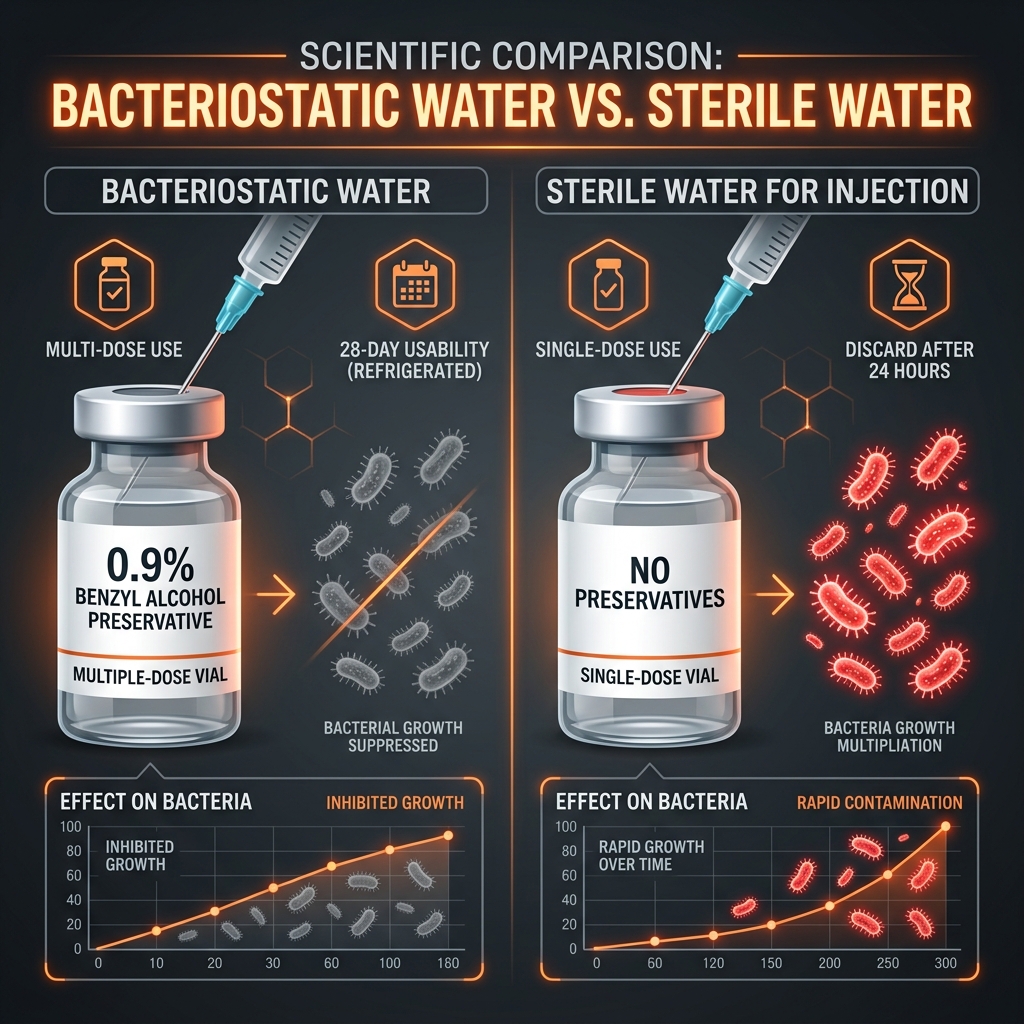
The numbers: about 28 days versus basically one
This is where it gets practical.
A vial reconstituted with bacteriostatic water is generally treated as good for around 28 days, kept refrigerated and handled cleanly. Four weeks, give or take, of repeat draws. That figure comes from how multi-dose preserved vials are handled in clinical settings, and it lines up with what the benzyl alcohol can actually hold back.
Plain sterile water is a different animal. No preservative means no safety margin once it's open. The conservative, and frankly correct, way to treat it is single-use: draw what you need, then it's done. Some people stretch a freshly opened sterile-water vial for a day in the fridge, but you're trusting luck at that point, because nothing in there is stopping bacterial growth. For anything you puncture repeatedly over weeks, it's simply the wrong tool.
So the contrast isn't subtle. Weeks versus a day. That gap is entirely the preservative.
Saline, since people always ask
Saline, 0.9% sodium chloride, comes up in the same breath, so let's be clear. Ordinary sterile saline for injection is also preservative-free in most forms. Same story as sterile water: fine sealed, single-use once opened, no protection against growth. There's a specific product called bacteriostatic saline that does contain benzyl alcohol, but if a bottle just says "sodium chloride for injection," assume it's the single-use kind. Reading the label beats assuming.
One more point that goes beyond shelf life: some peptides simply fall out of solution in saline. Retatrutide is the best-known example — clear in bacteriostatic water, routinely flocculent in NaCl. Why that happens is covered in mixing peptides in one syringe.
So which do you use for a peptide vial?
For most reconstituted peptides, bacteriostatic water, almost every time. The reason is the use pattern. A peptide vial isn't a one-and-done injection. You mix it once and then draw small doses from it across days or weeks, puncturing the stopper again and again. That's precisely the situation a preservative is built for. If you want the mechanics of mixing, our reconstitution guide walks the water-to-powder math, and the dose calculator turns it into units on the syringe.
Sterile water earns its place when a preservative is a problem, not a help. The classic case is anything where benzyl alcohol is contraindicated, which brings us to the part that actually matters for safety.
The honest part
None of this is medical advice. "Bacteriostatic water vs sterile water" is a real, practical difference, and getting it wrong tilts toward contamination and infection, which is not a small risk when you're injecting. A few things worth holding onto:
- A preservative buys you time, not sterility. Clean technique still matters: swab the stopper, fresh needle, don't touch what goes in the vial.
- "Up to 28 days" assumes refrigeration and careful handling. A vial left warm, or punctured with a dirty needle, doesn't get to claim the full window.
- If a solution turns cloudy, throws specks, or just looks off, it goes in the bin no matter what water you used.
- Anyone with a benzyl alcohol sensitivity, anyone mixing for an infant, or anyone unsure should be talking to a clinician, not a web page.
If you're newer to all of this, what peptides are covers the groundwork, and the reconstitution guide takes the mixing step by step.
This is educational information, not medical advice. Any reconstitution and dosing of a medicine belongs with a clinician who is supervising you.