
Reconstituting Peptides: How the Concentration Math Works
Reconstitution is the step between a dry container and a measurable liquid. A lyophilised (freeze-dried) preparation sits under the stopper as a compact cake or a barely visible film, and in that dry state it is stable, because the reactions that degrade it need water. Adding a defined volume of liquid turns that solid into a solution of defined concentration, and concentration, not the number on the label, is what a graduated syringe is read against.
What follows describes the term, the arithmetic in general placeholders, and the conventions attached to a container once liquid is in it. None of it is a recommendation to prepare anything: many of the substances this arithmetic gets applied to are not approved as medicines or are prescription-only, and where an approved product is involved, the directions on its own labelling govern. Background on the substance class is in what peptides are.
What "reconstitute" actually means
Reconstitution is the addition of a sterile liquid to a lyophilised solid so that it dissolves into a solution of known concentration. The term belongs to pharmaceutical compounding and applies to any freeze-dried preparation, which is why the colloquial phrase "mixing peptides" covers exactly one defined operation: a known mass of solid meets a known volume of liquid, and the result is a concentration.
The liquid is not interchangeable. Bacteriostatic Water for Injection is sterile water containing roughly 0.9% benzyl alcohol. The benzyl alcohol is a preservative rather than a steriliser: it inhibits bacterial multiplication, which is why the monograph describes the product as suitable for a container entered more than once. Plain Sterile Water for Injection has no preservative and is described as a single-use diluent; the two are compared in bacteriostatic vs sterile water.
What the compounding standards describe
The compendia distinguish preserved from unpreserved diluents by whether a container is entered once or more than once — a property of the preparation as it is labelled, not a decision taken at the bench. How finely the result can then be read is a property of the syringe alone, and follows from its graduation rather than from anything in the vial.
Disinfection of the rubber closure before each entry belongs to the aseptic technique in USP General Chapter 797, which regards the closure, not the needle, as the critical surface.
The one formula
There is a single equation, and it is a definition rather than a recommendation.
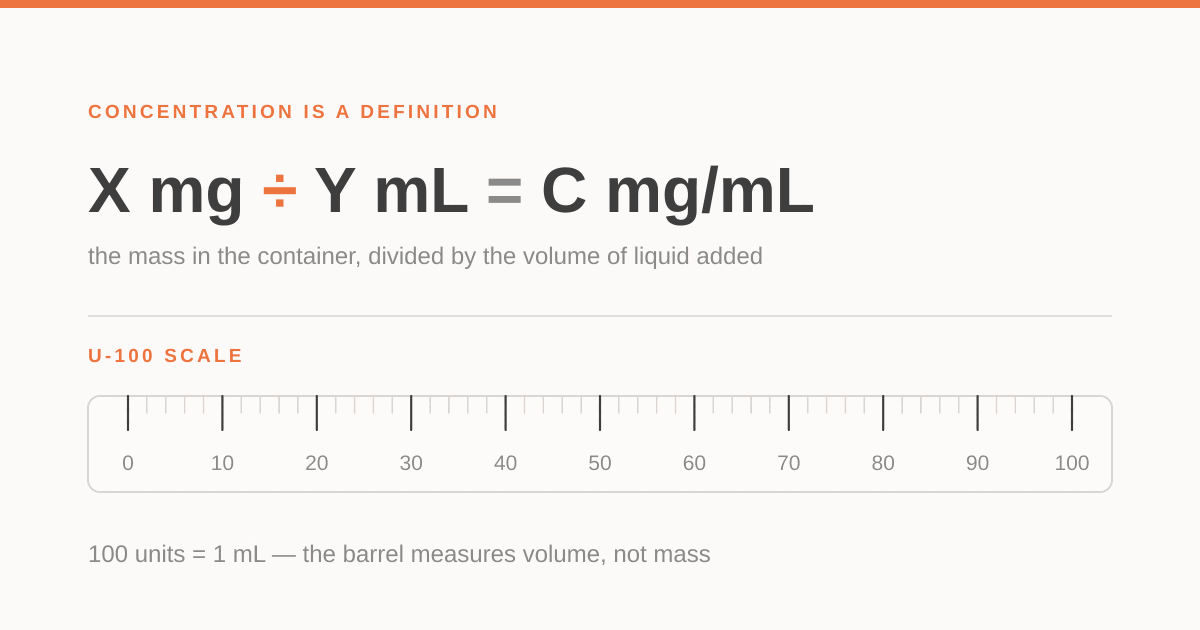
mass in the container ÷ volume of liquid added = concentration
In placeholders: X mg reconstituted with Y mL gives X ÷ Y mg/mL, and nothing about X changes when Y changes — only the concentration moves.
Reading the barrel adds two conversions: a quantity of Z mg divided by the concentration gives the volume in mL that contains it, and on a U-100 insulin syringe 1 mL is 100 units, so V mL corresponds to V × 100 units — how that scale is printed and read is covered in insulin syringe units. All of it is unit conversion, and none of it says which substance is in the container or what quantity would be appropriate.
The mass in a container is fixed at manufacture. Adding liquid spreads it across a larger volume, so the same quantity spans more graduations.
How the volume of water changes the concentration
There is no single correct volume, because the choice is a trade-off rather than a fact. A small volume gives a concentrated solution in which any quantity occupies few graduations, and a reading at the extreme bottom of a scale carries a large relative error. A larger volume spreads the same quantity over more graduations.
Two limits frame the range: concentrated solutions push the reading into the least accurate part of the barrel, and dilute ones can exceed the capacity of the syringe. The principle is metrology rather than pharmacy — a mid-scale reading carries less relative error than one crowded against either end.
The reconstitution calculator runs this conversion as a unit converter. Units are covered in mg, mL and IU.
How the process is described
Accounts of the physical part are consistent across pharmaceutical sources, and they read as chemistry rather than choreography.
USP General Chapter 797 describes disinfection of the closures of both containers, and the drying of the alcohol afterwards, as part of aseptic technique, because the antiseptic effect is bound to evaporation rather than to contact alone. The direction of the liquid stream appears in the formulation literature for a chemical reason: a jet driven into a lyophilised cake generates shear and creates an air-liquid interface, and Wang and Roberts (2018) name both as aggregation pathways for proteins in solution. Descriptions of dissolution accordingly refer to standing or to gentle swirling, the conditions under which neither is produced.
Shaking is the classic error, because it produces foam, and foam is surface area, where proteins unfold and aggregate. Dissolution is usually complete within minutes, though some preparations take longer, and a solution described as ready is clear and free of particles. USP General Chapter 790 (Visible Particulates in Injections) describes visual inspection against a lighted background; a preparation that remains cloudy or shows undissolved residue does not meet that description.
Storing a reconstituted vial
Dry powder is forgiving. Solution is not. Once water is present, hydrolysis, oxidation, deamidation and aggregation all become possible, and those rates rise with temperature.
The convention described for reconstituted peptide and protein preparations is refrigeration at 2–8 °C with protection from light. The door of a domestic refrigerator is its warmest and most variable position; the 2–8 °C range applies to the interior, not to the door shelf.
Beyond-use dating is the second convention. For a conventionally manufactured multiple-dose container, USP General Chapter 797 describes not more than 28 days after the container is first entered, unless the labelling states otherwise — the figure that circulates informally as "about four weeks". Two things about it are routinely misread: it is a ceiling rather than a promise, and it rests on the preservative system doing its job, not on any measurement of how much substance is left. An unpreserved diluent has no such window at all. Freezing is separate: freeze-thaw cycles are a documented cause of aggregation, and lyophilisation is an industrial process a household freezer does not reproduce. Related questions are covered in storing peptides in syringes.
Common failure modes
Three classes of error account for most of what goes wrong.
Mechanical damage during dissolution. Jetting the diluent onto the cake and shaking the container both introduce shear and foam. The damage is invisible: the volume is unchanged and the label still reads the same, while part of the material has left the solution.
Loss of the aseptic chain. An undisinfected closure, an unpreserved diluent in a repeatedly entered container, and a container kept past its beyond-use period are variations on one theme: in compounding standards it is the preservative system, not the needle, that determines whether a container may be entered more than once.
Arithmetic that no longer matches the container. A syringe measures volume and cannot know what is dissolved in it, so a wrong assumption about the mass makes every later reading wrong by the same factor. Labelling conventions answer that: the container carries the date of reconstitution and the concentration, so the two numbers can be compared.
A fourth class sits at the edge of the topic: combining preparations in one syringe, described in mixing peptides in one syringe.
Common questions
What does reconstitute mean?
Reconstitution describes adding a sterile liquid to a freeze-dried (lyophilised) solid so that it dissolves into a solution of known concentration. The term comes from pharmaceutical compounding and applies to any lyophilised preparation.
Why is the concentration the number that matters?
A syringe measures volume, not mass, so the amount of substance in a given volume depends entirely on the concentration of the solution. Concentration is the mass in the container divided by the volume of liquid added, in mg/mL.
Does adding more liquid change the amount of substance in the vial?
No. The mass is fixed at manufacture; adding more liquid spreads it across a larger volume and lowers the concentration, so the same quantity then occupies more graduations on a syringe barrel.
What is the 28-day beyond-use convention?
Beyond-use dating is the point past which a reconstituted preparation is no longer used. For a conventionally manufactured multiple-dose container, USP General Chapter 797 describes not more than 28 days after the container is first entered, unless the labelling states otherwise. The figure rests on the preservative system rather than on any measurement of how much substance is left.
Why is a reconstituted vial refrigerated?
In solution, peptide bonds are exposed to hydrolysis, oxidation and aggregation, and those reactions run faster at higher temperatures. Refrigeration at 2–8 °C with protection from light is the convention described for reconstituted peptide preparations; dry powder is far more stable.
Where these conventions come from
- USP General Chapter 797, Pharmaceutical Compounding — Sterile Preparations: aseptic technique, closure disinfection, beyond-use periods. https://www.usp.org/compounding/general-chapter-797
- USP General Chapter 790, Visible Particulates in Injections: visual inspection of a preparation for particulate matter. https://www.usp.org/
- Bacteriostatic Water for Injection USP, product labelling: 0.9% benzyl alcohol; unpreserved Sterile Water for Injection as single-use. https://dailymed.nlm.nih.gov/
- Manning MC, Chou DK, Murphy BM, Payne RW, Katayama DS: Stability of protein pharmaceuticals — an update. Pharmaceutical Research 27(4):544–575 (2010): hydrolysis, deamidation and aggregation as degradation routes in solution. https://pubmed.ncbi.nlm.nih.gov/20143256/
- Wang W, Roberts CJ: Protein aggregation — mechanisms, detection, and control. International Journal of Pharmaceutics 550(1–2):251–268 (2018): shear, air-liquid interfaces and freeze-thaw cycles as aggregation pathways. https://pubmed.ncbi.nlm.nih.gov/30145245/