
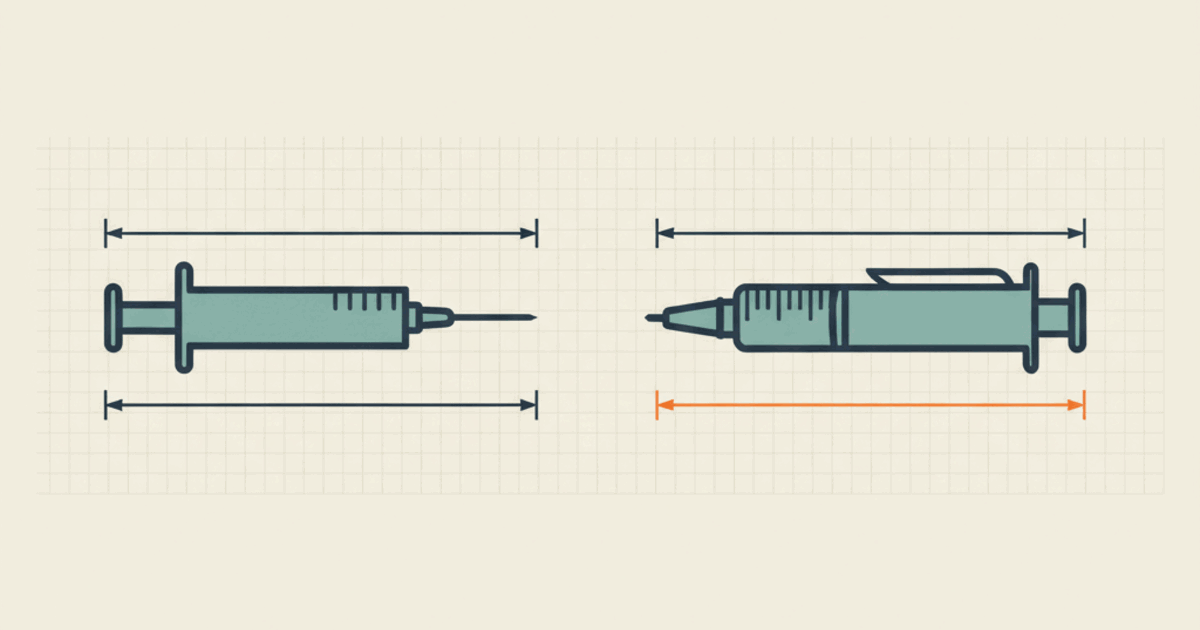
Syringe vs pen for peptides
First, the boring but necessary part. This is general educational information, not medical advice, and not a nudge to inject anything. Only use a medicine a clinician has prescribed and is watching over. Unapproved "research" compounds are not for human use. With that on the record: the syringe-versus-pen debate comes up constantly and gets muddier every time, so here is a clear version.
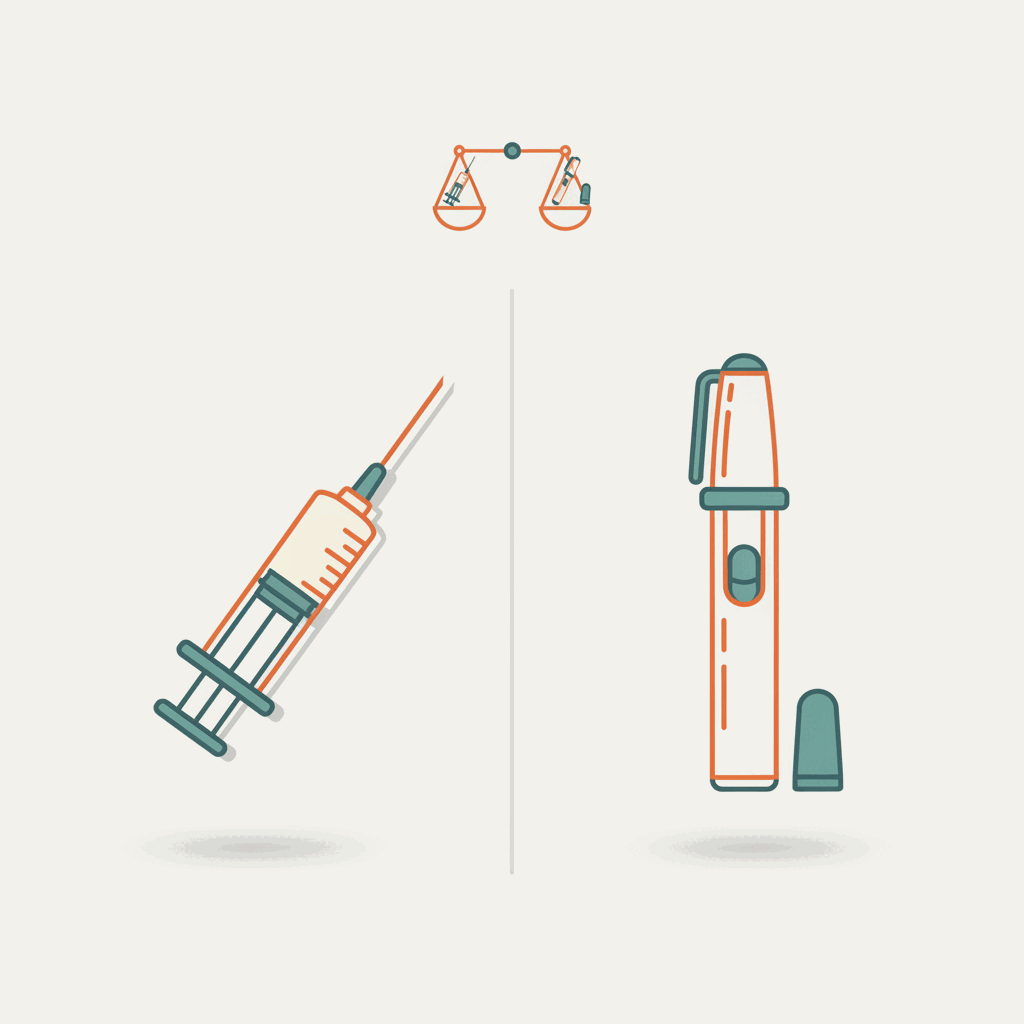
The short answer: a pen is more accurate and far more convenient, especially at small doses; an insulin syringe is cheaper, wastes almost nothing, and copes with any concentration you throw at it. Neither is "correct." They solve different problems, and plenty of people end up owning both.
What each one actually is
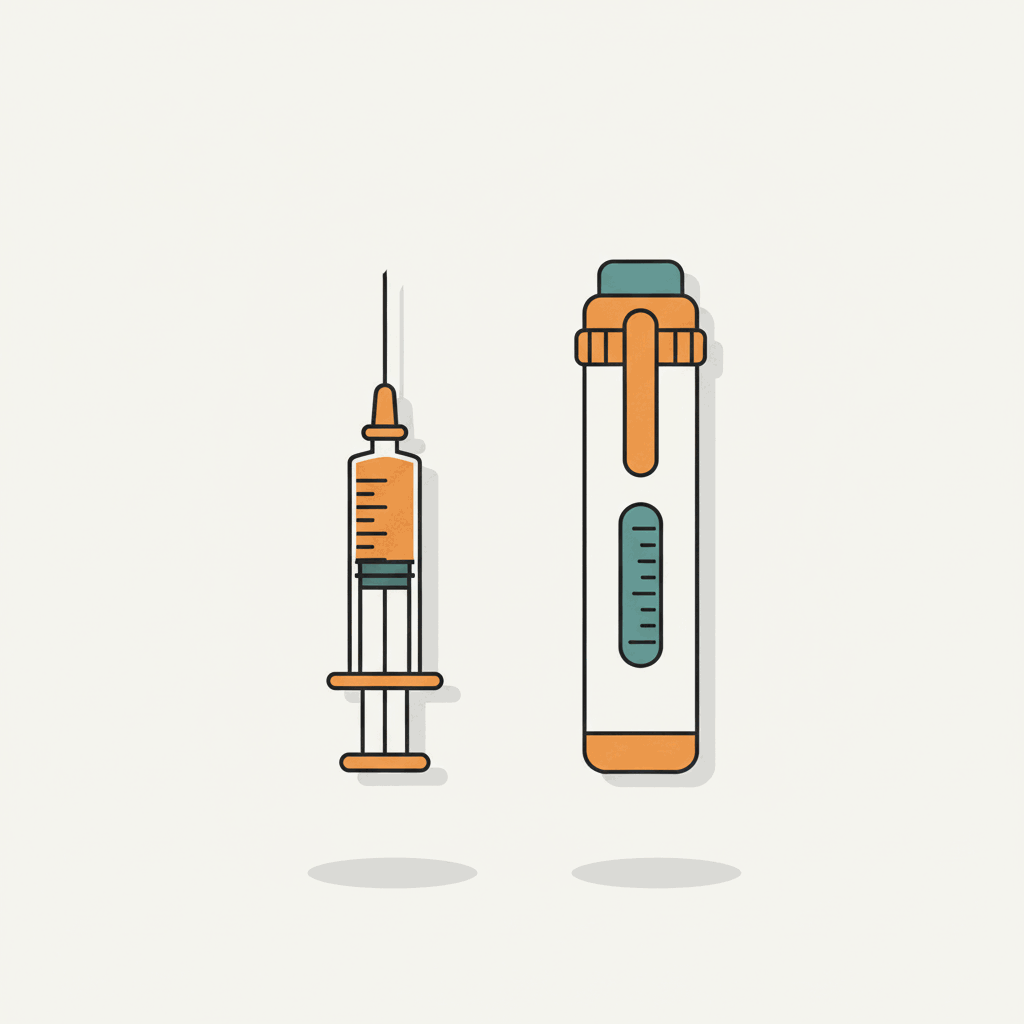
An insulin syringe is the plain option: a barrel marked in units (a "unit" is 0.01 mL on a U-100 syringe), a fixed or removable needle, and a plunger you push by hand. You draw liquid up to a line and inject. That's the whole device.
A pen is a small mechanical dose-counter. You load a glass cartridge of solution, screw a tiny needle onto the end, dial the number of units you want, and press a button. Each click on the dial meters out a fixed volume, so you are counting clicks instead of reading a line on a barrel. Some pens fire the dose themselves with a spring; on others you push the button down yourself. If that distinction matters to you, we go deeper in automatic vs manual pens, and the pen overview walks through the specific models people use.
Where the pen wins: accuracy at low doses
This is the pen's real advantage, and it is not marketing. When the dose is tiny, a small mistake reading the barrel becomes a big percentage error. Miss the line by "half a unit" on a syringe and at a two-unit dose you are off by 25%. A pen sidesteps that: the mechanism delivers the same metered volume per click every time, whether or not your eyes and the kitchen light are cooperating. Device-usability research on GLP-1 pens has repeatedly found pens to be more accurate than syringes at the low volumes where it counts most, which is exactly the range a lot of peptide work lives in.
The knock-on effects are the quiet ones. Consistent doses mean the picture you build over weeks is cleaner, because you are not adding a little random scatter to every single injection. And there is less faff: no squinting, no drawing-and-tapping-out-bubbles ritual each time.

Where the syringe still wins
Don't write off the syringe. It has three genuine edges.
Cost. A syringe costs pennies. A decent reusable pen is a real purchase up front, plus cartridges and pen needles on top.
Almost no waste. A pen holds back a little liquid in its cartridge and needle that you can never quite push out — dead space. Some pens "fully deplete," others need a spacer to get the last bit. A syringe, by contrast, gets you nearly the whole draw. When a vial is small and the contents are expensive, those spared microlitres add up.
It handles any concentration. A pen counts in fixed units of volume, so it assumes a particular concentration in the cartridge. Mix your solution to an odd strength and the click-to-dose maths gets awkward fast. A syringe just draws whatever volume you tell it to. This is why the reconstitution step and a good dose calculator matter more with a pen, not less.
Cost and waste, side by side
| Insulin syringe | Reusable pen | |
|---|---|---|
| Up-front cost | Very low | Higher (device + cartridges + needles) |
| Accuracy at low doses | Depends on your eyes | Consistent per click |
| Wasted product | Minimal | Some dead space in cartridge/needle |
| Any concentration? | Yes, draw any volume | Assumes a set concentration |
| Learning curve | Draw to a line | Load, dial, press |
| Discretion | Looks like a syringe | Looks like a pen |
Reconstitution: the step people forget
Whichever you pick, the powder starts the same way — a dry vial you mix with bacteriostatic water. With a syringe you then draw straight from that vial. With a pen you transfer the solution into a cartridge, which is one extra handling step and one more chance to introduce contamination if your technique is sloppy. Neither device changes the underlying arithmetic of concentration and volume; it only changes how you measure the final amount. If mixing is new to you, start with reconstitution basics and bacteriostatic vs sterile water.
So which should you use?
Rough guide, not a rule:
- Tiny, frequent doses where consistency matters and you don't mind the outlay: a pen earns its keep.
- Occasional use, tight budget, or an unusual concentration: a syringe is simpler and cheaper, and you lose almost nothing.
- Needle-shy? A pen with a very short needle and, if you like, automatic delivery tends to feel easier.
- Want the fewest moving parts and the least that can go wrong: it is hard to beat a syringe.
Common questions
Is a pen more accurate than a syringe? At low doses, generally yes — the per-click volume doesn't depend on how well you read a barrel. At larger volumes the gap shrinks.
Do I lose product with a pen? A little, to dead space in the cartridge and needle. A syringe wastes less. How much depends on the specific pen.
Can I use any concentration in a pen? Not comfortably. Pens count fixed volume units, so they assume a set concentration. Syringes don't care.
Is a pen worth the money? If you value accuracy and convenience and dose often, many people think so. For occasional use, a syringe is hard to argue against on cost.
Which needle length? That is a technique question, not a syringe-vs-pen one — see injection technique.
The part that matters
This is general educational information, not medical advice and not instructions to self-administer anything. Both a syringe and a pen are just tools for measuring and delivering a liquid; neither makes an unsafe or unapproved product safe, and neither substitutes for a clinician who knows your situation. If you want the numbers handled, the dose calculator does the concentration and volume maths for either device.