
GLP-1 dosing errors: why poison-control calls are surging
This is general educational information, not medical advice and not dosing guidance. It reports what a study found and where the mistakes cluster, so you can spot the traps. For anything about your own treatment, ask the prescriber and pharmacist who know your case.
The short version: US poison-control centers have seen GLP-1 calls climb about 1,500% since 2019, and a new analysis out of UT San Antonio (covered by U.S. News/HealthDay, 25 June 2026) found that roughly 91% of the cases were therapeutic errors, not overdoses in the dramatic sense, just people getting the dose or the timing wrong. Most were mild. But the share serious enough to send someone to a clinic crept up from 23% to about 33% over the study window. Almost all of it was avoidable.
What the numbers actually say
Before semaglutide got its 2021 obesity approval, poison centers logged somewhere around 1,000 to 1,500 GLP-1 cases a year. By 2023 that was north of 8,000. Semaglutide alone accounts for about 64% of the calls, which makes sense: it is the one most people are on.
The pattern matters more than the raw count. These are not, for the most part, people trying to take too much. They are people who lost track of a schedule or a number. That is a fixable problem, and it is worth understanding exactly where the confusion happens.
The four mistakes that show up again and again
| Slip-up | What happened | Why it happens |
|---|---|---|
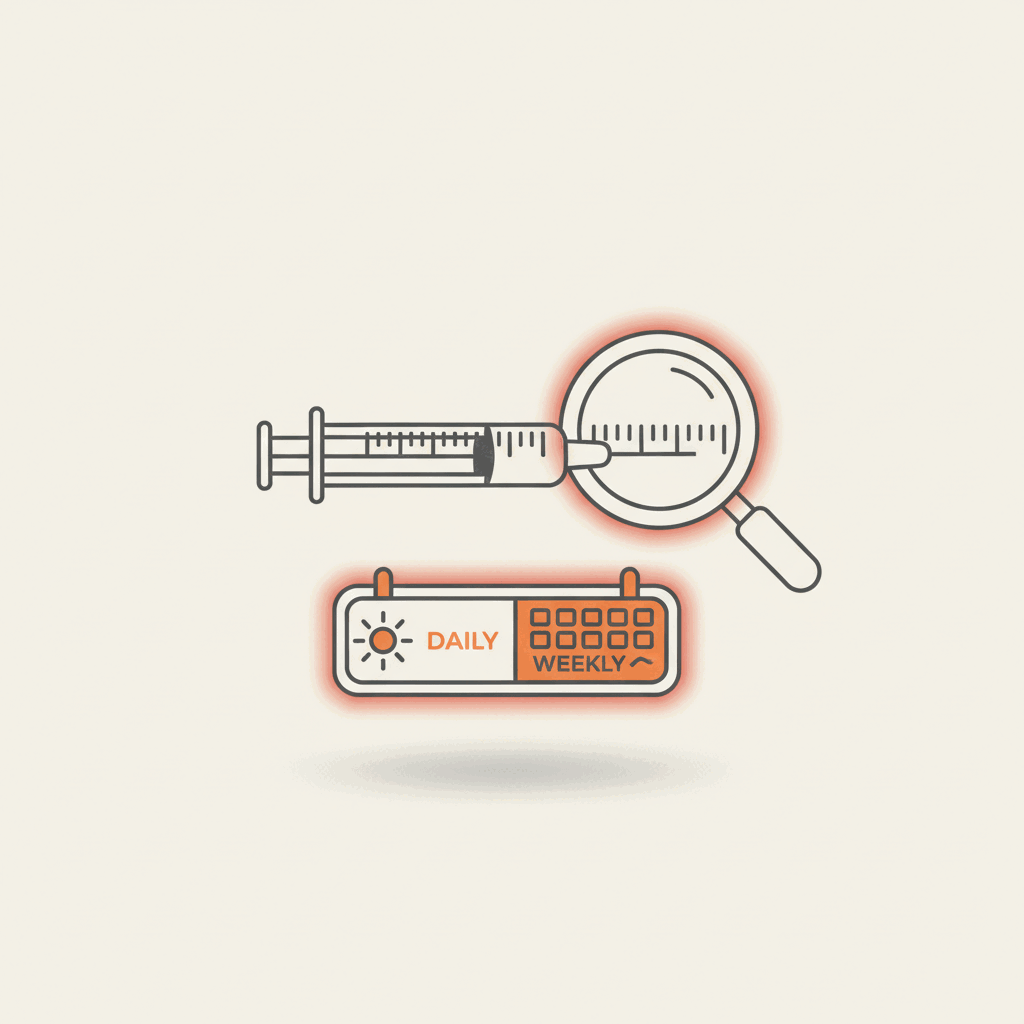
| Weekly taken as daily | A once-weekly dose injected every day | The habit of "take your meds daily" is strong; weekly dosing is unusual |
| Straight to the full dose | Starting high instead of titrating up | Missing or ignoring the step-up schedule the drug is designed around |
| Double dose | Two doses close together | Losing track of whether the last one was actually done |
| Vial-and-syringe math | Drawing the wrong number of units from a multi-dose vial | Converting a milligram dose into syringe units, by hand, under-caffeinated |
The last one is the one this site cares about most, because it is pure arithmetic and pure arithmetic is where a tired person at the kitchen table goes wrong. A pen meters the dose for you. A vial does not: you have to turn "this many milligrams" into "this many units on the barrel," and if the concentration in your vial is not what you assumed, the number you draw is off.
Why the vial crowd is exposed
The surge tracks the rise of telehealth and compounded GLP-1s supplied in multi-dose vials rather than pre-filled pens. A pen is a closed system with a dial; a vial hands you the whole calculation. That is more flexible and often cheaper, and it also removes the guardrail. When the reports talk about "double doses" and "doses taken too close together," a lot of that is someone unsure whether last week's draw actually went in, or misreading the barrel.
None of this means vials are bad. It means the measuring step deserves respect. Two habits do most of the work: keep one clear record of when you last dosed, and check the units-from-milligrams math with something other than your own tired head.
Keeping the math honest (without it being "advice")
We are not going to tell you a number to inject, that is between you and your clinician. What a tool can do is the neutral part: convert the values you already have. If you know the vial strength, the amount of bacteriostatic water you added, and the dose your prescriber set, the reconstitution calculator turns that into the exact units on the syringe, so the conversion is not happening in your head at 6am. It recommends nothing; it just does the arithmetic you would otherwise do by hand. If the mixing step itself is fuzzy, start with how reconstitution works and bacteriostatic vs sterile water.
The other half is boring and works: write down the date of each dose. Most double-dose calls trace back to "I could not remember if I had done it." A dated log removes the guess.
The bigger backdrop
The poison-control jump is not happening in isolation. Medication-error reports to the FDA involving these drugs have risen sharply over the same period, and the common thread is the shift from a clinic-administered injection to self-dosing at home, often from a vial. More people, more self-administration, same human tendency to misread a number. The study authors are blunt that most of these events were preventable with better patient education. That is the whole point of covering it here.
Bottom line
The scary headline ("poison-control calls up 1,500%") describes something fairly undramatic underneath: mostly mild, mostly avoidable, mostly a schedule or a unit-conversion gone sideways. If you are dosing from a vial, the two things that keep you out of that statistic are a dated record of every dose and a reliable way to convert milligrams into units. Neither is medical advice. Both are just refusing to do important arithmetic from memory. For the drug-specific background, see semaglutide and tirzepatide.
Sources
- U.S. News / HealthDay, 25 Jun 2026, GLP-1 weight-loss boom linked to surge in poison-control calls
- News-Medical, 26 Jun 2026, Semaglutide approval drove a surge in GLP-1 poison-center exposures
- Bioengineer, Jun 2026, UT San Antonio study on the semaglutide-era poison-control surge
Take myPeptides with you
Track doses, plans and progress on your phone — end-to-end encrypted.
This article is for informational purposes only and does not replace medical advice. myPeptides gives no dosing recommendations.