

Storing peptides in a syringe
First, the usual but necessary note: this is general educational information, not medical advice and not a nudge to inject anything. Only use a medicine a clinician has prescribed and is supervising; unapproved "research" compounds are not for human use. With that on the record, here's a question that comes up constantly — is it fine to draw a peptide up now and inject it later? — and a clear answer: a filled insulin syringe is one of the worst places to keep a peptide, and it's worth understanding why.
The short version: draw your dose right before you inject it. Don't fill a syringe in the morning for the evening, and don't line up a week's worth in advance. The reason lives in what the syringe is made of.
What an insulin syringe is actually made of
A syringe feels like a neutral little tube, but it's a small assembly of materials, each one touching your liquid:
- The barrel — usually polypropylene or a similar plastic.
- The plunger tip (the stopper) — a rubber or elastomer piece that seals and slides inside the barrel.
- A lubricant — most syringes carry a thin film of silicone oil on the inside so the plunger glides.
- The needle and the adhesive that bonds it in place.
Every one of these is chosen to be safe for a brief contact — the few seconds between drawing up and injecting. None of it is designed to store a sensitive molecule for hours.
Why time in the syringe is a problem
Things leach out of the plastic and the plunger. Given time, tiny amounts of material migrate from the barrel, the rubber tip and the silicone film into the liquid. In pharma this is the world of extractables and leachables — plasticizers, silicone-oil droplets, elastomer residues, trace metals. The longer the contact and the warmer the room, the more crosses over. A few seconds is nothing; twelve hours is not.
Peptides are fragile, and they react to exactly these things. Silicone oil is a well-documented trigger for peptide aggregation — the molecules clump together and lose activity. Leached residues can nudge oxidation and other degradation along, too. What you inject in the evening may not be quite what you drew up that morning.
The peptide sticks to the walls. Peptides tend to adsorb onto plastic and rubber. More surface, more contact time, and a little more of your dose is quietly left behind on the inside of the syringe instead of ending up in you.
Warmth, light and no seal. A reconstituted peptide already degrades faster at room temperature and in light. Left out on a nightstand — drawn up and warm — it's also no longer protected inside its sealed vial, which raises the odds of contamination on top of everything else.
The one rule that avoids all of it
Draw your dose right before injecting — not hours ahead. No morning-for-evening syringe, no batch for the week.
If you genuinely can't avoid preparing ahead, keep the window as short as you can and store the filled syringe cold and dark — but treat that as a compromise, not the safe path. Fresh always wins.
Store it properly instead
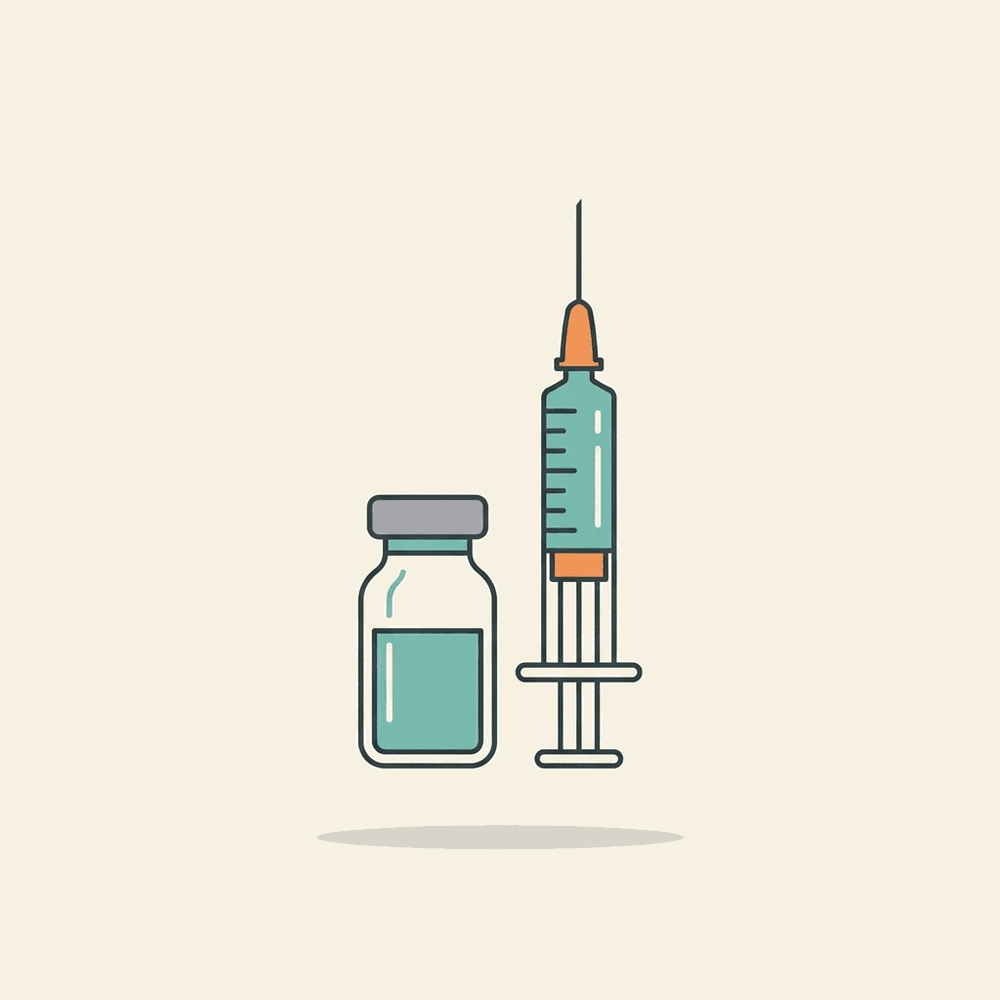
Think of it this way: the glass vial is the container built for storage, and the syringe is the tool for the moment of the injection.
- Keep the reconstituted peptide in its original glass vial. Glass is far more inert than a plastic syringe and doesn't shed the same leachables.
- Store the vial in the fridge, away from light.
- Draw a fresh dose each time, right before injecting.
- Work cleanly, use a fresh needle, and check the liquid is clear before use.
If reconstitution is new to you, start with reconstitution basics and bacteriostatic vs sterile water; for the injection itself, see injection technique. Still deciding between a syringe and a pen in the first place? That's its own article.
Common questions
Can I draw up my dose the night before? Better not. Even a few hours against the plastic, plunger and silicone works against a peptide, and there's no seal or cold protecting it. Draw it fresh.
How long is it safe to leave a peptide in a syringe? There's no clean number, which is rather the point — the risk grows with time, warmth and light. Treat "as short as possible" as the rule and "right before injecting" as the target.
Is a glass vial really better than the syringe? For storage, yes. Glass is far more inert, and it stays sealed and cold in the fridge; the syringe's plastic and rubber are the whole problem.
Does pre-filling waste product too? It can. The longer a peptide sits against plastic and rubber, the more adsorbs to the surfaces — so a stored syringe can quietly deliver a little less than you dialled in.
What about pre-filled pens? A cartridge inside a pen is a different, sealed system designed for exactly that; a hand-drawn insulin syringe left standing is not. If you're weighing the two, see syringe vs pen.
The part that matters
This is general educational information, not medical advice and not instructions to self-administer anything. Storage habits don't make an unapproved or unsafe product safe, and nothing here replaces a clinician who knows your situation. If you'd rather have the numbers handled either way, the dose calculator does the concentration and volume maths for you.