
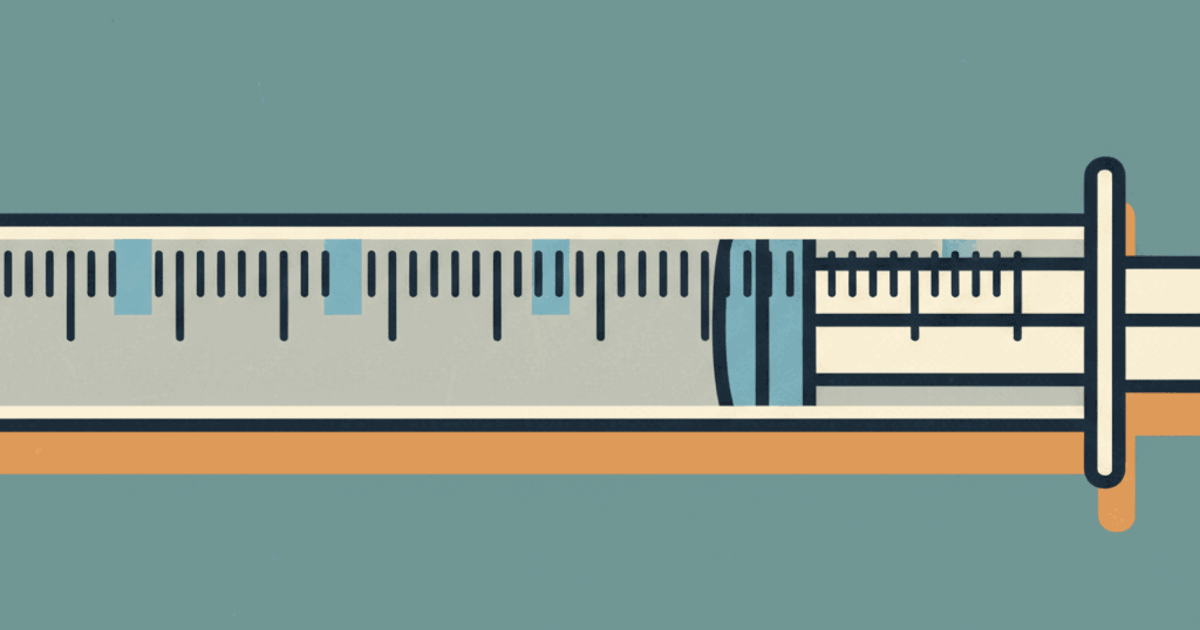
1 mL = how many units? Reading a U-100 insulin syringe
On a U-100 insulin syringe, 100 units correspond to 1 mL, so one unit is 0.01 mL and 50 units are 0.5 mL. The U-100 printed on the barrel is a concentration designation rather than a size: the scale was graduated for a solution holding 100 units per milliliter. Units on that barrel measure volume.
Units to mL on a U-100 scale
Units to mL is a conversion between two readings of the same volume, not between two printed scales: the milliliter figure describes how much liquid the barrel holds, the unit figure describes that same volume divided into hundredths. Because both refer to volume, the conversion is fixed arithmetic and needs no information about what the liquid contains. The published case literature states it plainly – one unit of a 100 units/mL preparation occupies 0.01 mL, one unit of a 40 units/mL preparation 0.025 mL [2].
Mathematical converter only – not a dosing recommendation, not medical advice.
| Units on a U-100 scale | Volume (mL) | Volume (microliters) |
|---|---|---|
| 1 | 0.01 | 10 |
| 2 | 0.02 | 20 |
| 5 | 0.05 | 50 |
| 10 | 0.10 | 100 |
| 15 | 0.15 | 150 |
| 20 | 0.20 | 200 |
| 25 | 0.25 | 250 |
| 30 | 0.30 | 300 |
| 40 | 0.40 | 400 |
| 50 | 0.50 | 500 |
| 60 | 0.60 | 600 |
| 70 | 0.70 | 700 |
| 75 | 0.75 | 750 |
| 80 | 0.80 | 800 |
| 90 | 0.90 | 900 |
| 100 | 1.00 | 1000 |
Mathematical converter only – not a dosing recommendation, not medical advice. Arithmetic conversion on a U-100 scale; no external source.
Read from the other direction, the same table answers the volume question. A milliliter figure multiplied by 100 gives the unit figure on a U-100 scale, which is why the numbers look familiar: 0.25 mL is a quarter of a milliliter and 25 units is a quarter of a hundred.
| Volume (mL) | Units on a U-100 scale | Share of a 1 mL barrel |
|---|---|---|
| 0.01 | 1 | 1/100 |
| 0.05 | 5 | 1/20 |
| 0.10 | 10 | 1/10 |
| 0.15 | 15 | 3/20 |
| 0.20 | 20 | 1/5 |
| 0.25 | 25 | 1/4 |
| 0.30 | 30 | 3/10 |
| 0.40 | 40 | 2/5 |
| 0.50 | 50 | 1/2 |
| 0.60 | 60 | 3/5 |
| 0.70 | 70 | 7/10 |
| 0.75 | 75 | 3/4 |
| 0.80 | 80 | 4/5 |
| 0.90 | 90 | 9/10 |
| 1.00 | 100 | full scale |
Mathematical converter only – not a dosing recommendation, not medical advice. Arithmetic conversion on a U-100 scale; no external source.
What the U-100 marking on the barrel means
U-100 is a concentration label borrowed from the solution and printed on the measuring instrument. The letter U stands for unit and the number is units per milliliter; it says nothing about barrel length, needle gauge or capacity.
The device side is standardized. ISO 8537, the international standard for sterile single-use syringes for insulin, covers barrels intended for 40 units/mL (U-40) and 100 units/mL (U-100) preparations. It requires that a syringe be graduated in increments corresponding to units of one concentration only, that the barrel be marked with the concentration it was designed for – for example the text U-100 insulin – and that on 1.0 mL syringes the graduation lines be numbered at every ten units [1]. The standard gives its own reason: serious problems can result when a syringe is used with a concentration other than the one it was graduated for.
Insulin syringes sit under a separate standard for exactly that reason. ISO 7886-1, the general standard for manually operated hypodermic syringes, excludes syringes for use with insulin from its scope and refers them to ISO 8537 [7]. A general-purpose 1 mL syringe carries a milliliter scale; a U-100 barrel is graduated in units only, with its nominal capacity (0.3, 0.5 or 1 mL) printed as a capacity statement rather than as a second graduated scale [1].
Reading the scale on 1 mL, 0.5 mL and 0.3 mL insulin syringes
Three barrel sizes dominate the U-100 family. All three use the same units-per-milliliter relationship; what changes is how much of the scale is spread over the same physical length, and therefore how fine the smallest readable mark is. The empty scales below show that difference directly.
A 1 mL U-100 barrel: 100 units across the full scale, one mark per unit, numbered every ten units.
A 0.5 mL U-100 barrel: 50 units across the same physical length, one mark per unit.
A 0.3 mL U-100 barrel: 30 units across the scale, the widest spacing of the three.
The half-unit variant of a 0.3 mL barrel: a shorter mark sits between every pair of unit marks, so the smallest marked step is 0.005 mL instead of 0.01 mL. Half-unit versions are offered in the 0.3 and 0.5 mL sizes [9].
On a 1 mL barrel the whole hundred-unit range is present, which is the barrel people picture when the question 1 mL = how many units comes up; the trade-off is that its hundred marks sit closest together, so the scale is the hardest of the three to read at a glance. A 0.5 mL barrel carries only fifty units over a comparable length, so the same 0.01 mL step is printed twice as wide. A 0.3 mL barrel spreads thirty units over the scale and reads most finely of the three; the half-unit versions offered in the 0.3 and 0.5 mL sizes are graduated a step further still, with a mark every half unit, that is every 0.005 mL [9].
| Barrel | Units on the full scale | Smallest printed graduation | Volume per mark | Source |
|---|---|---|---|---|
| 0.3 mL | 30 units | 1 unit, or 0.5 unit where a half-unit version is offered | 0.01 mL (0.005 mL) | ISO 8537:2016, Annex H [1]; Frohnert & Alonso 2015 [9] |
| 0.5 mL | 50 units | 1 unit, or 0.5 unit where a half-unit version is offered | 0.01 mL (0.005 mL) | ISO 8537:2016, Annex H [1]; Frohnert & Alonso 2015 [9] |
| 1 mL | 100 units | 1 unit | 0.01 mL | ISO 8537:2016, Annex H [1] |
Mathematical converter only – not a dosing recommendation, not medical advice.
The comparison between barrel sizes as devices – barrel diameter, gauge nomenclature, dead space and the fixed-versus-detachable needle – is set out separately in syringe sizes for peptides, and the difference between a barrel scale and a pen dial in syringe vs pen.
Where the reading is taken, and what makes it drift
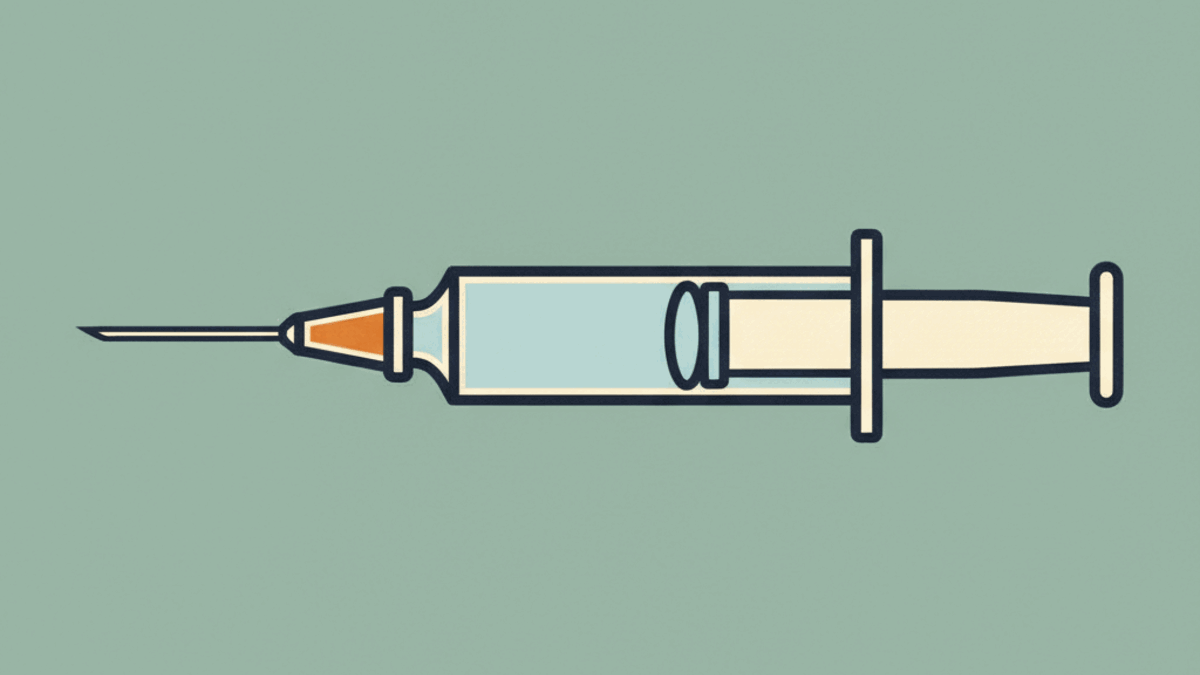
A syringe scale is read at the leading face of the plunger stopper, the flat front edge of the rubber piston, not at the ring behind it. Because the stopper has depth, the wrong reference edge shifts the reading by one or more graduation marks.
Parallax is the second distortion. The graduation is printed on the curved outer wall while the stopper sits inside, so the two are at different distances from the eye; viewed from above or below rather than square on, the mark that appears to line up with the stopper is not the one that does. The offset grows with the distance between the printed scale and the piston face inside the barrel.
Air is the third. The scale measures the space behind the stopper and cannot distinguish gas from solution, so a visible bubble makes the reading overstate the liquid volume by the volume of the bubble. A small residual volume also remains in the hub and needle bore after full plunger travel – the dead space – which is a device property rather than a reading error.
| What is seen | What it is | Effect on the reading | Source |
|---|---|---|---|
| Reading taken at the rear ring of the stopper | Wrong reference edge | Reading overstates the volume by the stopper depth | ISO 8537:2016 [1]; ISO 7886-1:2017 [7], graduated scale |
| Scale and stopper viewed at an angle | Parallax between printed scale and inner piston | Reading is off by one or more marks, in either direction | ISO 8537:2016 [1]; ISO 7886-1:2017 [7], graduated scale |
| Bubble visible in the barrel | Gas occupying graduated space | Liquid volume is smaller than the scale suggests | Jordan et al., Hospital Pharmacy 2021 [3] |
| Liquid remaining after full plunger travel | Dead space in hub and needle | Not a reading error; a fixed device property | Zule & Bobashev, Drug and Alcohol Dependence 2009 [10] |
| Faded or abraded printing | Damaged graduation | Marks are no longer identifiable; the barrel is unusable as a measuring device | ISO 8537:2016 [1]; ISO 7886-1:2017 [7], legibility of the graduated scale |
Mathematical converter only – not a dosing recommendation, not medical advice.
In pharmaceutical compounding practice the measurement error of a syringe is referenced to the nominal capacity of the barrel rather than to the volume drawn. A study published in Hospital Pharmacy, which examined syringes of 1, 3, 5, 10 and 20 mL at several fill levels, reports a mean percent error between 1.4% and 18.6% across the syringes and fill levels tested; an error above the 5% criterion the authors apply was more likely where less than 20% of the nominal capacity was measured, while at 20% of capacity the average relative standard deviation stayed below 5% for every syringe tested [3]. The guideline the authors derive from that finding is addressed to pharmacy compounding practice, which in the United States is governed by USP General Chapter 797 [6].
How much substance a given volume contains is a question of the concentration of the solution – fixed when it is made up with bacteriostatic water – not of the barrel; the barrel states volume and nothing else.
U-40 and U-500: scales that do not interchange
Three unit scales exist in circulation, and the number in each name is the number of units the scale packs into one milliliter. Because the milliliter is fixed and the unit count is not, a marking labeled 10 on one scale is a different volume from a marking labeled 10 on another.
| Scale marking | Units per mL | Volume of one marked unit | Volume per unit relative to U-100 | Source |
|---|---|---|---|---|
| U-40 | 40 | 0.025 mL | 2.5 times larger | Barrera & Murvelashvili 2019 [2] |
| U-100 | 100 | 0.01 mL | reference scale | Barrera & Murvelashvili 2019 [2] |
| U-500 | 500 | 0.002 mL | one fifth | Ro, Patient Safety 2025 [4]; FDA 510(k) K151870 [8] |
Mathematical converter only – not a dosing recommendation, not medical advice.
The U-40 scale persists mainly in veterinary use in some markets. A case report in Case Reports in Endocrinology documents what happens when the two are crossed: a 100 units/mL preparation measured on a U-40 barrel gives 2.5 times the volume per marking, because a U-40 unit is 0.025 mL against a U-100 unit at 0.01 mL [2]. Nothing about the barrels signals the mismatch – both are small, both are graduated in units, and the printed numbers look alike.
The U-500 scale runs the same trap in the opposite direction, at a factor of five. A dedicated U-500 syringe was cleared for the US market on 8 July 2016 through the Food and Drug Administration's 510(k) premarket notification route, recorded there as substantially equivalent [8]. The earlier practice of measuring a five-times-concentrated solution on a U-100 barrel required a mental conversion, and published patient-safety analyses trace fivefold errors in both directions to it [4]. The answer to a concentration problem was a separate scale, not a rule of thumb – which is the practical reading of ISO 8537 as well: a scale marking is only meaningful together with the scale it was cut for [1].
Units are volume, not IU and not milligrams
The word unit appears in three unrelated places. A syringe unit is a volume marking, fixed by the barrel at 0.01 mL on a U-100 scale. An international unit (IU) is a measure of biological activity, defined for each substance separately against an international reference preparation, and it is not readable from any barrel. A milligram is a mass. The three are related only through a concentration, never directly; the full separation is set out in mg, mL and IU. A barrel reading of 20 does not mean 20 IU and does not mean 20 mg – it means 0.20 mL of whatever the barrel contains.
Turning a mass figure into units requires a concentration
A mass in milligrams cannot be converted into scale units unless the concentration of the solution is known, because the barrel measures volume and the milligram measures matter. Written with placeholders, where m is a mass in milligrams and c is a concentration in milligrams per milliliter:
- volume in mL = m / c
- units on a U-100 scale = (m / c) × 100
Both lines are arithmetic identities and neither contains information about any substance. A milligram figure on its own – a label stating what a container held as dry matter, for instance – carries no volume information, so no unit figure follows from it until a concentration exists. Where a concentration is stated for an approved medicine it appears on the approved label; in the United States those labels are published through DailyMed, the National Library of Medicine service described as the official provider of FDA drug label information [5].
The syringe unit converter and the other calculators perform this arithmetic on values entered by the user; what is often searched for as a syringe unit calculator is this conversion and nothing more. They convert; they do not advise.
Common questions
1 mL = how many units in an insulin syringe?
On a U-100 insulin syringe, 1 mL corresponds to 100 units, because that scale is graduated for a solution containing 100 units per milliliter. One unit on the same scale is 0.01 mL. The relationship holds only for barrels marked U-100; a U-40 scale places 40 units in 1 mL and a U-500 scale places 500.
How many units in 1 mL?
That depends on which scale is printed on the barrel, because units are volume markings rather than an amount of substance. A U-100 scale shows 100 units in 1 mL, a U-40 scale 40 units, and a U-500 scale 500 units. The same physical milliliter is therefore labeled with three different numbers.
U-100: is 100 units = 1 mL?
Yes. On a barrel marked U-100 the 100-unit line sits at 1 mL, the 50-unit line at 0.5 mL and the 10-unit line at 0.1 mL. ISO 8537 requires that such a syringe be graduated for one concentration only and that the barrel state which concentration that is.
How many units is 1 mL?
One milliliter is 100 units on a U-100 scale, which is the entire length of a 1 mL barrel. A 0.5 mL barrel tops out at 50 units and a 0.3 mL barrel at 30 units, so neither of them can hold 1 mL at all. Barrel size changes the capacity, not the units-per-milliliter relationship.
0.5 mL units: how to read the scale?
A 0.5 mL U-100 barrel carries 50 units over its full length and is commonly graduated in 1-unit steps, with printed numbers every five or ten units. On that scale 0.5 mL reads as 50 units, 0.25 mL as 25 units and 0.05 mL as 5 units. Each single mark is worth 0.01 mL.
0.25 mL in units – what does it read as?
On a U-100 scale, 0.25 mL is 25 units. That falls at a quarter of a 1 mL barrel, at half of a 0.5 mL barrel and near five sixths of a 0.3 mL barrel. On a U-40 scale the same 0.25 mL would be marked as 10 units instead.
How do units convert to mL?
On a U-100 scale, dividing a unit figure by 100 gives milliliters and multiplying a milliliter figure by 100 gives units: 20 units are 0.2 mL, 75 units are 0.75 mL. The divisor is the number in the scale name, so it is 40 for a U-40 scale and 500 for a U-500 scale. This is a volume conversion and says nothing about the amount of any substance dissolved in that volume.
Are syringe units the same as IU?
No. A syringe unit is a volume marking on a barrel, fixed at 0.01 mL on a U-100 scale. An international unit (IU) is a measure of biological activity that is defined separately for each substance by an international reference preparation, so it cannot be read off a barrel.
Why do some barrels carry half-unit markings?
Some 0.3 mL and 0.5 mL barrels are produced with a mark every half unit, which is every 0.005 mL, so that the lower part of the scale can be read more finely. Half-unit graduation is a property of the individual syringe rather than of the U-100 scale in general, and the smallest marked increment is printed on the packaging.
Sources
- ISO 8537:2016, Sterile single-use syringes, with or without needle, for insulin. International Organization for Standardization. https://www.iso.org/standard/60510.html
- Barrera F, Murvelashvili N. Poorly Controlled Type 3c Diabetes due to Use of Veterinarian Insulin Syringes. Case Reports in Endocrinology. 2019;2019:7916435. https://pmc.ncbi.nlm.nih.gov/articles/PMC6601479/
- Jordan MA, Choksi D, Lombard K, Patton LR. Development of Guidelines for Accurate Measurement of Small Volume Parenteral Products Using Syringes. Hospital Pharmacy. 2021;56(3):165–171. https://pmc.ncbi.nlm.nih.gov/articles/PMC8114303/
- Ro M. Strategies to Prevent Fivefold Wrong Dose Errors With U-500 Insulin. Patient Safety. 2025;7(2). https://doi.org/10.33940/001c.144287
- DailyMed, U.S. National Library of Medicine – the official provider of FDA drug label information. https://dailymed.nlm.nih.gov/dailymed/
- USP General Chapter 797, Pharmaceutical Compounding – Sterile Preparations. United States Pharmacopeia. https://www.usp.org/compounding/general-chapter-797
- ISO 7886-1:2017, Sterile hypodermic syringes for single use – Part 1: Syringes for manual use. International Organization for Standardization. https://www.iso.org/standard/38078.html
- 510(k) Premarket Notification database, record K151870, U-500 insulin syringe, decision date 8 July 2016. US Food and Drug Administration. https://www.accessdata.fda.gov/scripts/cdrh/cfdocs/cfpmn/pmn.cfm?ID=K151870
- Frohnert BI, Alonso GT. Challenges in Delivering Smaller Doses of Insulin. Diabetes Technology and Therapeutics. 2015;17(9):597–599. https://pmc.ncbi.nlm.nih.gov/articles/PMC4939443/
- Zule WA, Bobashev G. High dead-space syringes and the risk of HIV and HCV infection among injecting drug users. Drug and Alcohol Dependence. 2009;100(3):204–213. https://pmc.ncbi.nlm.nih.gov/articles/PMC2654245/
A scale marking is a statement about volume and about the concentration the barrel was graduated for, and about nothing else. For any approved medicine the strength per milliliter is stated on its approved label, and questions about what a given volume means in a specific situation belong with a licensed physician or pharmacist.