

Mixing peptides in one syringe
This is general educational information, not medical advice and not a usage recommendation. It describes what happens chemically when two peptide solutions meet in the same barrel. Many substances discussed here are not approved as medicines or are prescription-only.
There is a moment familiar to anyone who has handled several peptide solutions. The first is drawn, then the second, then the third, all clear as water. Then the fourth goes in, and within seconds white strands hang in the barrel.
That is a peptide crash: the compound has come out of solution. It is not a cosmetic flaw, it is the end of that preparation.
What a crash looks like
The photographs below come from exactly such a case. Three peptide solutions had been drawn in sequence and the barrel was clear; one was a preparation supplied with a 0.9% sodium chloride diluent. The fourth addition was a lipidated GLP-1-class peptide, and the mixture turned on the spot:
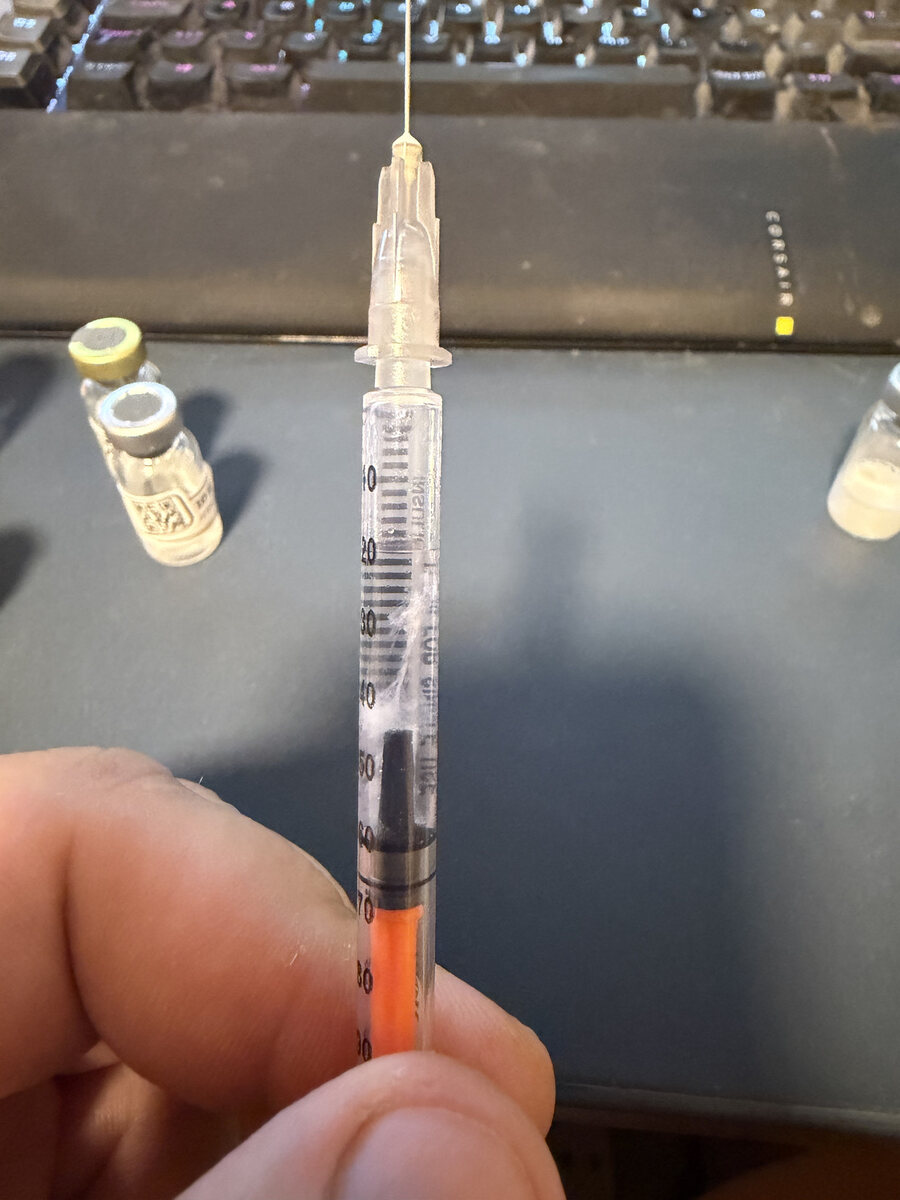
Up close these are not bubbles but solid flakes, collecting at the plunger:
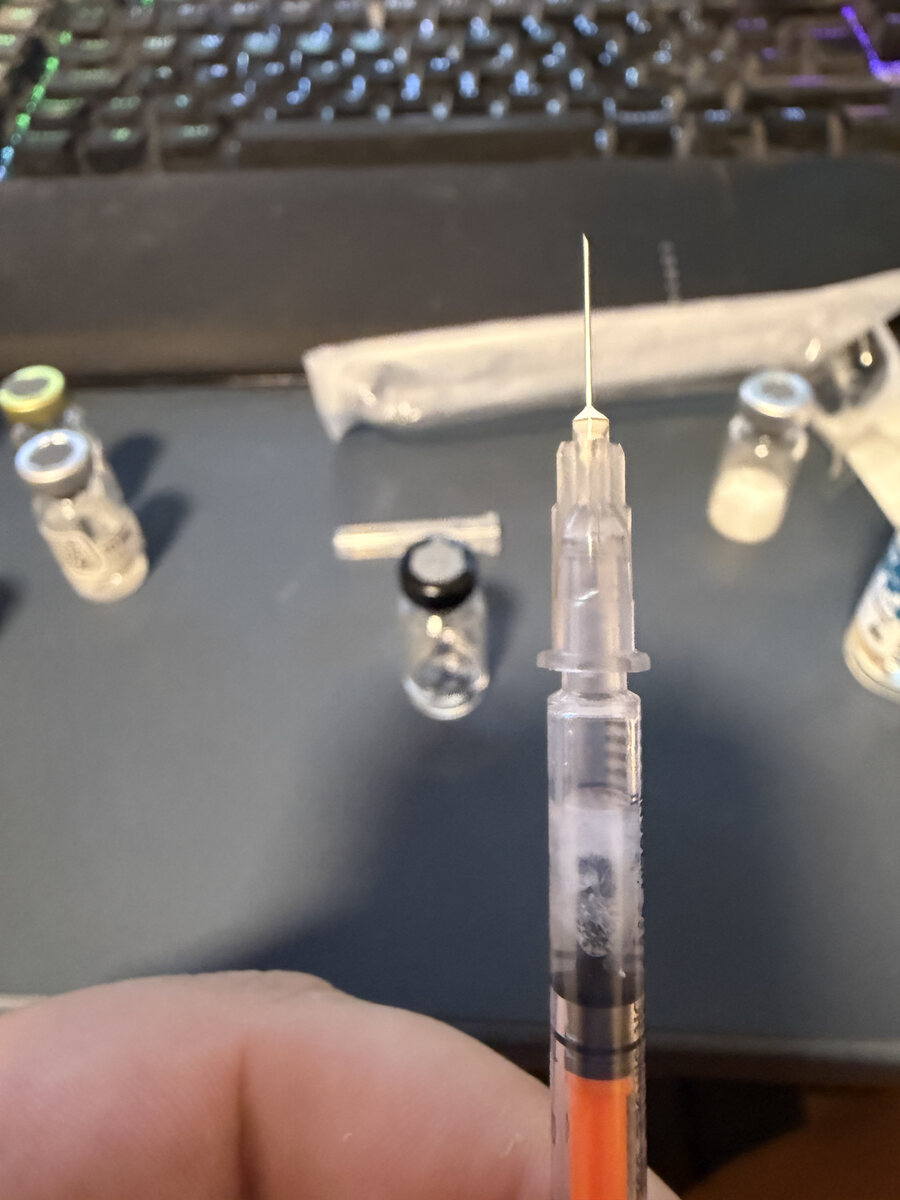
The trigger was most likely not the last compound added, but what was already in the barrel.
What actually happens in a crash
A peptide stays in solution because its molecules carry the same electrical charge and therefore repel each other. Without that charge they stick together, grow too large for the solution, and drop out.
The point at which a peptide's positive and negative charges exactly cancel is called the isoelectric point (pI). There the net charge is zero, the repulsion is gone, and that is precisely where any peptide is least soluble. As a rule of thumb, the closer the pH of the solution sits to the pI, the more likely the crash.
Two ways a mixture drifts toward the isoelectric point
The pH shifts. Research peptides essentially always arrive as lyophilised powder with no buffer. That is the decisive difference from a finished pharmaceutical, which contains a buffer system that pins the pH in place. A self-mixed solution is effectively unbuffered, so anything added shifts its pH immediately and without resistance. Synthetic peptides are also supplied by default as the TFA salt (trifluoroacetic acid from purification), less often as acetate. Both counterions are acidic, so several such solutions in one barrel drift toward the acidic side — where the GLP-1-type peptides have their pI.
The salt concentration rises. The second mechanism is salting out. Salt ions bind water molecules to themselves, and that water is no longer available for the hydration shell. Past a certain concentration too little is left and the peptide comes out of solution — independently of pH, and for lipidated peptides well documented.
Why lipidated peptides are the fragile link
Retatrutide, an investigational compound not approved as a medicine anywhere, is a lipidated peptide: a fatty-acid chain binds it to albumin and accounts for its long half-life. That chain also makes the molecules readily associate with one another, and its pI sits in the weakly acidic range, around 4.5 to 5.5 — close to where a mixture of acidic peptide solutions drifts. Published compatibility data for this compound does not exist; what is documented for lipidated peptides generally is that rising ionic strength lowers their solubility, which matches the reported pattern: precipitation is described where sodium chloride is present in the barrel and not where it is absent. Comparable behaviour is rarely described for the other lipidated GLP-1-class actives, which are prescription-only — a quirk of the molecule rather than a class effect.
That brings the case back into focus: the diluent is the most likely source of the salt. Preparations shipped with a 0.9% sodium chloride ampoule, whose formulation also carries buffer salts and mannitol, raise the ionic strength of everything they meet. Such preparations are typically prescription-only medicines, and for an approved medicine the manufacturer's product information is the governing document. Raised ionic strength plus a pH that has slid toward the isoelectric point is exactly the pairing under which the least robust molecule drops out. The compound that visibly crashed was probably fine; it was the most fragile molecule in an environment the others had created.
Why "in one syringe" is the hard question in the first place
Hospital pharmacy maintains extensive compatibility tables for whether two injectable solutions may share a syringe. They exist because the answer cannot be deduced: every combination is tested in the laboratory for turbidity, particles, pH shift and loss of potency.
For research peptides those tables do not exist. There is no published data on what one of these compounds does to another, in which order, at which concentration, in which diluent. A mixture in a syringe barrel is an experiment with a sample size of one.
And what is visible is only part of the picture. A crash with flakes is obvious; a pH shift that slowly degrades a peptide, or drives it into soluble aggregates, is not. A clear mixed syringe is not proof that everything is fine, merely the absence of proof to the contrary.
The second error class: concentrations that no longer add up
Chemistry is only half of what a shared barrel costs; the other half is bookkeeping. A unit marking on an insulin syringe stands for a volume, and a volume only stands for an amount of compound if the concentration behind it is known. Two solutions of different strengths in one barrel produce a mixture whose composition can no longer be read off the markings, and partial precipitation removes a further unknown share. Concentration confusion of this kind is its own error class, independent of pH, and the reason the arithmetic belongs per vial.
What a preparation in that state is worth
Nothing. Syringe and needle belong in the sharps container, not back into any vial. There are solid reasons behind that:
- The amount is no longer the amount that was calculated. What has flocculated is no longer dissolved, and how much compound remains in the liquid is unknown, so every number worked out beforehand is void.
- Particles do not belong in tissue. Precipitates from incompatibilities are a recognised source of particulate contamination in medicines safety; subcutaneously the consequences are usually local, from irritation to a granuloma, a palpable lump of foreign-body reaction.
- The needle can block. Solid flakes and the very fine bore of an insulin needle are a poor combination, and a partial blockage is not always obvious from the outside.
- Redissolved is not undone. Warmth or swirling may bring material visually back into solution, but appearance does not reveal whether the molecule is intact or now an aggregate. Aggregates are also the mechanism by which peptides can become immunogenic.
Three routes are sometimes taken and all make matters worse: emptying the barrel back into a vial carries the crash into the stock, flushing it through leaves the unknown quantity unknown, and a filter takes out the particles along with the compound.
The vials themselves are affected in the same way: one that is cloudy, flocculent or stringy is finished as well, and so is a clear vial with sediment that does not redissolve when swirled.
The convention that avoids the question
One peptide per syringe. That is the whole of it. Each point behind that convention is a mechanism rather than a preference:
- The diluent decides. Saline is described as the trigger for precipitation with lipidated GLP-1-type peptides, and anything reconstituted in it carries that ionic strength onward. The difference between the diluents is covered in bacteriostatic water vs sterile water.
- The weakest link sets the limit. The molecule with the smallest solubility margin decides whether a mixture holds.
- Turbidity is a timed observation. In compatibility testing a combination is assessed after a defined standing period, because haze can take minutes to develop; a mixture that looks clear in the first seconds has not been assessed at all.
- Shear forces and foam promote aggregation, which is why the procedure described for reconstitution is a gentle roll rather than a shake. How that is described in the pharmaceutical literature is covered in reconstituting peptides.
- Visual inspection has a standard. Checking a solution against a bright background for visible particulates is the pharmacopoeial check described in USP <790> and Ph. Eur. 2.9.20. Its verdict is binary: clear means clear, not nearly clear.
How a precipitate is recognised
| What is visible | What it means |
|---|---|
| White strands or streaks that move when the barrel is swirled | Precipitated peptide, preparation unusable |
| Milky haze that does not clear | Precipitation or aggregation, preparation unusable |
| Flakes collecting at the plunger or the bottom | Solid out of solution, preparation unusable |
| Fine bubbles rising and disappearing | Air, harmless |
| Light foam after vigorous swirling | Mechanical, settles again, aggregation still possible |
| Crystals after refrigeration that vanish at room temperature | Borderline, aggregation cannot be ruled out |
The simplest way to tell air from precipitate is time: bubbles rise and disappear, flakes stay and drift.
The calm part: the arithmetic
The neutral part of all this is the number on the syringe. Given the amount of compound in a vial and the volume of bacteriostatic water added, our calculator converts that into units — unit mathematics, not a recommendation to use anything. Tracking when a vial was reconstituted, and how long it stays within its described shelf life, is what the peptide tracker is for.
Common questions
What does it mean when a mixed peptide syringe turns cloudy?
Cloudiness, white strands or flakes mean peptide has come out of solution: a precipitate. That is a physical change in the preparation, not a cosmetic one.
Why do peptide solutions precipitate when they are combined?
Peptides stay dissolved because their molecules carry the same net charge and repel one another. Combining unbuffered solutions can shift the pH toward a peptide's isoelectric point, where that charge is zero, or raise the salt concentration until too little free water remains.
What is the isoelectric point of a peptide?
The isoelectric point, abbreviated pI, is the pH at which a peptide's positive and negative charges cancel out and the net charge is zero. Solubility is at its minimum there, so the closer a solution's pH sits to the pI, the more likely the peptide is to drop out.
Are there compatibility tables for combining peptide solutions?
Hospital pharmacy uses compatibility tables for licensed injectable solutions, built from laboratory testing for turbidity, particles, pH shift and loss of potency. Comparable data does not exist for research peptides, so the behaviour of a combination cannot be deduced.
Can a precipitate be redissolved or filtered out?
Warmth or gentle rolling can make a precipitate disappear visually, but appearance says nothing about whether the molecule is intact or has formed aggregates. Filtration removes the particles and with them an unknown share of the compound, so neither returns the preparation to a known state.
Does a clear mixed syringe mean the combination was compatible?
No. Visible precipitation is only the obvious failure mode, while a pH shift that slowly degrades a peptide or drives it into soluble aggregates leaves the liquid looking perfectly clear. The absence of turbidity is not evidence of compatibility.
Where these conventions come from
- USP General Chapters <790> and <1790> on visible particulates and visual inspection (https://www.usp.org).
- European Pharmacopoeia 2.9.20, Particulate contamination: visible particles, EDQM (https://www.edqm.eu).
- Trissel's Handbook on Injectable Drugs (ASHP), the standard compatibility reference.
- Reviews on peptide and protein solution stability (pH, ionic strength, aggregation), e.g. Manning et al., Pharmaceutical Research, 2010.
In short
A peptide crash is not a defect in the material, it is chemistry. As soon as the pH of an unbuffered solution slides toward the isoelectric point, or the salt concentration rises, the most fragile molecule loses its solubility and drops out.
A syringe with strands or clouds in it is a write-off, not filtered and not redissolved. The convention that stops the problem arising at all is mundane: one peptide per syringe.