
How to store peptides: powder, solution, fridge and freezer
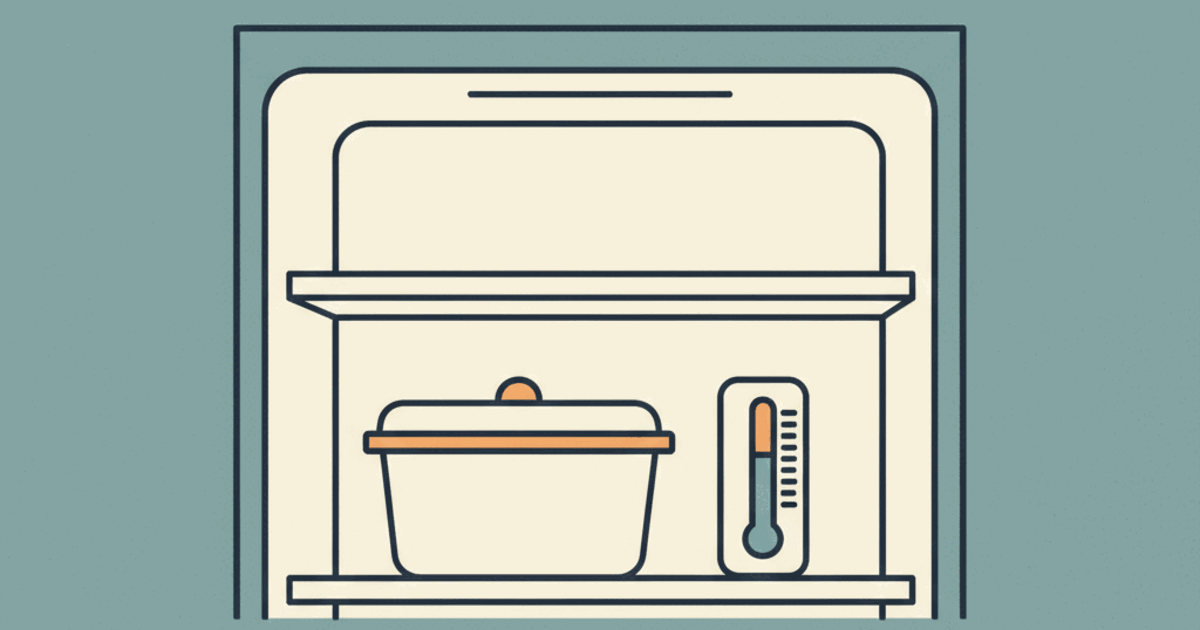
Peptides exist in two storage states that do not behave alike. A sealed lyophilised powder is a dry, glassy solid, kept dark at the temperature class its label names. Reconstituted, it sits in water, where hydrolysis, deamidation and oxidation run continuously, and the conventional conditions are 2–8 °C in the body of the refrigerator, dark, under a 28-day in-use limit.
Everything below is stability chemistry and compounding convention, not a product specification. Many substances people apply these conventions to are not approved as medicines or are prescription-only; where an approved medicinal product is involved, the storage statement and in-use shelf life printed on its own label and package leaflet take precedence over any general convention described here.
The two states, and why the distinction does the work
Almost every conflicting storage claim online comes from mixing the two states up. A freeze-dried cake is an amorphous solid: water, the reactant that hydrolysis and most deamidation routes need, has been removed by sublimation and secondary drying, and what remains is held in a glass whose molecules barely move. A reconstituted solution is the opposite situation, with the reactant now the solvent, present in vast excess, and molecular mobility unrestricted.
That single difference explains why a powder tolerates conditions that would be unthinkable for the same peptide in a vial of water, and why reconstitution is the moment the interesting clock starts.
Temperature classes as the pharmacopoeias define them
"Fridge", "cold" and "room temperature" are not casual words in pharmacy. Both major pharmacopoeias define them numerically, and a storage statement on a label refers to those definitions rather than to a household intuition.
| Standard | Term | Defined range |
|---|---|---|
| USP <659> | Freezer | −25 °C to −10 °C |
| USP <659> | Cold | any temperature not exceeding 8 °C |
| USP <659> | Cool | 8–15 °C |
| USP <659> | Refrigerator | 2–8 °C |
| USP <659> | Controlled cold temperature | 2–8 °C thermostatically, allowing excursions between 0 °C and 15 °C such that the calculated mean kinetic temperature is not more than 8 °C; transient spikes up to 25 °C only where the manufacturer so instructs and, absent supporting stability data, not beyond 24 h |
| USP <659> | Controlled room temperature | 20–25 °C |
| USP <659> | Warm | 30–40 °C |
| USP <659> | Excessive heat | above 40 °C |
| Ph. Eur. General Notices 1.2 | In a deep-freeze | below −15 °C |
| Ph. Eur. General Notices 1.2 | In a refrigerator | 2–8 °C |
| Ph. Eur. General Notices 1.2 | Cold or cool | 8–15 °C |
| Ph. Eur. General Notices 1.2 | Room temperature | 15–25 °C |
Two things fall out of the table. The refrigerator window is identical on both sides of the Atlantic, 2–8 °C, which is why that pair of numbers turns up in almost every cold-chain document. And "room temperature" is not the same term as "controlled room temperature": the European definition starts at 15 °C, the American one is a thermostatically maintained band of 20–25 °C. The 8–15 °C band is the sharper of the two splits: the European text treats it as a single class, cold or cool, while USP separates cold, meaning any temperature not exceeding 8 °C, from cool at 8–15 °C, so the same words on a label can carry a different lower bound depending on which pharmacopoeia it follows.
Why water is the problem
Peptide degradation is not one process. It is a family of reactions, and a storage decision is really a decision about which of them is being slowed down.
| Pathway | What happens | What it needs | What suppresses it | Reference |
|---|---|---|---|---|
| Hydrolysis | The peptide bond is cleaved | Water, catalysed by acid or base | Removal of water; pH control | Nugrahadi et al. 2023 (source 8) |
| Deamidation | Asn and Gln convert to Asp and isoAsp, often via a cyclic imide | Sequence context such as Asn-Gly or Asn-Ser; usually water | A pH range around 3–5; low moisture; low temperature | Nugrahadi et al. 2023 (source 8); Lai & Topp 1999 (source 10) |
| Oxidation | Met, Cys, His, Trp and Tyr are attacked | Oxygen, trace metal ions, or light | Darkness, reduced headspace oxygen, cold | Manning et al. 2010 (source 9); Akbarian & Chen 2022 (source 11) |
| Racemisation | An L residue converts to D | Alkaline pH, heat | Neutral to acidic pH, cold | Lai & Topp 1999 (source 10) |
| Disulfide exchange | Disulfide bonds scramble or dimerise | Alkaline pH, heat | pH control, cold | Manning et al. 2010 (source 9) |
| Beta-elimination | Disulfides and Ser residues break down | High temperature with alkaline pH | Cold, pH control | Manning et al. 2010 (source 9) |
| Aggregation and precipitation | The peptide leaves solution as particles | Concentration, interfaces, agitation, freezing | Low interfacial and mechanical stress; a single freeze-thaw history | Manning et al. 2010 (source 9); Akbarian & Chen 2022 (source 11) |
| Adsorption | The peptide binds to the container wall | Surfaces, with His and Arg residues prone to it | Container material chosen for the purpose | Akbarian & Chen 2022 (source 11) |
| Maillard reaction | The peptide reacts with a reducing sugar excipient | A reducing sugar, plus heat and moisture | Non-reducing sugar excipients, dryness | Lai & Topp 1999 (source 10) |
The pattern is hard to miss: water, heat, light, oxygen and pH extremes are the five levers, and storage practice is the act of pushing all five in the same direction at once. It is also why storage and reconstitution are not separable topics, since the choices made at reconstitution, above all which diluent is used, set the pH and preservative situation the solution then lives in.

Lyophilised powder: what freeze-drying changes
Lyophilisation, spelled lyophilization in American usage, is freezing followed by sublimation of the ice under vacuum and then a secondary drying step that pulls off the water still bound to the solid. The output is an amorphous cake rather than a crystal, and its stability rests on two numbers.
The first is residual moisture. Freeze-dried biologic formulations are typically specified below roughly 1 percent by weight, measured by Karl Fischer titration, because residual moisture lowers the formulation's glass transition temperature and compromises stability directly (sources 10 and 12).
The second is that glass transition temperature itself. As long as the formulation's glass transition temperature stays above the storage temperature, the cake remains a rigid glass and molecular mobility is minimal. If it drops below, the system shifts from glassy to rubbery, mobility rises, and the degradation reactions in the table above accelerate together.
The two numbers are linked, and that is why moisture is the central handling risk for a freeze-dried product. Water taken up from room air is not merely water added; it lowers the glass transition temperature, which can push the cake into the rubbery state at a temperature that was previously safe.
The same physics sits behind a piece of handling folklore. A container taken from a fridge or freezer has a surface far below the dew point of the room around it, so water condenses on it, and opening it while still cold gives that condensate somewhere to go. How much water appears depends only on the gap between the container's surface temperature and the dew point of the surrounding air, and in a sealed container that has equilibrated to room temperature that gap is gone. The condensation risk is a property of the temperature difference rather than of the container. It also explains why an intact stopper and crimp cap matter as much as the temperature does: they are the barrier keeping the atmosphere out, which makes the vial itself part of the storage system rather than mere packaging.
Reconstituted solution: two clocks at once
Once water is added, two independent clocks start, and confusing them is the single most common error in the storage material circulating online.
The chemical clock is the loss of intact peptide through the reactions above. It has no universal value. It depends on the sequence, the diluent, the pH, the concentration and the temperature, and the only trustworthy figures for it are the manufacturer's own stability data for that specific product.
The microbiological clock is entirely different: it counts from the first puncture of the closure, regardless of what is inside. Here a stated convention does exist. Under USP General Chapter <797>, a conventionally manufactured multiple-dose container is not used for more than 28 days after it is first entered, unless the manufacturer's labelling specifies otherwise. CDC injection safety guidance states the same rule in the same terms: once a multi-dose vial is punctured it is dated and discarded within 28 days unless the manufacturer states another date.
Two things about that 28-day figure are routinely misread. It applies to preserved multiple-dose containers and derives from the antimicrobial preservative doing its job, not from any measurement of how much peptide is left. And it is a ceiling rather than a promise: the point past which a container is not used, not an assurance that the contents are unchanged up to it.
The preservative is usually benzyl alcohol, which is what makes bacteriostatic water bacteriostatic and separates it from the sterile water that carries no preservative at all. Its US label is blunt about the limits of the arrangement: Bacteriostatic Water for Injection, USP states that reconstituted solutions of drugs for injection are not to be stored unless the manufacturer of the solute directs it. The diluent has its own two clocks as well, an unopened shelf life printed on its label and an in-use limit that starts at its own first puncture.
Keeping a drawn-up solution in a plastic syringe rather than in its glass vial is a separate question with a separate answer, covered in storing peptides in a syringe.
Freeze-thaw: what happens at the ice front
Freezing a reconstituted solution sounds like the logical extension of refrigerating it. Chemically it is not, and the biopharmaceutical freezing literature is consistent about why. Three distinct stresses appear during a freeze-thaw cycle: cold denaturation destabilises the folded state at low temperature; the growing ice front creates a large ice-liquid interface at which peptide adsorbs and partially unfolds; and cryoconcentration excludes solutes from the ice, concentrating peptide, salts and buffer in the shrinking liquid fraction and driving both concentration and pH away from where the formulation was designed to sit.
Slow and fast freezing merely trade one stress for another, slow freezing producing larger crystals and more cryoconcentration, fast freezing producing smaller crystals and far more interface. Neither route is free, which is why repeated freeze-thaw cycling is treated as a stress condition in stability programmes rather than as a storage mode.
Light, oxygen and the container
Light-induced oxidation targets the aromatic residues Trp, Tyr and Phe, and it does not require the solution to be warm: photo-oxidation proceeds directly through UVB absorption by those residues and indirectly through singlet oxygen generated by other chromophores present.
Every cold-chain document reaches the same practical conclusion, and the most detailed of them are written for vaccine storage rather than for peptides. The CDC vaccine storage and handling toolkit (source 6) has products stay in their original packaging with lids closed until use, precisely because that packaging protects from light as well as carrying identity and storage information, and has a product which must leave its packaging protected from light by a resealable opaque container. The reasoning is about light and the primary container rather than about the contents, which is what makes it transferable.
How long peptides last
There is no universal number, and any page that offers one is describing a single product's data as though it were a property of peptides. What can be stated is what each cited convention actually establishes.
| State | Location | Reported or conventional range | What that figure actually is | Source of the convention |
|---|---|---|---|---|
| Lyophilised powder, sealed | Freezer, −20 °C ± 5 °C | At least 12 months of real-time data before a retest period is set | A regulatory testing condition; re-test period is based on real-time data, with no accelerated equivalent | ICH Q1A(R2), section 2.1.7.3 |
| Lyophilised powder, sealed | Refrigerator, 5 °C ± 3 °C | 12 months long-term, 6 months at 25 °C/60 % RH as the accelerated arm | A regulatory testing condition, not a shelf life | ICH Q1A(R2), section 2.1.7.2 |
| Lyophilised powder, sealed | ICH long-term general case, 25 °C ± 2 °C / 60 % RH ± 5 % | 12 months long-term | The general-case long-term condition for substances not stored cold | ICH Q1A(R2), section 2.1.7.1 |
| Lyophilised powder, sealed | 40 °C/75 % RH | 6 months | A stress condition designed to force change, never a storage recommendation; 40 °C sits at the top of the USP <659> warm band of 30–40 °C, immediately below what the chapter calls excessive heat | ICH Q1A(R2), general case |
| Lyophilised powder, opened or humid environment | Any | Not statable | Moisture uptake lowers the glass transition temperature; the relevant limit becomes the glassy-to-rubbery threshold | Lai & Topp 1999 (source 10) |
| Reconstituted solution, preserved multiple-dose container | 2–8 °C after first puncture | Not more than 28 days, unless the manufacturer states another date | A microbiological in-use limit resting on the preservative, not a potency measurement | USP <797>; CDC injection safety |
| Reconstituted solution, no preservative or single-dose container | Any | Not statable from a general rule | The product's own labelling governs; the diluent label directs that reconstituted solutions are not stored unless the solute manufacturer says so | DailyMed, Bacteriostatic Water for Injection, USP |
| Reconstituted solution | Controlled room temperature | Not statable | Rates of hydrolysis and deamidation rise with temperature; the ranking is reliable, the number is not | Nugrahadi et al. 2023 (source 8) |
| Reconstituted solution | Freezer | Not a storage mode in general | Freeze-thaw introduces cold denaturation, ice-interface adsorption and cryoconcentration | Manning et al. 2010 (source 9); Maharjan et al. 2026 (source 12) |
| Unopened container of any kind | As labelled | The expiry date printed on the label | A manufacturer statement backed by that product's stability programme | Product labelling; see source 7 as an example |
The case that generates the most questions is the one the table above deliberately does not settle with a number, which is what happens to a preparation left out of the cold. The answer splits along the same line as everything else here: a sealed powder and a reconstituted solution are two different questions, and neither has a general tolerance figure.
Storage containers: what actually matters
The container question is usually asked as a product question and is answered here as a requirements question. Nearly every requirement worth stating already appears in cold-chain guidance, and none of them is about a particular product. The most detailed publicly available cold-chain requirements are written for vaccine storage, and the CDC toolkit is drawn on below for the general 2–8 °C practice it describes, not as guidance on peptides.
| Requirement | Why it matters | Reference point |
|---|---|---|
| Opaque or light-tight | Photo-oxidation attacks aromatic residues without any heat involved; where a product leaves its original packaging, guidance is to use a resealable opaque container | CDC vaccine storage and handling toolkit (source 6) |
| An insulating barrier between the containers and any coolant kept in the storage unit | A single exposure to freezing, meaning 0 °C or colder, can destroy the potency of a refrigerated product outright, and contact with a below-zero surface is enough to deliver it | CDC vaccine storage and handling toolkit (source 6) |
| Cushioned, rigid interior rather than loose stacking | The primary container is glass and its closure is the sterile barrier; a container whose protective cap is missing is discarded rather than assessed, because whether the seal has been breached is not something inspection settles | CDC vaccine storage and handling toolkit (source 6) |
| Room to circulate, not crowded | Crowding blocks cold air circulation and produces temperature fluctuation | CDC vaccine storage and handling toolkit (source 6) |
| A thermometer with the probe among the containers, display outside | A device near the wall, floor, vent, ceiling or door reads colder or warmer than the actual product temperature | CDC vaccine storage and handling toolkit (source 6) |
| Position in the main body of the fridge, a few centimetres clear of walls, ceiling, floor and door | Door shelves, crisper drawers and the area directly under cooling vents do not provide stable temperature or airflow | CDC vaccine storage and handling toolkit (source 6) |
| Original packaging retained | It carries identity, storage requirements and expiry, and it protects from light | CDC vaccine storage and handling toolkit (source 6) |
The most transferable point in that list is the negative one. A refrigerator door is the worst position in the appliance, because it is the part that swings into room air several times a day, and an opaque box in the body of the unit solves the light problem and the temperature-stability problem in one move.
Whether a substance may lawfully be possessed and used at all is a separate question from how it is kept, answered by the law of the country of residence rather than by any storage standard, and covered in are peptides legal.
What degradation looks like, and what appearance cannot establish
Visual inspection is a coarse instrument. It detects gross physical change and nothing else.
| Observation | Physical description | What it does not establish |
|---|---|---|
| Haze or cloudiness in a previously clear solution | Particles scattering light, from aggregation or precipitation | Nothing about the fraction of peptide still intact |
| Visible strands, flakes or sediment | A precipitate has formed | Whether it can be redissolved to a known state, which it cannot |
| Yellowing or other discolouration | Frequently associated with oxidation or Maillard chemistry | The identity or extent of the reaction |
| Collapsed, shrunken or melted-looking cake | Cake structure lost, commonly linked to moisture uptake or storage above the glass transition temperature | Whether the content is affected, which requires assay |
| Powder gone sticky or gummy | Moisture uptake; the amorphous solid has left the glassy state | How much moisture, which requires measurement |
| A clear, colourless solution | Nothing visible has changed | Degradation that leaves a solution clear is the normal case, not the exception |
The last row is the important one. Appearance is a one-way signal: a changed appearance is informative, an unchanged appearance is not. That asymmetry is why compounding practice does not treat visual inspection as a release test, and why a preparation whose appearance has changed is discarded rather than assessed. One related failure mode produces the same visual result for a different reason: combining two peptide solutions in one syringe can precipitate one of them on contact, which is a compatibility problem rather than a storage problem.
Labelling a container
Storage discipline collapses without dates. The variables that decide the two clocks above are the date a container was first punctured, the amount of diluent added and therefore the resulting concentration, and the batch identity, none of which is recoverable later from the container itself.
A short field list written on the container solves that, and what such a list deliberately omits matters as much as what it contains: the volume corresponding to a given amount depends on the syringe scale in use, so putting it on the vial invites exactly the confusion the label was meant to prevent. What such a field list contains, and what a manufacturer's own vial label already carries, is set out in peptide vials.
Common questions
How long do peptides last in the fridge?
No single figure applies, because the answer depends on the state the peptide is in. For a sealed lyophilised powder, 5 °C ± 3 °C is the refrigerated long-term stability testing condition in ICH Q1A(R2), and regulatory dossiers are built on at least twelve months of real-time data at it. For a reconstituted preserved multiple-dose container, the limiting number is usually not chemical at all but the in-use convention of 28 days after the first puncture.
Do peptides need to be refrigerated?
It depends on the state. A lyophilised powder is a dry solid in which water-driven degradation is largely suppressed, so it tolerates warmth far better than a solution, and freeze-dried substances exist with storage statements ranging from freezer to controlled room temperature. Once reconstituted, the peptide is in water, and refrigeration at 2–8 °C is the conventional way to slow hydrolysis, deamidation and oxidation. For an approved medicine, the storage statement on its own label governs.
How long do reconstituted peptides last?
There is no general shelf life for a reconstituted peptide solution, because it depends on the sequence, the diluent, the pH and the temperature. Two limits run at the same time: a chemical one, the gradual loss of intact molecule, and a microbiological one. For a conventionally manufactured multiple-dose container, USP General Chapter <797> and CDC injection safety guidance both place the second limit at 28 days after initial puncture unless the manufacturer specifies otherwise.
How long do peptides last in powder form?
Longer than in solution, because the main degradation routes need water and freeze-drying removes it. What is left is an amorphous glassy solid with low molecular mobility, in which the solid-state literature describes deamidation, oxidation, the Maillard reaction and aggregation as slow but not absent. Residual moisture, which the lyophilisation literature typically specifies below about 1 percent by weight, and a storage temperature below the formulation's glass transition temperature are the two variables that decide how slow.
How long do peptides last after reconstitution?
The clock that can be stated with a source is the microbiological one: a conventionally manufactured multiple-dose container is not used for more than 28 days after initial puncture unless the labelling says otherwise. The chemical clock has no universal value and comes from the manufacturer's own stability data for that product. The label of Bacteriostatic Water for Injection, USP is explicit on the point, stating that reconstituted solutions of drugs for injection are not stored unless the manufacturer of the solute directs it.
How to store lyophilized peptides?
The stability literature describes lyophilised peptides as kept sealed, dry, cold and dark: in the original closed container, protected from light, at the temperature class the manufacturer states. Two failure modes dominate. The first is moisture uptake, which lowers the glass transition temperature of the cake, so that storage above that temperature turns the amorphous solid from glassy to rubbery, raising molecular mobility and accelerating every reaction in it. The second is photo-oxidation, which attacks the aromatic residues Trp, Tyr and Phe without requiring any warmth, which is why the original opaque packaging matters as much as the temperature class.
Do lyophilized peptides need to be refrigerated?
Not universally. A lyophilised powder tolerates ambient temperature far better than the same peptide in water, which is the reason freeze-dried presentations exist, and ICH Q1A(R2) provides for substances whose long-term storage condition is 25 °C at 60 percent relative humidity alongside those stored refrigerated or frozen. Which class applies to a particular product is a property of that product and is stated on its label rather than derivable from a general rule about peptides.
How long does a peptide vial last?
As a storage question the vial's clock starts at the first puncture, not at the first use of its contents, and it is measured in time rather than in the number of withdrawals. For a conventionally manufactured multiple-dose container the convention is not more than 28 days after initial entry unless the manufacturer states another date. An unopened vial is governed instead by the expiry date printed on its label.
Sources
- USP General Chapter <659>, Packaging and Storage Requirements, USP–NF, Temperature and Storage Definitions (freezer, refrigerator, cold, cool, controlled cold temperature, controlled room temperature; beyond-use date of 28 days for an entered multiple-dose container): https://doi.usp.org/USPNF/USPNF_M2773_06_01.html — chapter text as published by USP: https://www.usp.org/sites/default/files/usp/document/our-impact/covid-19/uspnf-standards-vaccine-handling.pdf
- European Pharmacopoeia, General Notices 1.2, temperature terms (deep-freeze, refrigerator, cold or cool, room temperature), EDQM: https://www.edqm.eu/en/european-pharmacopoeia
- USP General Chapter <797>, Pharmaceutical Compounding – Sterile Preparations (beyond-use dates; multiple-dose containers not used beyond 28 days after initial puncture unless otherwise specified): https://www.usp.org/compounding/general-chapter-797
- ICH Q1A(R2), Stability Testing of New Drug Substances and Products, FDA Guidance for Industry, November 2003 (storage conditions for the general case, refrigerated and frozen substances): https://www.fda.gov/media/71707/download
- Centers for Disease Control and Prevention, Injection Safety – Safe Injection Practices (multi-dose vials dated and discarded within 28 days of puncture unless the manufacturer states another date): https://www.cdc.gov/injection-safety/hcp/clinical-safety/index.html
- Centers for Disease Control and Prevention, Vaccine Storage and Handling Toolkit (unit placement, door shelves and drawers, probe placement, loss of potency from a single freezing exposure, protective caps, opaque containers, original packaging): https://www.cdc.gov/vaccines/hcp/downloads/storage-handling-toolkit.pdf
- DailyMed, Bacteriostatic Water for Injection, USP – FDA label (0.9 % benzyl alcohol, multiple-dose container, storage at 20–25 °C, "do not store reconstituted solutions of drugs for injection unless otherwise directed by the manufacturer of the solute"): https://dailymed.nlm.nih.gov/dailymed/lookup.cfm?setid=87d6e9dc-fe3b-4593-ac9a-d7493d1959c7
- Nugrahadi PP, Hinrichs WLJ, Frijlink HW, Schoneich C, Avanti C. Designing formulation strategies for enhanced stability of therapeutic peptides in aqueous solutions: a review. Pharmaceutics. 2023;15(3):935: https://doi.org/10.3390/pharmaceutics15030935
- Manning MC, Chou DK, Murphy BM, Payne RW, Katayama DS. Stability of protein pharmaceuticals: an update. Pharmaceutical Research. 2010;27(4):544–575: https://doi.org/10.1007/s11095-009-0045-6
- Lai MC, Topp EM. Solid-state chemical stability of proteins and peptides. Journal of Pharmaceutical Sciences. 1999;88(5):489–500: https://doi.org/10.1021/js980374e
- Akbarian M, Chen SH. Instability challenges and stabilization strategies of pharmaceutical proteins. Pharmaceutics. 2022;14(11):2533: https://doi.org/10.3390/pharmaceutics14112533
- Maharjan R, Shin CY, Lee SK, et al. Stabilization strategies and advancements in lyophilization to preserve integrity and efficacy of next-generation biologicals. International Journal of Pharmaceutics: X. 2026;11:100575: https://doi.org/10.1016/j.ijpx.2026.100575
Every figure above is a stability convention or a testing condition drawn from the cited standards and literature, and none of it is a statement about the quality, potency or fitness of any particular preparation. Where a product is an approved medicine, its own label and package leaflet carry the storage statement and the in-use shelf life that apply to it; questions about a specific preparation belong with a licensed pharmacist or physician.