
Syringe sizes for peptides: 0.3, 0.5 and 1 mL insulin syringes explained
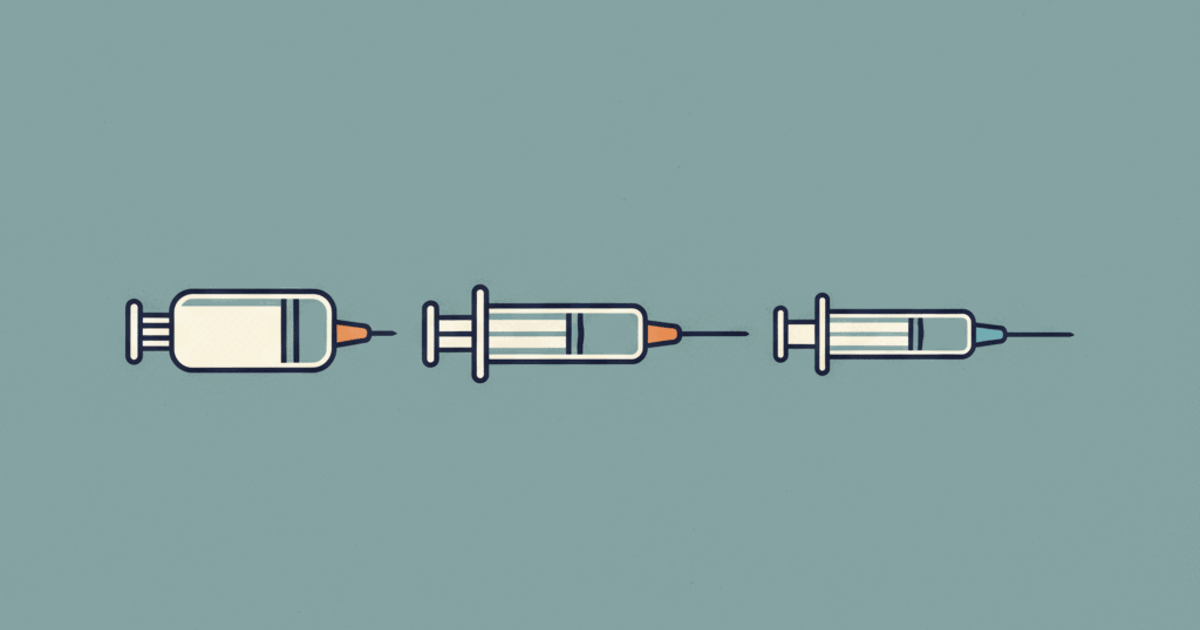
Insulin syringes come in three barrel sizes, 0.3, 0.5 and 1 mL, holding 30, 50 and 100 units on a U-100 scale, where one unit is 0.01 mL. These are the barrels described alongside reconstituted peptide solutions; what differs between them is the spacing of the divisions and how much liquid the tip and needle retain, not what a unit means.
Why there are three barrel sizes
A syringe scale is a ruler printed on a cylinder. The barrels are roughly the same length whichever capacity is chosen, so what differs is the number of divisions squeezed onto that length: a 0.3 mL barrel spreads 30 unit marks over it, a 1 mL barrel spreads 100. The volume behind one mark is identical, the distance between two marks is not. That geometry is the whole reason more than one size exists, and it is why half-unit graduations appear on the smallest barrels and not on the largest: there is simply room to print them.
| Barrel (nominal capacity) | Scale span on a U-100 barrel (units) | Volume behind one unit | Smallest printed graduation | Source |
|---|---|---|---|---|
| 0.3 mL | 30 | 0.01 mL | 0.5 unit = 0.005 mL | ISO 8537:2016, Annex H (graduation and numbering increments for U-40 and U-100 syringes); Frohnert & Alonso, Diabetes Technol Ther 2015 (half-unit graduation) |
| 0.5 mL | 50 | 0.01 mL | 0.5 unit = 0.005 mL, where a half-unit version is offered; otherwise 1 unit = 0.01 mL | ISO 8537:2016, Annex H; Frohnert & Alonso, Diabetes Technol Ther 2015 (half-unit graduation) |
| 1 mL | 100 | 0.01 mL | 1 unit = 0.01 mL | ISO 8537:2016, Annex H (graduation and numbering increments for U-40 and U-100 syringes) |
Half-unit graduation is a property of the small barrels only. A paper in Diabetes Technology and Therapeutics on the delivery of smaller insulin doses describes half-unit syringes as the finer-graduated option available at the low end of the range, alongside 1 mL barrels graduated in whole units.
Insulin syringes carry a unit scale rather than a millilitre scale, and ISO 8537, the standard for these devices, covers both the 40 units per millilitre (U-40) and the 100 units per millilitre (U-100) concentration scales, requiring that an individual syringe be graduated and labelled for a single concentration only. The unit is a volume marking tied to an assumed concentration, nothing more. The arithmetic behind that assumption sits in milligrams, millilitres and IU, and what the printed scales mean, including why a U-40 and a U-100 scale cannot be read against each other, is set out in reading a U-100 insulin syringe.
What the accuracy tolerance actually promises
The number printed beside a mark is a nominal figure, and the relevant standard says how far the real volume may deviate from it. ISO 7886-1:2017 covers general-purpose sterile single-use hypodermic syringes for manual use and excludes syringes for use with insulin, which fall under ISO 8537. Its tolerance rule, set out in Clause 8 and Table 1, therefore describes the larger transfer barrel; the insulin barrels carry their tolerances through ISO 8537, whose Table H.1 gives the tolerances on graduated capacity. Either way the tolerance is defined against the barrel's nominal capacity, not against the volume being read.
| Volume being measured | Tolerance permitted by ISO 7886-1:2017 | Worked example on a 3 mL barrel | Source |
|---|---|---|---|
| Below half the nominal capacity | ±(1.5% of nominal capacity + 2% of the expelled volume) | 1 mL reading: ±(1.5% × 3 mL + 2% × 1 mL) = ±0.065 mL | ISO 7886-1:2017, Clause 8, Table 1, EXAMPLE 1 |
| At or above half the nominal capacity | ±5% of the expelled volume | 2 mL reading: ±(5% × 2 mL) = ±0.100 mL | ISO 7886-1:2017, Clause 8, Table 1, EXAMPLE 2 |
The consequence is easy to miss. On that 3 mL barrel the permitted error at the 1 mL mark is 0.065 mL, which is 6.5 percent of the reading, while at the 2 mL mark it is 0.100 mL, or 5.0 percent of the reading. The absolute error grows with capacity; the relative error grows as the reading gets smaller. Table 1 of the same edition bands its other requirements by nominal-capacity class in the same way: for a barrel below 2 mL it sets a maximum dead space of 0.07 mL and a scale interval to be numbered of 0.1 mL.
Measurement research points the same way. A study in Hospital Pharmacy tested 1, 3, 5, 10 and 20 mL syringes gravimetrically at 5, 10 and 20 percent fill volumes and found mean percent errors from 1.4 to 18.6 percent, against a manufacturer claim of ±5 percent. The authors reported an increased likelihood of unacceptable error, above 5 percent, whenever less than 20 percent of a syringe's labelled capacity was measured, and described selecting the syringe whose capacity sits closest to the volume in question.
Gauge numbers, and why they run backwards
Needle tubing is labelled with a gauge number, and the scale is counter-intuitive because it is not a measurement at all. The number is an inherited label from 19th-century wire manufacture, where it counted drawing steps rather than stating a diameter, and the increments came from tooling and production constraints rather than from a formula, which is why the steps are uneven and why a larger number means a thinner tube. Needles described in the context of peptide reconstitution are ordinary hypodermic needles, and the gauge designation says nothing about the liquid in the barrel.
Modern practice keeps the label and adds a metric designation. ISO 9626 covers rigid stainless steel needle tubing for the manufacture of medical devices and designates a tube by its nominal outer diameter in millimetres, the corresponding gauge size, and the wall thickness, with a tolerance band around each nominal size. For the 0.33 mm size, the 29-gauge designation, that band runs from 0.324 to 0.351 mm.
| Gauge designation | Nominal outer diameter (mm) | Source |
|---|---|---|
| 18 G | 1.20 | ISO 9626:2016, Table 1 |
| 19 G | 1.10 | ISO 9626:2016, Table 1 |
| 20 G | 0.90 | ISO 9626:2016, Table 1 |
| 21 G | 0.80 | ISO 9626:2016, Table 1 |
| 22 G | 0.70 | ISO 9626:2016, Table 1 |
| 23 G | 0.60 | ISO 9626:2016, Table 1 |
| 24 G | 0.55 | ISO 9626:2016, Table 1 |
| 25 G | 0.50 | ISO 9626:2016, Table 1 |
| 26 G | 0.45 | ISO 9626:2016, Table 1 |
| 27 G | 0.40 | ISO 9626:2016, Table 1 |
| 28 G | 0.36 | ISO 9626:2016, Table 1 |
| 29 G | 0.33 | ISO 9626:2016, Table 1 |
| 30 G | 0.30 | ISO 9626:2016, Table 1 |
| 31 G | 0.25 | ISO 9626:2016, Table 1 |
Nominal metric sizes as designated in ISO 9626:2016. The standard places a tolerance band around each nominal figure and specifies minimum inside diameters separately for regular, thin, extra-thin and ultra-thin walls, so the bore does not follow from the gauge number alone.
Inner diameter is the figure that governs how fast liquid moves through the lumen, and it is not fixed by the gauge alone. ISO 6009, the colour-coding standard, applies to regular-walled, thin-walled, extra-thin-walled and ultra-thin-walled needles, so two tubes carrying the same gauge number can have different bores. That standard also establishes the colour code used to identify needles of designated metric sizes from 0.18 mm (34 G) up to 3.4 mm (10 G), with the colour references given in an annex. The coloured hub is a size label, not a quality mark.
Insulin syringes sit at the thin end of that range: a review in Clinical Diabetes records insulin syringe needle gauges of 28 to 31, with 31 the finest.

Needle length as a device specification
Length is the second dimension on the label, and like gauge it is a device specification rather than a judgement. The same Clinical Diabetes review lists insulin syringe needle lengths of 5, 6, 8 and 12.7 mm. Across hypodermic needles generally, nursing references give a range from about 1/8 inch (roughly 3 mm) to 3 inches (roughly 76 mm). ISO 7864 governs the finished needle, covering designated metric sizes from 0.18 mm to 1.2 mm and specifying the hub, sheath, tube, point, size designation, colour coding, performance, packaging and labelling.
Which length is appropriate in a given clinical situation is not a question a general reference page can answer: it depends on the approved product, its label and the person administering it. Injections belong in trained hands.
Fixed needle or detachable: dead space in numbers
Not everything drawn into a barrel comes back out. Dead space is the liquid retained when the plunger is fully depressed, and it sits in three places: the needle lumen, the needle hub, and the tip of the barrel between the plunger face and the nozzle.
The design decides how much, and what settles it is where the needle ends. A tube seated on an external nozzle leaves the residue spread across three cavities – the barrel tip, the inside of the hub, and the lumen. A bonded needle that runs through the nozzle down to the base of the barrel leaves only the lumen to hold anything. Zule and Bobashev measured both arrangements in 2009, and the gap between them is large.
| Configuration | Where the residue sits | Retained volume, plunger fully depressed | Same volume on a U-100 scale | Source |
|---|---|---|---|---|
| 1 mL insulin syringe, 28 G needle permanently attached | Needle lumen | approx. 2 µL | approx. 0.2 units | Zule & Bobashev 2009 |
| 1 mL insulin syringe, detachable 26 G, 12.7 mm needle | Syringe tip, needle hub, needle lumen | approx. 84 µL | approx. 8.4 units | Zule & Bobashev 2009 |
| General hypodermic barrel below 2 mL nominal capacity, specified maximum | Measured on the syringe per the standard's method, that is without a detachable needle's hub and lumen | max. 0.07 mL | 7 units | ISO 7886-1:2017, Table 1 |
The figures come from that published comparison of high and low dead-space syringe designs (Zule and Bobashev, 2009). The two rows are not measured the same way: the published 84 µL figure includes the hub and the lumen of a detachable needle and therefore sits above the barrel-only limit the standard sets, since ISO 7886-1:2017 measures dead space on the syringe itself. The volume arithmetic transfers regardless: 84 µL is 0.084 mL, and 0.084 mL is 8.4 units on a U-100 barrel. Against a 30-unit fill that residue is more than a quarter of the barrel content; against a 100-unit fill it is under a tenth. Dead space is a fixed volume, so its weight depends on how much was drawn in the first place. The same effect appears in the pen format, where liquid stays behind in the cartridge and the pen needle, compared in syringe versus pen and peptide pens.
What a reconstitution syringe is
"Reconstitution syringe" is not a separate product category. It is a description of a role: the syringe used to move diluent into a vial of lyophilised peptide material, as distinct from the syringe used to read a measured fraction back out.
The separation follows from the tolerance rules above. Transferring one or several millilitres and reading a few hundredths of a millilitre are different measuring problems, and syringe accuracy is specified relative to nominal capacity, so the container that suits one is a poor instrument for the other. The compounding literature accordingly describes matching syringe capacity to the volume being measured; for the diluent transfer it describes a larger barrel with a detachable, threaded (Luer-lock) needle connection. Nursing references describe the Luer-lock design as the one whose hub threads provide a secure connection for needles, tubing or other devices.
Sterile compounding practice in the United States is governed by USP General Chapter <797>, which became official on 1 November 2023 and sets out personnel, facility, environmental and preparation requirements for compounded sterile preparations. Aseptic technique itself is assigned to those compounding rules of pharmaceutical practice and is not the subject of this device overview.
Filtration is a separate question with its own device constraints, covered in filtering peptides, and what happens to a solution left sitting in a barrel is covered in storing peptides in a syringe.
The standards behind the parts
Five documents cover most of what is printed on a syringe or needle package.
| Standard | What it specifies |
|---|---|
| ISO 7886-1:2017 | Sterile single-use hypodermic syringes for manual use: cleanliness, acidity and alkalinity limits, extractable metals, lubricant, graduated scale, tolerance on graduated capacity, maximum dead space, barrel, piston and plunger assembly, nozzle, performance, packaging, labelling; excludes insulin syringes, see ISO 8537 |
| ISO 8537 | Empty sterile single-use syringes, with or without needle, made of plastic and intended solely for the injection of insulin; covers U-40 and U-100 graduation, with tolerances on graduated capacity per Table H.1 |
| ISO 7864 | Sterile single-use hypodermic needles of designated metric sizes 0.18 mm to 1.2 mm: nomenclature, size designation, colour coding, hub, sheath, tube, point, performance, packaging, labelling |
| ISO 9626 | Rigid stainless steel needle tubing for the manufacture of medical devices: designation by nominal outer diameter, gauge and wall thickness, plus stiffness, breakage resistance and corrosion testing |
| ISO 6009 | Colour coding for identification of single-use hypodermic needles, metric sizes 0.18 mm (34 G) to 3.4 mm (10 G), for regular, thin, extra-thin and ultra-thin walls |
One further note from ISO 8537: syringes covered by that standard are intended for use soon after filling and are described as unsuitable for holding insulin over extended periods. The barrel is a measuring and delivery device, not a storage container.
Common questions
What does a gauge number mean?
A gauge number is a size label for needle tubing, inherited from 19th-century wire manufacture, where the number counted drawing steps rather than stating a diameter. It runs backwards: the higher the number, the thinner the tube. ISO 9626 keeps the inherited label but ties it to a metric designation, giving the nominal outer diameter in millimetres together with the gauge number and the wall thickness, so 31 gauge is designated 0.25 mm and 18 gauge 1.20 mm.
Is a higher gauge number a thicker or a thinner needle?
Thinner. The gauge scale runs in the opposite direction to the diameter, so 30-gauge tubing is thinner than 25-gauge, which is thinner again than 21-gauge. Nursing references state the rule plainly: the larger the diameter of a needle, the smaller the gauge number.
What is dead space in a syringe?
Dead space is the liquid that stays behind once the plunger is fully depressed, held in the needle lumen, in the needle hub and in the tip of the barrel. A peer-reviewed measurement of high and low dead-space syringe designs (2009) reports roughly 2 microlitres for a 1 mL insulin syringe with a permanently attached 28-gauge needle, and roughly 84 microlitres for a comparable barrel with a detachable 26-gauge needle. On a U-100 scale, 84 microlitres is 8.4 units.
Can a 1 mL syringe be read at small volumes?
It can be read, but the permitted error is defined against the barrel's nominal capacity, not against the volume sitting in it. In the general hypodermic standard ISO 7886-1 the rule reads plus or minus 1.5 percent of nominal capacity plus 2 percent of the expelled volume below half capacity; insulin barrels follow the equivalent table in ISO 8537. Either way a small reading in a large barrel carries a proportionally larger permitted error. A study in Hospital Pharmacy found an increased likelihood of error above 5 percent when less than 20 percent of a syringe's labelled capacity was measured.
Why are two syringe types described for reconstitution?
Because two different measuring tasks are involved. Moving a diluent volume of one or several millilitres into a vial and withdrawing a fraction of a millilitre sit at opposite ends of a scale, and syringe accuracy is specified relative to nominal capacity. The compounding literature therefore describes selecting the syringe whose capacity is closest to the volume being measured, which is why a larger transfer syringe with a detachable needle is described alongside a small graduated barrel.
What is the difference between a Luer-lock and a Luer-slip syringe?
Both are nozzle designs for attaching a needle or another device. A Luer-lock nozzle carries threads in the hub that screw the connection tight, while a Luer-slip nozzle relies on a friction fit over a tapered tip. Nursing references describe the threaded version as the secure connection. Insulin syringes frequently sidestep the question by having the needle permanently bonded to the barrel.
Sources
- ISO 7886-1:2017, Sterile hypodermic syringes for single use – Part 1: Syringes for manual use. International Organization for Standardization. https://www.iso.org/standard/64790.html
- ISO 8537:2016, Sterile single-use syringes, with or without needle, for insulin. International Organization for Standardization. https://www.iso.org/standard/60510.html
- ISO 7864:2016, Sterile hypodermic needles for single use – Requirements and test methods. International Organization for Standardization. https://www.iso.org/standard/60481.html
- ISO 9626:2016, Stainless steel needle tubing for the manufacture of medical devices – Requirements and test methods. International Organization for Standardization. https://www.iso.org/standard/60480.html
- ISO 6009:2016, Hypodermic needles for single use – Colour coding for identification. International Organization for Standardization. https://www.iso.org/standard/63277.html
- Jordan MA, Choksi D, Lombard K, Patton LR. Development of Guidelines for Accurate Measurement of Small Volume Parenteral Products Using Syringes. Hospital Pharmacy. 2021;56(3):165–171. https://pubmed.ncbi.nlm.nih.gov/34024924/
- Zule WA, Bobashev G. High dead-space syringes and the risk of HIV and HCV infection among injecting drug users. Drug and Alcohol Dependence. 2009;100(3):204–213. https://pmc.ncbi.nlm.nih.gov/articles/PMC2654245/
- McKee AM, Yancey AM, Zhang RM, McGill JB. The Nuances Surrounding Insulin Prescribing. Clinical Diabetes. 2023;41(3):411–419. https://pmc.ncbi.nlm.nih.gov/articles/PMC10338272/
- Frohnert BI, Alonso GT. Challenges in Delivering Smaller Doses of Insulin. Diabetes Technology and Therapeutics. 2015;17(9):597–599. https://pmc.ncbi.nlm.nih.gov/articles/PMC4939443/
- Administration of Parenteral Medications. In: Nursing Skills (2nd edition), Open Resources for Nursing. NCBI Bookshelf NBK593214. https://www.ncbi.nlm.nih.gov/books/NBK593214/
- USP General Chapter <797>, Pharmaceutical Compounding – Sterile Preparations. United States Pharmacopeia. https://www.usp.org/compounding/general-chapter-797
Everything above describes devices and the standards that define them. Where an approved medicinal product is involved, the diluent, the volume and the equipment are set by that product's own label and by the professionals who prepare and administer it, and nothing on this page substitutes for either.