
TB-500 vs TB-4: differences, evidence and safety
Answer first
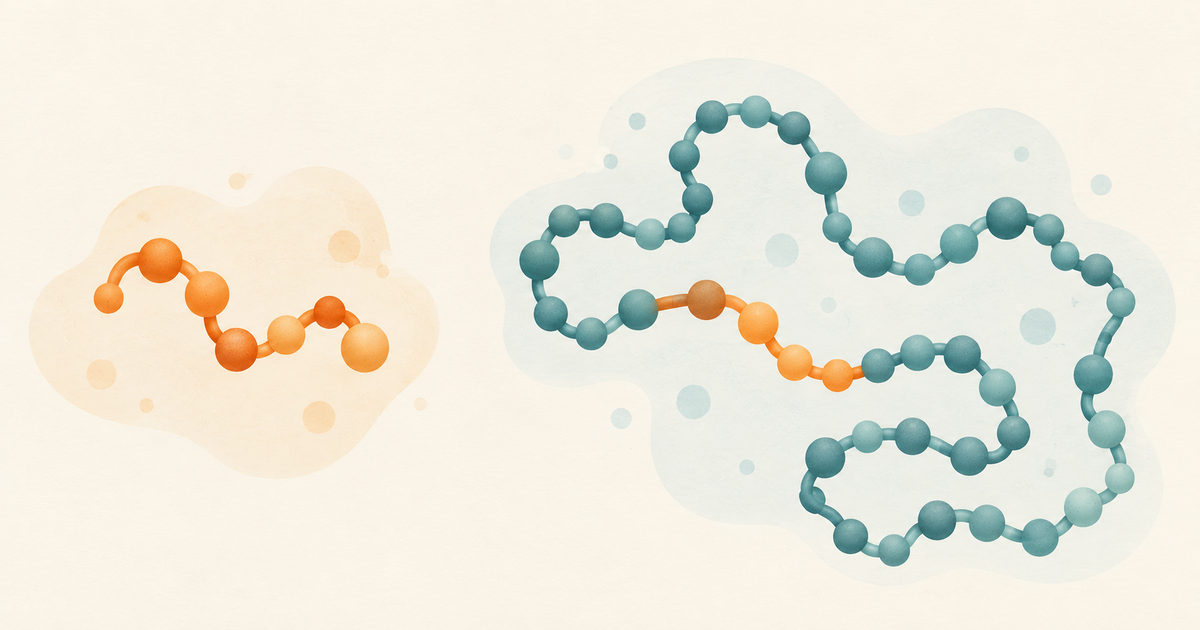
TB-500 here means the synthetic seven-amino-acid fragment Ac-LKKTETQ; TB-4 means full-length thymosin beta-4, with 43 amino acids. Human trials of TB-4 do not establish effects or safety for TB-500. The shared sequence explains their relationship, but not interchangeability. Neither the available clinical results nor the reviewed sources establish which is better or safer.
At a glance
How they differ
The most important difference comes before any discussion of healing: the names can refer to different molecules. TB-500 is defined here by its sequence, Ac-LKKTETQ. TB-4, also written Tβ4 or thymosin beta-4, is the complete peptide. This distinction determines which studies belong to each substance [1], [2].
In an analytical study, researchers identified the acetylated fragment in material labelled TB-500. Its seven amino acids match positions 17–23 within the complete peptide. The prefix Ac describes a chemical group attached to the fragment's beginning. This study identified the material; it did not test whether the material improved human health [1].
TB-4 has 43 amino acids. Its central region participates in binding actin, a protein that helps cells maintain their shape and move. Research on different parts of TB-4 links different sequences to different biological activities. A short fragment cannot simply be assigned everything reported for the whole peptide [2].
The actin-related sequence explains why the fragment attracted interest. It does not establish identical binding, distribution through the body or effects in tissue. A molecule containing a relevant sequence remains a different test substance when other regions are missing or its chemical ends have changed [1], [2].
This also explains why “synthetic thymosin beta-4” is an incomplete description. Full-length TB-4 can be made synthetically, just as a shorter fragment can. The word synthetic describes production, not the number or arrangement of amino acids. The published methods and molecular identity matter more than a shortened name [1].
There are several separate questions behind a claim about this peptide family:
- Which sequence was actually tested, and were its ends chemically modified?
- Was the experiment conducted in cells, animals or people?
- Was the preparation applied to the eye or skin, or delivered into the bloodstream?
- What outcome did the researchers measure, and did the planned comparison support their conclusion?
Those details are necessary to connect a result to the substance in question. Similar names do not remove differences between preparations. Even a result obtained with full-length TB-4 in an eye study remains a result about that formulation and setting, not a general finding about tissue recovery throughout the body.
What the studies show
Direct comparisons and the limits of fragment research
Animal comparison A published mouse study tested full-length TB-4 and a synthetic peptide containing its actin-binding region. The short peptide was unacetylated LKKTETQ. The study reported wound-repair findings for both. That is relevant evidence about the domain, but the short peptide should not automatically be equated with the acetylated Ac-LKKTETQ used here to define TB-500 [3].
No human study directly comparing chemically identified Ac-LKKTETQ with full-length TB-4 could be found in the sources reviewed for this page. The FDA states that it has not identified human exposure data for drug products containing the thymosin beta-4 fragment. These are limits of the available record, not proof that unreported use has never occurred [4].
The FDA’s 2026 review notes that websites sometimes use TB-500 and thymosin beta-4 interchangeably. This naming problem makes the molecular definition essential. Applying another label to a study of the complete peptide does not turn it into evidence for the fragment [4].
The older mouse experiment therefore cannot establish clinical equivalence. A skin wound in an animal also differs from a human tendon injury or an eye disorder. Establishing a biological effect in one experimental setting does not establish the size, reliability or safety of an effect in another setting [3].
What the identified TB-500 fragment has shown
Laboratory and animal data A metabolism study examined TB-500 in human serum, enzyme systems and rats. In its cell-based wound-closure experiment, the metabolite Ac-LKKTE showed a significant effect, while the parent TB-500 did not. The authors proposed that a breakdown product might explain some earlier claims [5].
Human serum in a laboratory does not make an experiment a human clinical trial. The study helps identify what happens to the molecule under the tested conditions. It does not establish treatment effects, adverse-event rates or how long a useful effect would last in people [5].
The result also cautions against describing the fragment as a proven “active part”. A region can be biologically interesting without every isolated, modified or degraded version having the same activity. The parent fragment and its metabolites need to be distinguished when discussing that experiment [2], [5].
Full-length TB-4 in healthy volunteers
Phase 1 A placebo-controlled study enrolled 40 healthy volunteers and examined intravenous synthetic TB-4, including repeated exposure over 14 days. Reported adverse events were infrequent and mild or moderate. The investigators reported no serious adverse events or toxicity that limited the studied exposure [6].
This provides human tolerability information for that full-length preparation. It is not a clinical safety study of the seven-amino-acid fragment. Healthy volunteers, short observation and controlled manufacturing also limit what the result says about long-term use or products sold under similar names [6].
Full-length TB-4 in dry-eye trials
Phase 3 ARISE-2 enrolled 601 participants, while ARISE-3 enrolled 700. Both evaluated the ophthalmic full-length TB-4 preparation RGN-259. Neither trial met its prespecified primary outcomes. Those main outcomes assessed eye discomfort and corneal staining, a measure of damage to the eye's surface [7], [8].
These results belong in any account of the clinical evidence. A later analysis of selected symptoms, time points or participant groups does not replace the main questions specified for the trial. Equally, a missed study endpoint does not prove that every biological action proposed for TB-4 is absent [7], [8].
The studies investigated eye drops, not an injected TB-500 fragment. Their participants, formulation and measured outcomes do not support a claim about general recovery or sports injuries. Transferring a trial citation between the two molecules would conceal all of those differences [7], [8].
Full-length TB-4 in neurotrophic keratopathy
Phase 3 Another RGN-259 study enrolled 18 people with neurotrophic keratopathy, a disorder involving impaired corneal nerves and persistent surface damage. On day 29 complete healing occurred in 6 of 10 participants receiving the active preparation, compared with 1 of 8 receiving placebo [9].
The prespecified primary statistical test did not reach significance: p = 0.0656. That distinction matters even though the observed proportions looked different. A small trial with an uncertain main result does not establish a reliable clinical benefit, and secondary findings should be described separately [9].
Across these studies, the populations, routes, durations and outcomes differ. They cannot be combined into a ranking between TB-500 and TB-4. The accurate comparison concerns the kind of evidence available: clinical research on specific full-length preparations, and a much more limited record for the identified fragment [4], [5], [6], [7], [8], [9].
Safety and remaining uncertainties
The FDA identifies potential immune-reaction risks for compounded preparations containing the fragment. It links these concerns to aggregation, where peptide molecules clump together, and to peptide-related impurities. The agency also states that important information needed to assess harm in humans is missing [4].
This does not provide a measured rate of side effects. It explains why an absence of published patient data cannot be presented as reassuring safety evidence. Statements such as “well tolerated in a clinical trial” must name the tested molecule and preparation [4], [6].
The FDA review also describes two consumer reports concerning mixtures labelled TB-500 and BPC-157. These lacked safety assessments. They are not clinical studies and cannot establish a side-effect rate or attribute an effect to the chemically identified TB-500 fragment [4].
Full-length TB-4 has short-term human safety observations, including the healthy-volunteer study. Those observations cannot quantify uncommon or delayed risks, nor do they establish safety for pregnancy, childhood or prolonged unsupervised exposure. They also cannot be transferred to Ac-LKKTETQ merely because its sequence comes from TB-4 [6].
Chemical identity is another limitation. A laboratory investigation of products labelled TB500 and TB1000 found that their contents did not consistently match their descriptions. A commercial label alone therefore does not establish that a product matches either the defined fragment or a preparation used in a clinical trial [10].
TB-4 occurs naturally in the body, but that fact does not establish the safety of giving additional peptide in a manufactured preparation. Route, formulation and exposure still matter. Likewise, making the molecule shorter does not demonstrate that the fragment is safer [2], [4], [6].
This page gives no doses or administration schedules because the full-length preparations discussed remain investigational. The purpose of the comparison is to explain what was studied and where the evidence stops. It cannot supply a validated conversion between the fragment and the complete peptide.
Approval status and sport
The reviewed records describe research or investigational preparations, not interchangeable approved medicines. FDA orphan designation for TB-4 in neurotrophic keratopathy is not marketing approval; the record explicitly states that the orphan indication is not approved. The FDA compounding safety entry for the fragment also does not grant approval. Under the 2026 WADA List, thymosin beta-4 and derivatives such as TB-500 are prohibited at all times in section S2.3. The distinction between the molecules does not provide an exception to that rule [4], [11], [12].
Have TB-500 and TB-4 been studied together?
The site's blend directory does not list a dedicated combination of TB-500 and TB-4. No human study evaluating a chemically defined combination of Ac-LKKTETQ and full-length TB-4 could be found in the sources reviewed here [4], [5], [6], [7], [8], [9].
Shared sequence does not establish an additional effect when the two are combined. Nor does it establish that one can replace the other. Studies comparing a parent peptide with a fragment ask a different question from studies giving both together. The mouse experiment discussed above cannot settle the safety or effects of their combined use [3].
Frequently asked questions
Which is better, TB-500 or TB-4?
The reviewed sources do not support a clinical ranking. TB-4 has human studies of specific preparations, including eye trials with missed primary endpoints; equivalent clinical evidence for the defined TB-500 fragment could not be found. More clinical research on one molecule does not establish that either is an effective choice for an unrelated purpose.
Is TB-500 or TB-4 safer?
A direct safety comparison in people could not be found. Full-length TB-4 has short-term tolerability data, while the FDA identifies major gaps for the fragment. Those differences describe the evidence available, rather than demonstrating a lower risk for either substance.
What is the difference between TB-500 and TB-4?
TB-4 is full-length thymosin beta-4, with 43 amino acids. Here, TB-500 means Ac-LKKTETQ, a seven-amino-acid fragment corresponding to positions 17–23 with an acetyl group at its beginning. Informal labels can be ambiguous, so a study's stated sequence and formulation determine which evidence applies.
Can TB-500 and TB-4 be taken together?
A human study of the defined combination could not be found in the reviewed sources. Related sequences do not establish additional benefit, safety or an appropriate combined exposure. The available evidence does not provide a clinically validated combination regimen.
Do RGN-259 studies provide evidence for TB-500?
RGN-259 studies concern an ophthalmic preparation of full-length TB-4. They do not establish effects or safety for Ac-LKKTETQ. They also cannot establish what an injected full-length preparation would do in a different tissue or patient group.
Does the natural presence of TB-4 mean that TB-500 is safe?
No. Natural TB-4 and a manufactured short fragment are different molecular contexts. Neither the origin of a sequence nor the absence of published adverse-event rates establishes safety for a product administered to people.
Are TB-500 and TB-4 prohibited in sport?
Yes. The 2026 WADA List prohibits thymosin beta-4 and derivatives such as TB-500 at all times under S2.3. Calling a substance a research peptide or using a different abbreviation does not change that classification.
Does TB-4 orphan designation mean that TB-500 is approved?
No. The designation concerns full-length TB-4 for a specific rare condition and is separate from marketing approval. It does not approve the fragment, and the FDA record states that the designated TB-4 indication is not approved.
Sources
- Esposito S, Deventer K, Goeman J, Van der Eycken J, Van Eenoo P (2012). Synthesis and characterization of the N-terminal acetylated 17-23 fragment of thymosin beta 4 identified in TB-500, a product suspected to possess doping potential. Drug Testing and Analysis 4(9):733-738. PMID 22962027. DOI 10.1002/dta.1402.
- Sosne G, Qiu P, Goldstein AL, Wheater M (2010). Biological activities of thymosin beta4 defined by active sites in short peptide sequences. FASEB Journal 24(7):2144-2151. PMID 20179146. DOI 10.1096/fj.09-142307.
- Philp D, Badamchian M, Scheremeta B, Nguyen M, Goldstein AL, Kleinman HK (2003). Thymosin beta 4 and a synthetic peptide containing its actin-binding domain promote dermal wound repair in db/db diabetic mice and in aged mice. Wound Repair and Regeneration 11(1):19-24. PMID 12581423. DOI 10.1046/j.1524-475x.2003.11105.x.
- US Food and Drug Administration (2026). TB-500 (free base) and TB-500 acetate: briefing document for the July 2026 Pharmacy Compounding Advisory Committee. Also: Certain bulk drug substances for use in compounding that may present significant safety risks; fragment entry under nominated but withdrawn substances. Reviewed 30 September 2026. FDA safety assessment.
- Rahaman KA, Muresan AR, Min H, Son J, Han HS, Kang MJ, Kwon OS (2024). Simultaneous quantification of TB-500 and its metabolites in in-vitro experiments and rats by UHPLC-Q-Exactive orbitrap MS/MS and their screening by wound healing activities in-vitro. Journal of Chromatography B 1235:124033. PMID 38382158. DOI 10.1016/j.jchromb.2024.124033.
- Ruff D, Crockford D, Girardi G, Zhang Y (2010). A randomized, placebo-controlled, single and multiple dose study of intravenous thymosin beta4 in healthy volunteers. Annals of the New York Academy of Sciences 1194:223-229. PMID 20536472. DOI 10.1111/j.1749-6632.2010.05474.x.
- ClinicalTrials.gov. ARISE-2: RGN-259 in dry eye disease, phase 3; results for both co-primary endpoints. Reviewed 30 September 2026. NCT02974907.
- ClinicalTrials.gov. ARISE-3: RGN-259 in dry eye disease, phase 3; results for both co-primary endpoints. Reviewed 30 September 2026. NCT03937882.
- Sosne G, Kleinman HK, Springs C, Gross RH, Sung J, Kang S (2023). 0.1% RGN-259 (thymosin β4) ophthalmic solution promotes healing and improves comfort in neurotrophic keratopathy patients in a randomized, placebo-controlled, double-masked phase III clinical trial. International Journal of Molecular Sciences 24(1):554. PMID 36613994. DOI 10.3390/ijms24010554.
- Delcourt V, Garcia P, Chabot B, Barnabé A, Bouscarel M, Loup B, Popot MA, Bailly-Chouriberry L (2023). TB500/TB1000 and SGF1000: a scientific approach for a better understanding of misbranded and adulterated drugs. Drug Testing and Analysis 15(4):458-464. PMID 36482504. DOI 10.1002/dta.3421.
- US Food and Drug Administration. Thymosin beta 4, orphan designation for neurotrophic keratopathy; record states not FDA approved for the orphan indication. Reviewed 30 September 2026. Orphan drug record 416613.
- World Anti-Doping Agency. The 2026 Prohibited List, section S2.3 and S2 class header. Reviewed 30 September 2026. Official Prohibited List.