
Preparing and using a peptide nasal spray: Semax, Selank and Adamax
A peptide nasal spray is prepared in two stages: the powder is first dissolved in its vial, then the solution is transferred to a spray bottle and brought to the intended final volume. The pump is primed before use. During application, the nozzle points towards the outer wall of the nostril, with the head slightly forward.
This illustrated guide covers equipment, volume calculations, dissolving, filling, labelling and spray technique, with Semax, Selank and Adamax as the main examples. The exact formulation, vehicle and dose need to be established for the particular product with medical or pharmacy guidance.
Equipment and materials
Prepare the equipment before opening the vial. Each item has a specific purpose:
| Item | What it is used for |
|---|---|
| Peptide vial | The starting material, with the exact substance and total mass in mg identified. A label such as “5 mg + 5 mg” means two ingredients, not 5 mg in total. |
| Suitable liquid vehicle | Dissolves the peptide and makes up the final volume. Its composition must suit the particular nasal formulation. |
| Nasal spray bottle with a metering pump and cap | Holds the finished solution and dispenses it. The pump’s output in mL per actuation and its compatibility with the preparation need to be known. |
| Graduated measuring and transfer equipment | Measures liquid in mL and transfers it between containers. A suitable syringe or pipette is easier to read for small volumes than a spoon; access to a rubber-stoppered vial requires a compatible withdrawal device. |
| Clean working surface and appropriate single-use equipment | Reduce avoidable contact and contamination during handling. Clean appearance alone does not establish microbiological quality. |
| Label and pen | Record the substance, concentration, pump output, preparation date, storage conditions and assigned use-by date. |
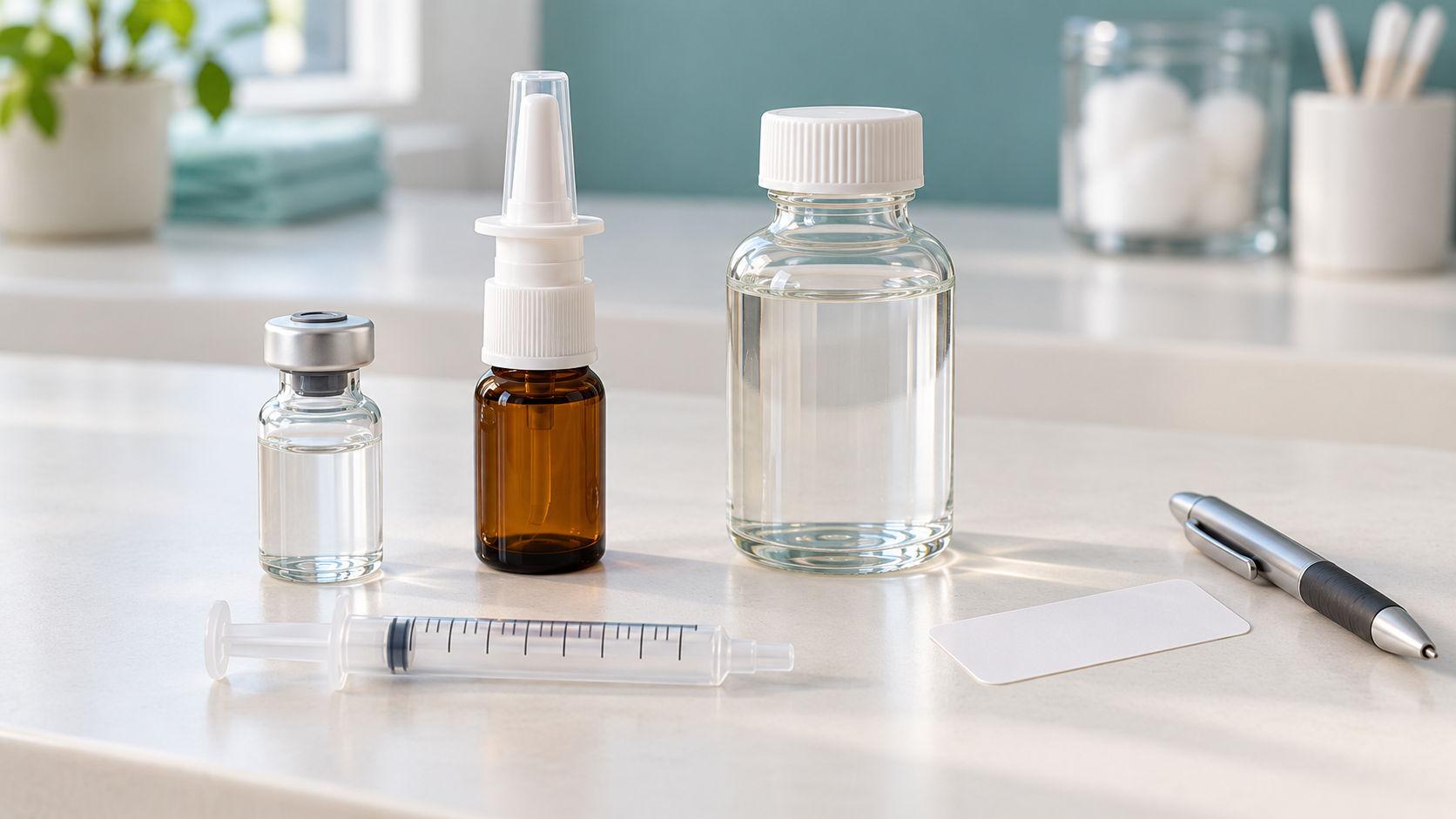
The syringe measures and transfers liquid, the spray bottle holds the finished preparation, and the label records its contents and conditions of use. Select an illustration to view it at full size.
Which liquid? Use the vehicle specified for the nasal formulation. Isotonic saline contains 0.9% sodium chloride; hypertonic products have a higher salt concentration. Bacteriostatic water for injection may contain 0.9% benzyl alcohol and is not an interchangeable substitute for a nasal vehicle. Benzyl alcohol and benzalkonium chloride are different preservatives. Check the actual composition and intended use of the liquid. [13, 14]
Calculating the final volume and amount per spray
Three figures belong on the preparation sheet: total peptide mass, final solution volume and actual pump output. The dose or target concentration is established separately; the calculation translates that specification into a liquid volume.
Concentration (µg/mL) = peptide mass (mg) × 1,000 ÷ final volume (mL)
Amount per spray (µg) = concentration (µg/mL) × pump output (mL)
The following examples assume a pump output of 0.10 mL per spray:
| Peptide mass | Final volume | Concentration | Amount per assumed 0.10 mL spray |
|---|---|---|---|
| 1 mg | 2 mL | 500 µg/mL | 50 µg |
| 2 mg | 2 mL | 1,000 µg/mL | 100 µg |
| 2 mg | 1 mL | 2,000 µg/mL | 200 µg |
| 5 mg | 5 mL | 1,000 µg/mL | 100 µg |
| 10 mg | 10 mL | 1,000 µg/mL | 100 µg |
| 10 mg | 5 mL | 2,000 µg/mL | 200 µg |
These are concentration examples, not recommended Semax, Selank or Adamax doses. They describe the amount leaving the nozzle, rather than the amount absorbed by the body.
A 5 mL fill divided by 0.10 mL gives a nominal 50 sprays. Priming, transfer losses and liquid left in the bottle reduce the usable count. Nor does every pump deliver 0.10 mL: specific licensed sprays deliver 0.1 mL or 0.137 mL, for example. [10, 11] The actual device specification belongs in the calculation.
Preparing the solution and filling the bottle
Once the substance, compatible vehicle, target concentration and suitable equipment have been specified, preparation follows six steps.
1. Record the starting amounts
Before opening the containers, record the exact peptide, total mass, intended final volume and pump output. Keeping mg, µg and mL in separate fields prevents a mass from being mistaken for a liquid volume.
For the running example, the figures are 5 mg total, 5 mL final volume and an assumed 0.10 mL pump output. That gives 100 µg per spray. The example is an arithmetic illustration and applies only if all three stated figures are correct.
2. Prepare the workspace and equipment
Wash your hands, clean the work surface and lay out the specified measuring and transfer equipment. Avoid touching container interiors, transfer tips or the pump’s intake tube, or resting these parts on the work surface. The bottle and closure must be suitable for the formulation and prepared as specified for that equipment. An old household spray bottle is not made suitable merely by rinsing it with alcohol.
Use a graduated transfer device to measure small volumes and avoid open pouring. A needle-free syringe can measure accessible liquid; a vial with a rubber stopper also needs a compatible access adapter. The transfer illustration below shows this connection.
3. Dissolve the powder in the original vial
A measured portion of the specified vehicle is introduced into the peptide vial, and the powder is dissolved using the mixing method specified for that substance. This first step is reconstitution. The liquid used at this stage is recorded because it forms part of the final preparation.
Follow the formulation’s mixing instructions and allow the powder to dissolve as specified. If particles remain unexpectedly, or the liquid becomes cloudy or forms a gel, check the preparation before continuing. Do not improvise a solvent or pH adjustment.
4. Work out how much liquid remains to be added
The initial solution is included in the total. The calculation is:
Remaining volume = intended final volume − volume of the initial peptide solution
If the dissolved peptide solution occupies 1 mL and the intended final volume is 5 mL, the remaining volume is 4 mL. Adding another 5 mL would instead give 6 mL and a different concentration. The relevant quantity is the measured final solution volume, not simply the sum of nominal additions.
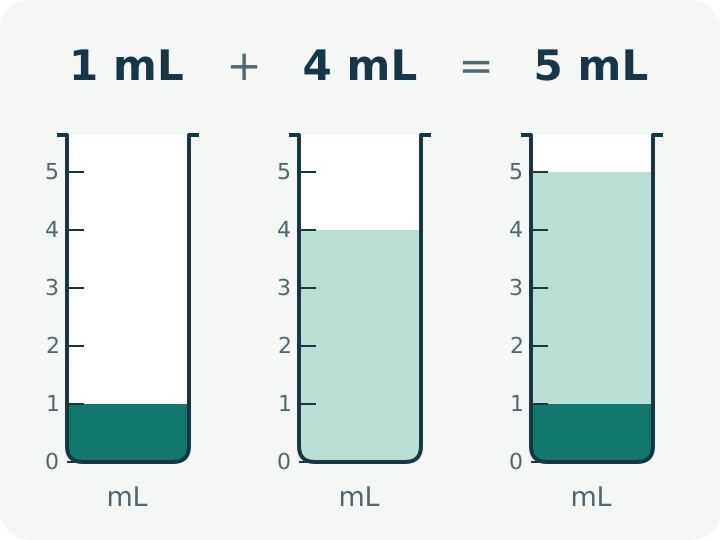
Volume example: the initial 1 mL is already part of the final 5 mL. Add the remaining 4 mL, not another 5 mL.
5. Transfer the solution and complete the final volume
Using the appropriate transfer device, the dissolved peptide is transferred from its vial into the compatible spray bottle. The specified vehicle is then added to reach the intended final volume. In the example, that means 1 mL of peptide solution plus the remaining 4 mL, for 5 mL in total.
The aim is to transfer the full dissolved amount without spilling it or leaving an unaccounted quantity behind. If material is lost, the original mass-per-volume calculation is no longer reliable. Any rinse liquid specified by a formulation also counts towards the final volume. Once filled, the solution is mixed as required by that formulation and the pump is fitted securely.
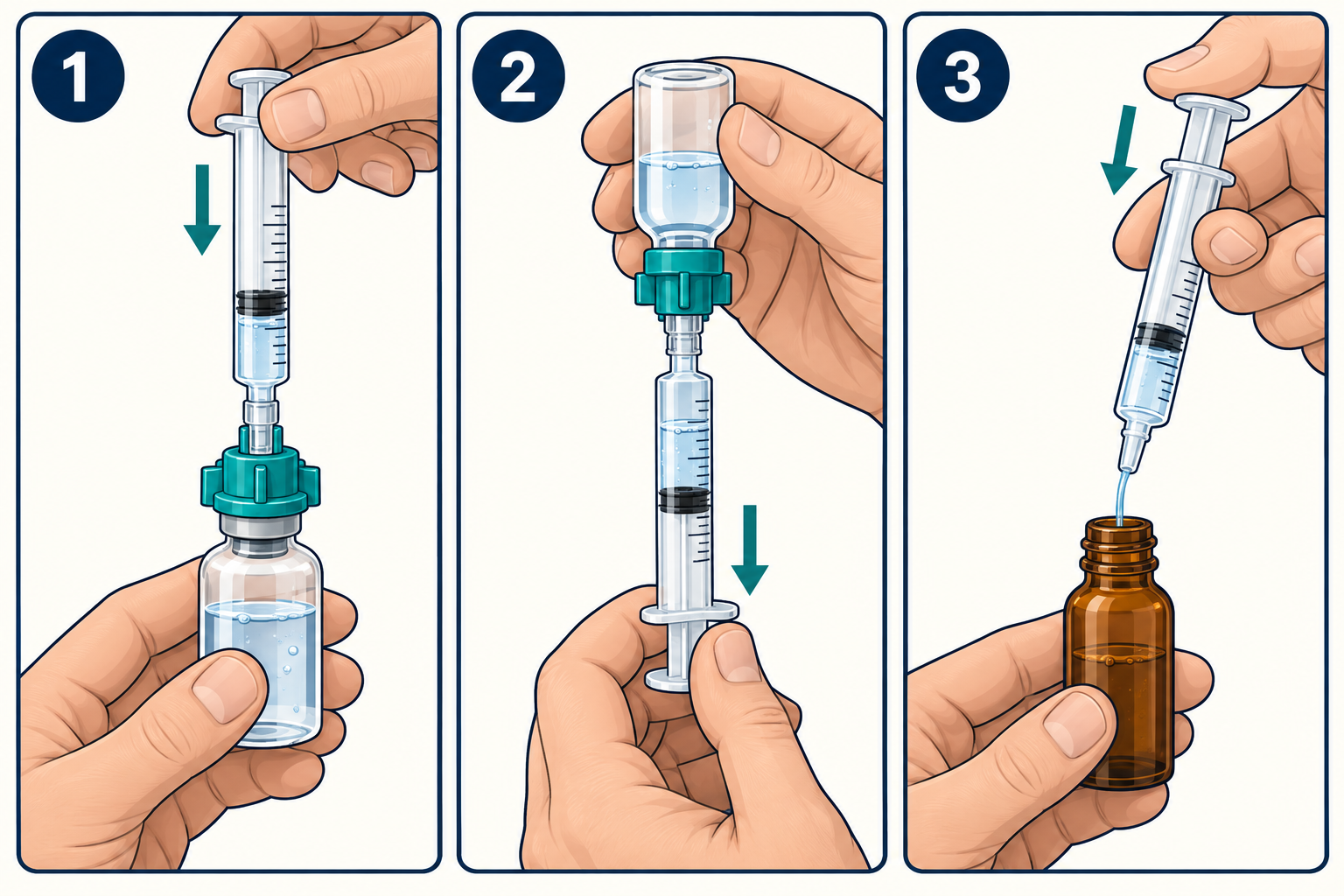
1: Add the measured portion of liquid through a compatible vial adapter. 2: Once the powder has dissolved, turn the connected vial upside down and draw the solution into the syringe. 3: Transfer it into the open spray bottle, then complete the final volume as calculated above. The adapter is shown in teal.
6. Label the finished bottle
The label identifies the peptide and any mixture components, concentration in µg/mL, pump output in mL, calculated amount per spray, preparation date, storage conditions and use-by date. For the example, the concentration is 1,000 µg/mL and the assumed emitted amount is 100 µg per 0.10 mL.
Record both the preparation date and the use-by date established for this formulation. They serve different purposes: one identifies when it was made, the other when it must be discarded.
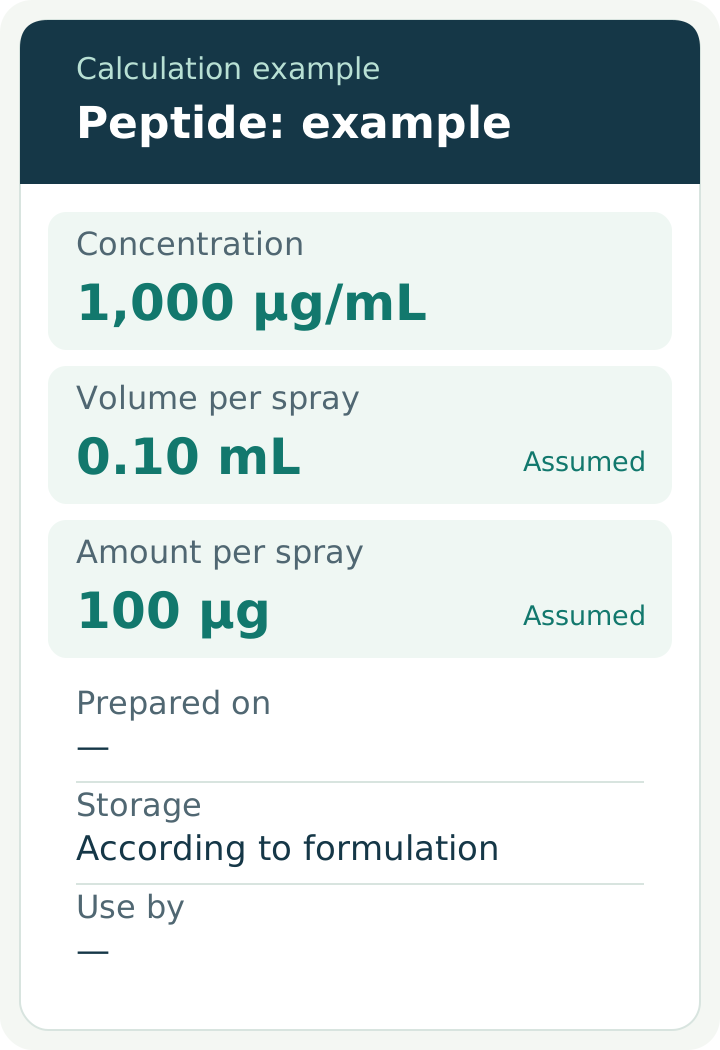
Example label for the calculation used here. Fill in the actual substance, preparation date, storage conditions and use-by date.
Priming the pump before the first use
Priming fills the pump’s internal pathway so that it can deliver its intended output. The device instructions specify how to hold it and how many initial actuations are needed. Priming sprays are released away from the face and are not counted as administered doses. [10, 11]
A regular-looking mist does not by itself confirm an exact volume. Some devices need to be primed again after a period without use, and the required interval varies. When a labelled spray count has been reached, remaining liquid is not proof that the device can still deliver reliable doses. The bottle’s own instructions govern cleaning and pump maintenance. [10, 12]
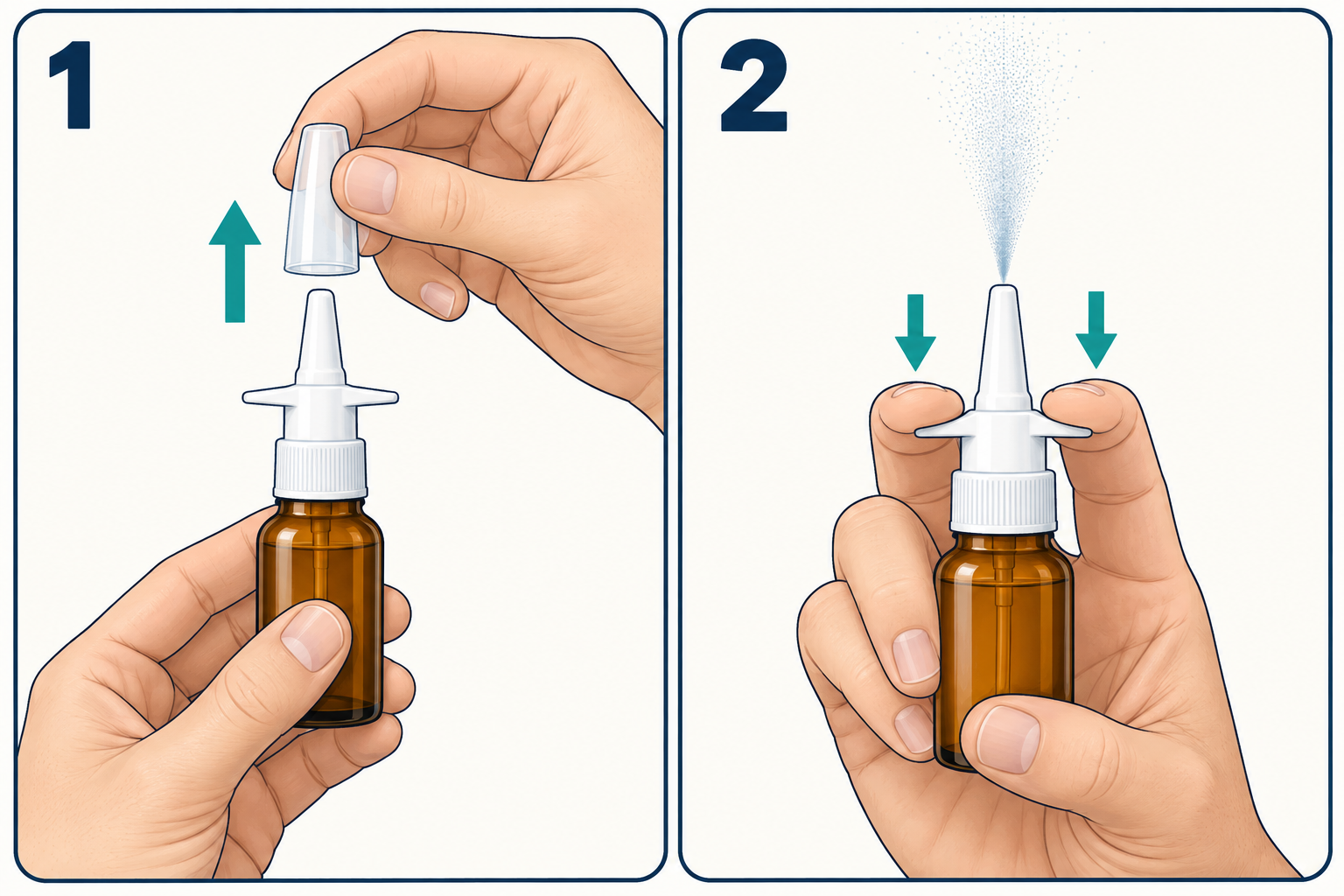
1: Remove the cap. 2: Prime away from the face, holding the bottle as specified for the device. Follow its instructions for the number of priming sprays.
Applying a conventional nasal spray
For an appropriate finished nasal product, NHS guidance describes the following technique. The product leaflet determines the actual number of sprays, frequency and any exceptions. [8]
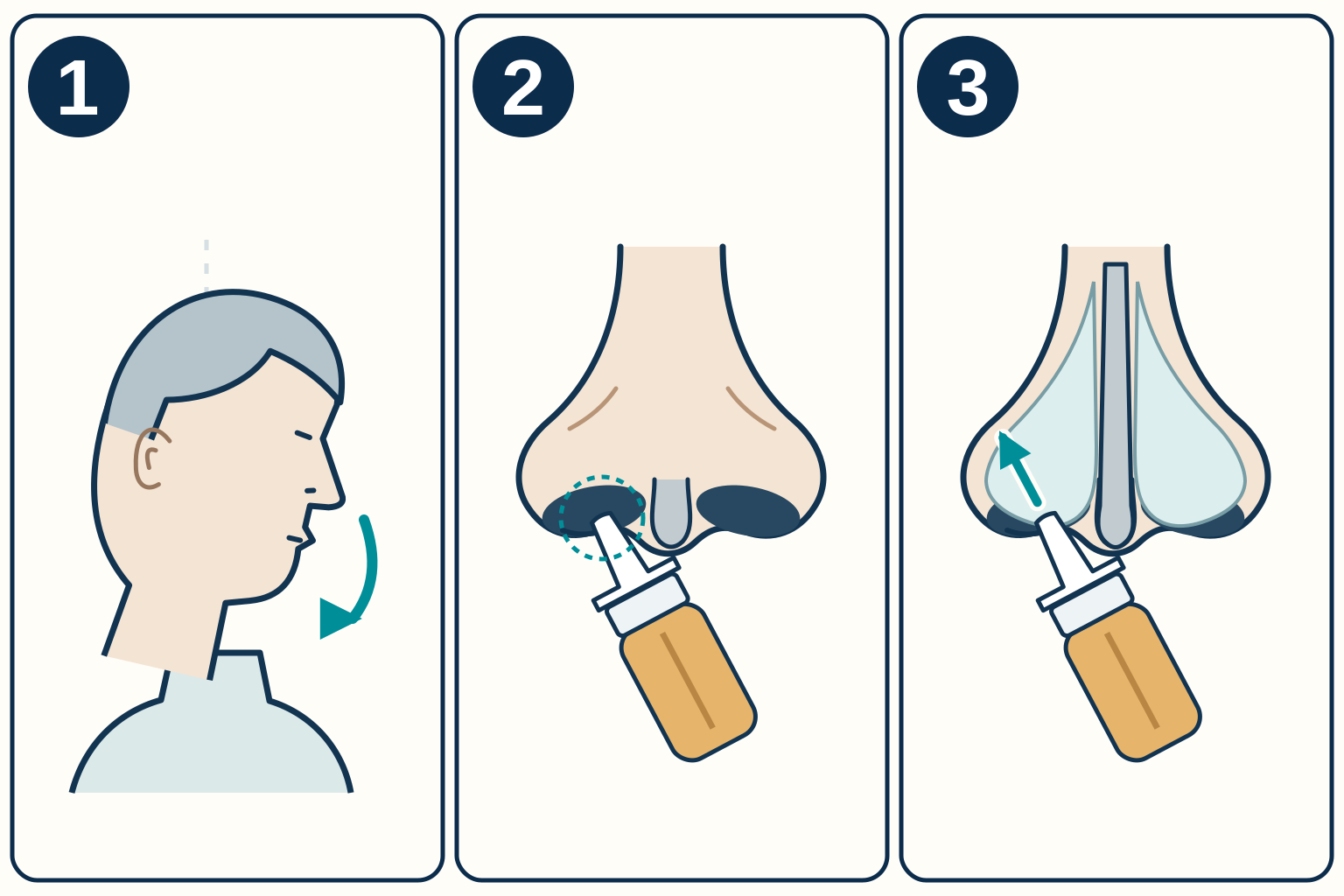
1: Lower the chin slightly. 2: Place only the tip inside the nostril. 3: Aim outwards, away from the septum. Breathe in gently while spraying.
- Prepare the nose and bottle. Hands are clean; the nose is gently cleared if needed. The cap is removed and the pump is primed if its instructions require it. Shaking is done only when specified for the product.
- Keep the head slightly forward. The chin is lowered a little instead of tipping the head back.
- Place the nozzle just inside the nostril. It is not pushed deeply into the nose. Using the opposite hand makes it easier to aim away from the central nasal septum: right hand for the left nostril, left hand for the right.
- Aim towards the outer nasal wall. The nozzle points away from the septum, roughly towards the ear on that side.
- Actuate while breathing in gently. The prescribed number of sprays is used. A forceful sniff can draw liquid into the throat. The other nostril is treated only as directed for the product.
- Clean and recap. The nozzle is cleaned according to its instructions and the protective cap replaced. The bottle is not shared with another person.
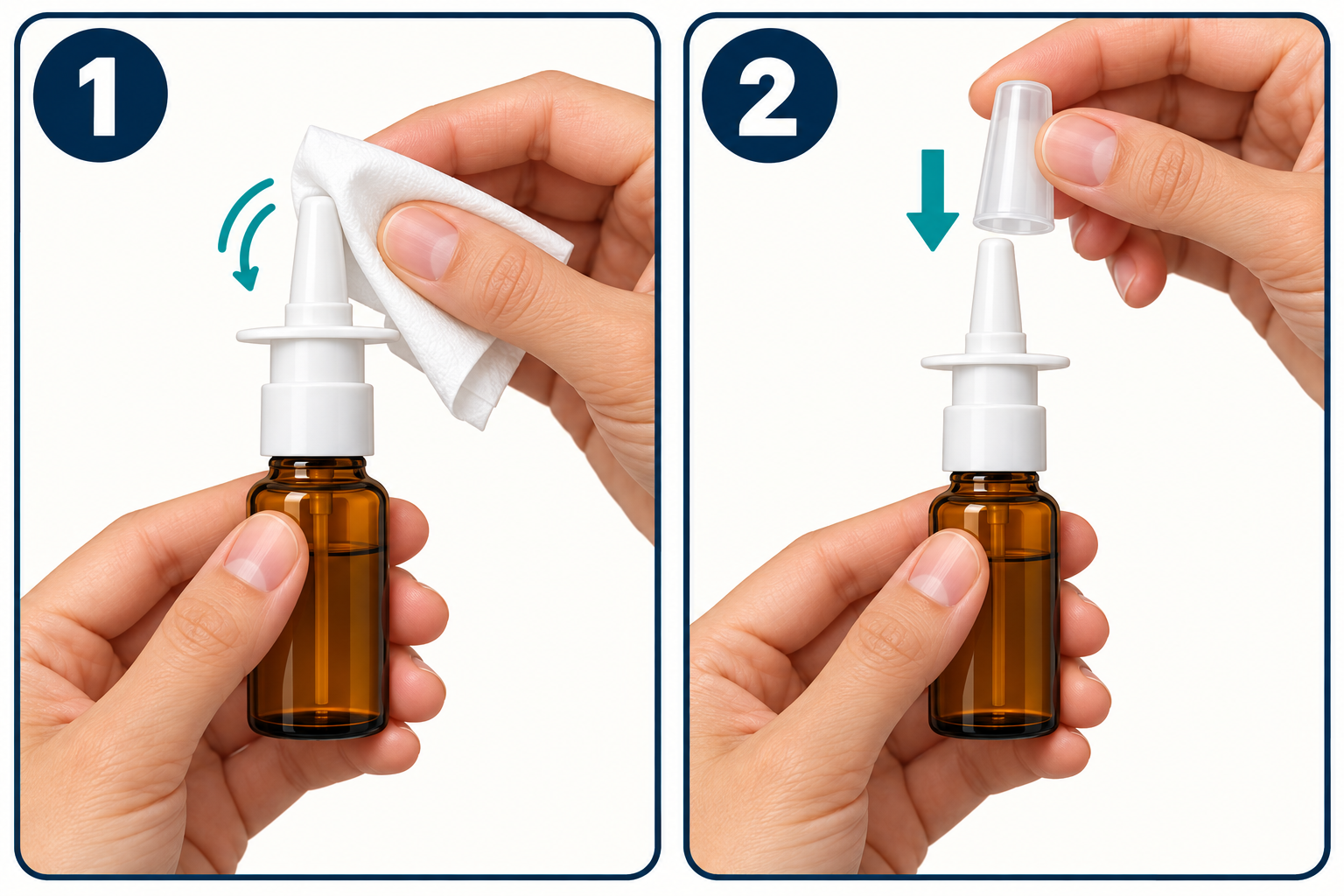
1: Clean the nozzle according to the device instructions; the illustration shows an external wipe. 2: Replace the cap and store the labelled bottle as specified.
Sprays and drops: different head positions
For a conventional spray, keep the head slightly forward. Nasal drops can require a different position, including tilting the head back or lowering it below the shoulders, depending on the product. Follow the instructions for the delivery system you are using. [8, 9]
Semax and Selank product information describes nasal drops. Transferring a drop preparation into a different pump changes the delivery system, so neither the number of drops nor the original administration instructions can simply be renamed “sprays”. [1, 4]
Storage and use after opening
The filled bottle is stored under the conditions specified for its formulation, with its cap in place and its label readable. Refrigeration is used when those instructions require it. Even licensed nasal products containing the same peptide, such as desmopressin, can have different storage instructions. [10, 15]
The use-by period depends on the specific formulation and container. Chemical stability, microbial quality and pump function all need to be maintained throughout that period. Refrigeration or a clear-looking solution alone cannot establish how long a preparation remains usable. [12]
Reusing the bottle also depends on validated cleaning instructions and continued pump performance. Alcohol cleaning alone does not establish that a reused container is suitable for a new batch.
Semax, Selank, Adamax and other nasal peptides
The preparation sequence is about handling a liquid. The evidence for the individual substances remains separate:
| Substance | Nasal evidence and practical distinction |
|---|---|
| Semax | Human nasal studies and Russian nasal-drop medicines are documented. Those data do not validate every independently prepared spray. [1] |
| Selank | Nasal-drop product information and small human anxiety studies exist, including a 62-patient comparison with medazepam. They do not establish a universal spray formulation or a cognitive benefit in healthy people. [2, 4] |
| Adamax | A regulatory document names it among peptides marketed for cognitive effects. Comparable published human nasal trials were not identified. The name does not establish the contents or suitability of a particular vial. [3] |
| N-acetyl Semax / N-acetyl Selank | Modified compounds that require their own assessment. A change to the molecule does not justify copying the parent peptide’s formulation or instructions. |
| Insulin / oxytocin | Investigated intranasally in humans, but these are separate clinical research programmes. Large trials in cognitive impairment and autism respectively did not show benefit over placebo on their primary outcomes. [6, 7] |
An early human study of insulin, vasopressin and melanocortin(4–10) found increases in cerebrospinal-fluid concentrations after nasal administration. It did not test Semax, Selank or Adamax and does not establish that every nasal peptide reaches the brain effectively. [5] More detail is available in the monographs for N-acetyl Semax, N-acetyl Selank and oxytocin.
Keeping amounts and units clear
- A “5 mg / 5 mg” blend contains 10 mg in total. In a final 5 mL, an assumed 0.10 mL spray contains 100 µg of each component, or 200 µg combined. The calculation does not prove that the two ingredients are compatible.
- Keep mass and volume separate. mg and µg describe the amount of peptide; mL describes the volume of liquid. Write the unit beside every measurement so that the quantities remain unambiguous.
Common questions
How is the peptide transferred into the nasal spray bottle?
Dissolve the peptide in its original vial with a measured portion of the specified liquid, transfer the solution into a suitable spray bottle, and add the remaining liquid to reach the intended final volume. The vehicle, equipment and mixing method must be specified for that preparation.
Does the liquid used for reconstitution count towards the final volume?
Yes. If the initial peptide solution occupies 1 mL and the intended final volume is 5 mL, the remaining volume is 4 mL. Adding a further 5 mL would give 6 mL and change the concentration.
How is the amount per spray calculated?
Concentration in micrograms per millilitre is multiplied by actual pump output in millilitres. For example, 5 mg in a final 5 mL gives 1,000 micrograms/mL; an assumed 0.10 mL spray would contain 100 micrograms. This is a concentration example, not a recommended peptide dose.
Why must a nasal spray pump be primed?
Priming fills its internal pathway before it can deliver its intended output. The device instructions determine the initial actuations and any repriming after a pause. A visible mist alone does not prove that a particular volume is being delivered.
Which way should a conventional nasal spray be aimed?
With the head slightly forward, the nozzle sits just inside the nostril and points towards the outer nasal wall, away from the septum. The opposite hand helps achieve that angle. Inhalation is gentle; the number of sprays follows the product’s own instructions.
Can the same mixing instructions be used for Semax, Selank and Adamax?
The arithmetic is the same, but compatibility, nasal suitability, concentration and storage depend on the actual substance and formulation. Semax and Selank have nasal-drop data; comparable published human nasal evidence for Adamax was not identified.
How long does a prepared peptide nasal spray keep?
The storage conditions and use-by period must be established for the specific preparation and its container. Refrigeration and a clear appearance do not establish chemical stability or acceptable microbial quality.
Sources
- FDA. Semax briefing document for the Pharmacy Compounding Advisory Committee, 2026. Clinical literature, nasal-drop background and quality questions for compounded sprays.
- Zozulia et al. Selank in generalised anxiety disorder and neurasthenia, 2008. Small active-comparator study; 62 participants.
- Medsafe. Medicines Classification Committee submission on peptides, June 2025. Regulatory discussion, including Adamax; not a clinical trial or an approval.
- Selank. Manufacturer’s product information. Nasal-drop formulation and product-specific information.
- Born et al. Sniffing neuropeptides: a transnasal approach to the human brain, 2002. Human cerebrospinal-fluid study; DOI: 10.1038/nn849.
- Craft et al. Safety, efficacy, and feasibility of intranasal insulin for mild cognitive impairment and Alzheimer disease dementia, 2020. Randomised trial; DOI: 10.1001/jamaneurol.2020.1840.
- Sikich et al. Intranasal oxytocin in children and adolescents with autism spectrum disorder, 2021. Randomised trial; DOI: 10.1056/NEJMoa2103583.
- East Kent Hospitals NHS. How to use a nasal spray.
- East Kent Hospitals NHS. How to use nose drops.
- DailyMed. Desmopressin nasal spray, Apotex: prescribing information.
- DailyMed. Azelastine hydrochloride nasal spray: prescribing information.
- FDA. Nasal spray and inhalation solution, suspension, and spray drug products: chemistry, manufacturing, and controls documentation.
- NeilMed. NasaMist Extra Strength Hypertonic. Product information identifying a hypertonic saline preparation.
- DailyMed. Bacteriostatic water for injection: product information.
- DailyMed. Desmopressin acetate nasal spray, Bausch: prescribing information.