

SLU-PP-332 solubility: why this compound is reconstituted differently
SLU-PP-332 is a research compound without marketing authorisation and without published human data; what follows describes its solubility behaviour, not a preparation procedure. Aqueous solvents leave the solid largely untouched, and an hour of swirling changes little – that outcome is solubility behaving as predicted rather than a question of material quality: water has nothing to offer a lipophilic solid, a cosolvent such as dimethyl sulfoxide (DMSO) does, and the moment that stock meets water is the fragile one.
Not a peptide, and that is the whole point
The name keeps peptide company, but SLU-PP-332 is a synthetic small molecule that the preclinical literature describes as a pan-agonist at the estrogen-related receptors (ERRα, ERRβ, ERRγ) and characterises as a medicinal-chemistry tool compound; human data are not published. The identifier follows a laboratory series, not an amino-acid sequence. That is why the usual habits fail: a lyophilised peptide is an amorphous cake of ionisable side chains that wants water, while a lipophilic solid has a crystal lattice to break and nothing for water to organise around.
Why bacteriostatic water leaves the solid sitting there
Like dissolves like does real work here. Dissolving something in water means opening its hydrogen-bonded network and re-forming it around the solute; polar and ionic solutes pay that energetic bill with charge-dipole interactions and hydrogen bonds, and a non-polar molecule has nothing to pay with. pH is no lever either: peptide solubility often turns on pH relative to the isoelectric point, but a molecule without ionisable groups has no such handle.
Bacteriostatic water changes nothing: its benzyl alcohol is a preservative at roughly 0.9%, far below a cosolvent concentration, so in solvent terms it is sterile water.
Patience and ultrasound act on kinetics – agglomerates, boundary layers, a dissolution that would finish anyway. Neither shifts equilibrium solubility, so the haze after a spell in an ultrasonic bath is a suspension that settles back out.

Cosolvents: what DMSO actually does
Dimethyl sulfoxide is a polar aprotic solvent: large dipole moment, a sulfinyl oxygen that accepts hydrogen bonds unusually well, no acidic hydrogen to donate. It therefore solvates polar and non-polar regions of the same molecule, which is why it is a default vehicle for poorly water-soluble compounds. Ethanol, propylene glycol, polyethylene glycol 400 and cyclodextrins serve the same end in marketed parenteral products: lowering the dielectric constant so a non-polar solute is less unwelcome.
The fragile part is the transition back to water
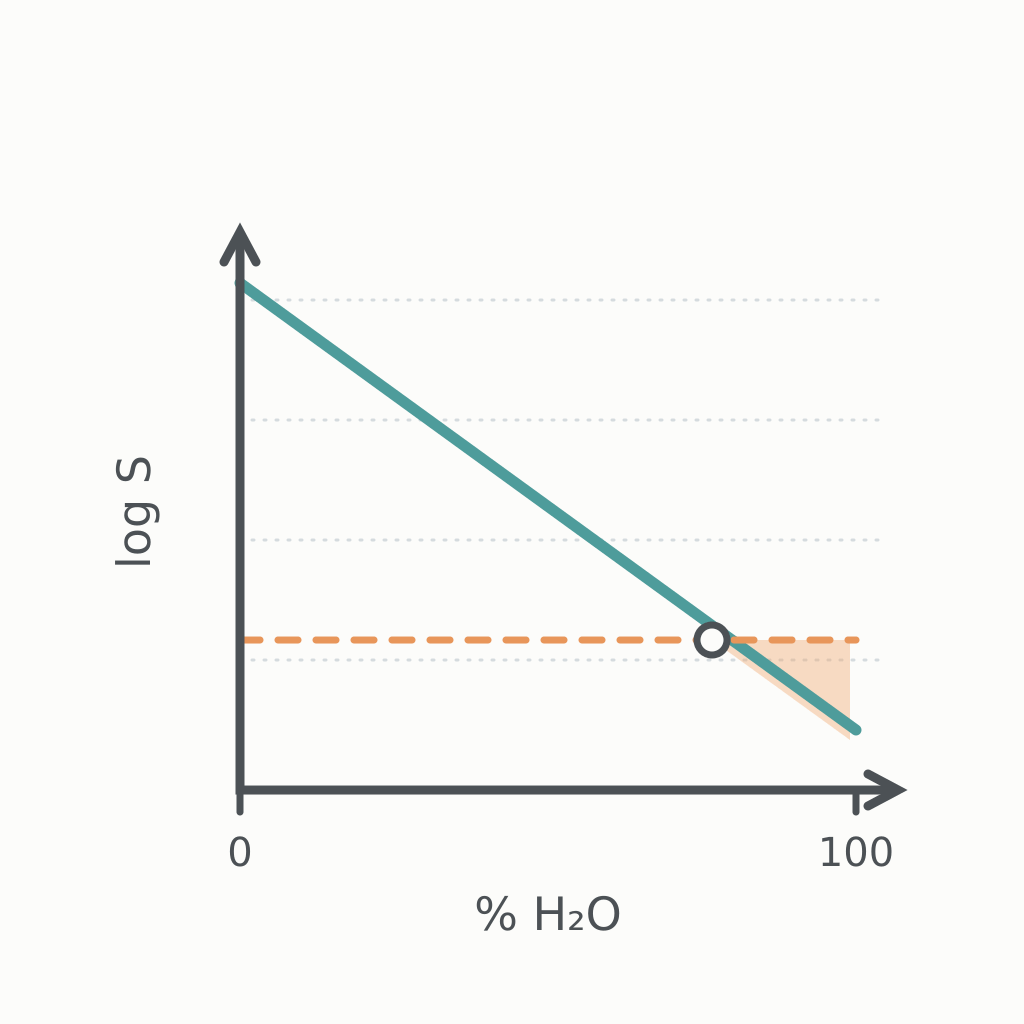
A cosolvent stock hands the problem back once water arrives: solvent power falls roughly log-linearly with cosolvent fraction – the classical cosolvency model – and where the dissolved amount exceeds what the new mixture can hold, the compound leaves solution. Formulators call it solvent-shift precipitation.
The same model explains where such mixtures fail. Wherever a concentrate and water first meet, the local composition is momentarily far poorer in cosolvent than the bulk, so the solubility limit is exceeded at that boundary long before it is exceeded on average, and nucleation starts in those pockets. That is a description of the cosolvency model as the cited literature sets it out, not a usage recommendation.
Haze, sediment and what cold does to the mixture
With a peptide, cloudiness usually means something failed. In a cosolvent-water mixture near its solubility limit it can also be a phase phenomenon: scattering from very small particles, or a transient supersaturated state. Sedimented or floating solid is the compound out of solution; redissolution of a crystallised phase is slow and often incomplete.
Temperature moves that line, since the solubility of most organic solids falls as a mixture cools. Freezing is harsher: neat DMSO solidifies near 18.5 °C, and ice formation concentrates whatever remains in the shrinking liquid phase, which is why freeze-thaw cycling crashes such mixtures for good. Cold, dark and unfrozen is what the handling literature describes for reconstituted material.
DMSO is not an inert diluent
DMSO crosses skin and membranes readily and carries dissolved solutes with it. It is also irritant on contact with tissue when concentrated, one reason parenteral formulations keep cosolvent fractions low. Monographs for dimethyl sulfoxide exist in USP-NF and Ph. Eur. and set limits for purity and water content; technical grades fall outside those monographs.
Concentration arithmetic
The maths afterwards is substance-independent: concentration is the mass in the vial divided by the total final volume, cosolvent included, and the volume for a given amount is that amount divided by the concentration. The reconstitution calculator does the conversion; what mg, mL and IU actually mean covers the units.
Regulatory status
SLU-PP-332 is not approved as a medicine in the United States, the European Union, Australia or elsewhere, and no human clinical safety or efficacy data are published. It is a research compound, and a research-use-only label is a commercial description rather than a regulatory category. Legal status varies by country – that question has its own page.
Common questions
Is SLU-PP-332 a peptide?
No. It is a synthetic small molecule described as a pan-agonist at the estrogen-related receptors, and its identifier comes from a laboratory compound series rather than an amino-acid sequence. It behaves like a poorly water-soluble organic solid.
Why does SLU-PP-332 not dissolve in bacteriostatic water?
It is largely non-polar, so water has no favourable interactions to offer it. Bacteriostatic water differs from sterile water only by a preservative, which is far too dilute to act as a cosolvent.
Does an ultrasonic bath change anything?
Sonication changes how fast a dissolution happens, not whether it can happen at all. It breaks up agglomerates and refreshes the liquid layer around each particle, but equilibrium solubility stays where it was.
Why can a clear cosolvent stock turn cloudy once water is added?
Solvent power falls as the water fraction rises, roughly log-linearly with cosolvent content. Where the dissolved amount exceeds what the new mixture can hold, the compound precipitates, an effect known as solvent-shift precipitation.
Is SLU-PP-332 an approved medicine?
No. It has no marketing authorisation in any major jurisdiction and no published human clinical safety or efficacy data. A research-use-only label carries no regulatory assurance of identity, purity or sterility.
Where this comes from
- SLU-PP-332 as a pan-ERR agonist (preclinical, mouse model — the effects named in the title were measured in animals, not in humans): Billon C, Sitaula S, Banerjee S, et al., "Synthetic ERRα/β/γ agonist induces an ERRα-dependent acute aerobic exercise response and enhances exercise capacity", ACS Chemical Biology 2023;18(4):756–771, doi:10.1021/acschembio.2c00720 — PubMed 36988910.
- Log-linear cosolvency: Yalkowsky, Solubility and Solubilization in Aqueous Media (1999).
- Solubilising excipients in parenteral products: Strickley, Pharmaceutical Research 21(2), 2004.
- Constants, grades and monographs for dimethyl sulfoxide: USP-NF monograph "Dimethyl Sulfoxide"; European Pharmacopoeia monograph "Dimethyl sulfoxide" (Latin title Dimethylis sulfoxidum).
General, neutral information about the chemistry of a research compound – not medical advice, not a dosing or usage recommendation, and not an invitation to obtain any substance. SLU-PP-332 holds no marketing authorisation, and whether possession and use are lawful depends on the law of your country of residence. Health questions belong with a qualified physician or pharmacist.