
Cagrilintide in Solution: pH, Aggregation and Fibrils
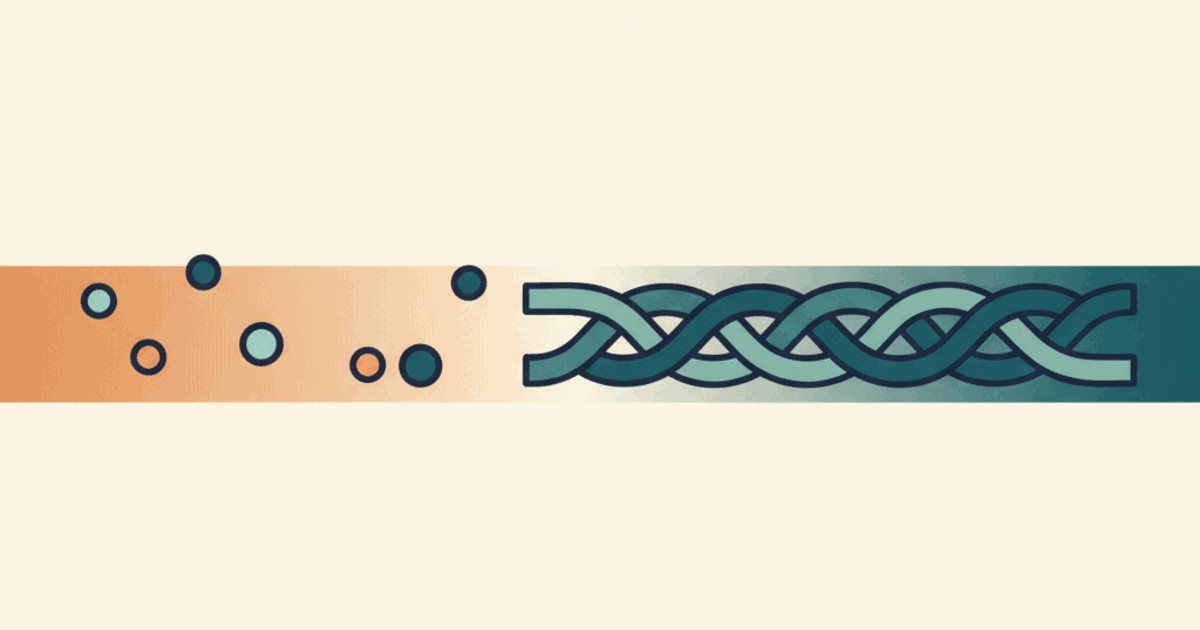
Two claims travel with cagrilintide, an amylin analogue still in clinical trials and not approved as a medicine: that it has to be held at pH 4, and that whatever forms above that pH is dangerous in the long run. Both are solubility questions, and this page stays inside that boundary — the pH behaviour of an amylin analogue, what an aggregate physically is, and which parts of the argument chemistry cannot settle.
What kind of molecule this is
Cagrilintide is a long-acting analogue of amylin, developed under the laboratory code AM833 and structurally related to pramlintide. Amylin is a pancreatic hormone co-secreted with insulin, and the amylin family is textbook material for self-association: these sequences stack rather than stay dispersed. That is why analogues in the class carry proline substitutions and other stabilising modifications intended to slow the tendency down.
Two status facts frame everything below. Cagrilintide is in clinical development and holds no marketing authorisation in the EU, the US, the UK or Australia, and human safety data over long periods is correspondingly thin. Nothing here is a preparation procedure.
Why pH keeps coming up
The underlying observation is real. Stability work on amylin analogues describes a mildly acidic optimum, in the region of pH 4, at which the molecule degrades most slowly; at neutral pH the reported degradation rate is higher.
The chemistry behind it is ordinary peptide chemistry, and two routes dominate. Hydrolysis, particularly deamidation of asparagine and glutamine residues, accelerates as pH rises toward neutral. And net charge shifts: a strong like-charge on every molecule keeps molecules electrostatically apart, while a peptide nearer its isoelectric point loses that repulsion and self-associates more easily. Acidic conditions do both jobs at once, which is where a formulation scientist targeting a sealed multi-year shelf life lands.
That is also where the pH-4 figure is usually misread. A shelf-life optimum answers "how does sealed material survive for years", not "what happens in a cold solution over a few weeks". Bacteriostatic water sits nearer pH 5.5 to 6. Degradation at that pH is described in the published degradation kinetics for this peptide class as gradual and strongly temperature-dependent. Separately, stability work on excipient-protected amylin-analogue formulations reports recovery above 95% after five weeks at 30 °C, against below 70% for the same peptide without the protecting excipient. Those figures describe protected formulations under defined conditions and are not transferable to an unbuffered solution.
What a fibril actually is
A fibril has a precise structural definition, and the definition does most of the explanatory work. Peptide chains misfold into flat beta-sheet conformations, those sheets stack, and the result is a long, rigid, cross-beta strand that is essentially insoluble. Between dissolved monomer and mature fibril sit intermediates — dimers, oligomers, protofibrils — still soluble and still mobile.
That progression matters when stability numbers are quoted out of context. Aggregation figures in the literature come from forced-degradation studies: material deliberately heated, agitated at speed and stressed for dozens of hours so a shelf-life model can be extrapolated from an accelerated timescale. The methodology is standardised, for example under the ICH stability guidelines, and is designed to be far harsher than any storage condition. Even under that regime, the degradation kinetics reported for this peptide class describe hydrolytic cleavage into smaller fragments as a major route alongside aggregation (Kenley et al. 2000), so only part of the peptide lost from an assay is accounted for as fibril. Lost assay signal and a vial full of fibrils are not the same finding.
The second physical fact is mobility, and here the literature is more useful than a flat assertion. Insolubility is the defining property of a mature fibril, and the clinical literature on aggregate-forming injectable peptides describes deposited material as staying where it was deposited. The best-documented case is insulin, for which review articles report a local deposit and a local tissue reaction at the site of administration rather than distribution through the body. That body of work concerns insulin rather than an amylin analogue, and it records what has been observed — it is not a guarantee about a different molecule.
Where the chemistry stops
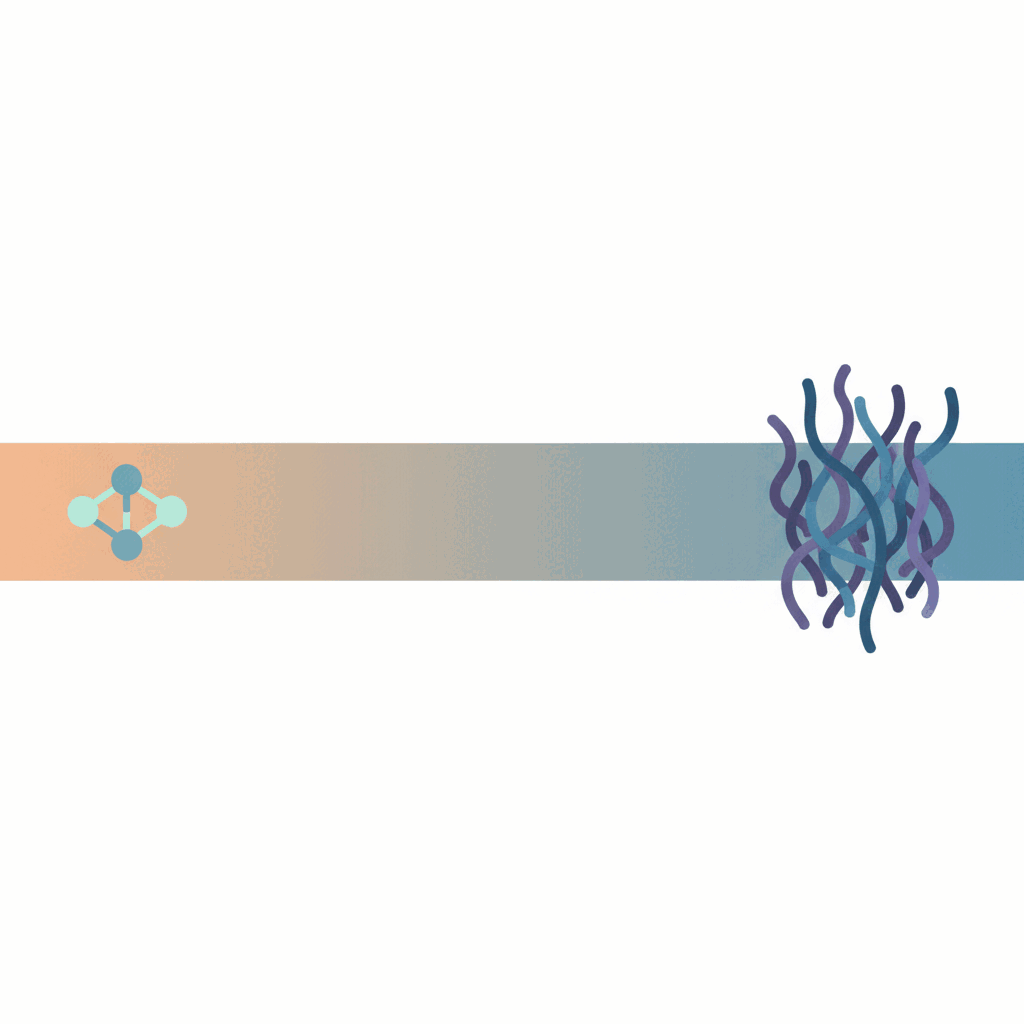
The claim circulating online chains three statements: that solution above pH 4 produces fibrils, that those fibrils travel through the body, and that their arrival elsewhere causes long-term harm.
The first two are chemistry questions, and the sections above are the chemistry answer as far as it goes: forced-degradation conditions are not storage conditions, and insolubility is what the literature describes for mature fibrils. The third is not a chemistry question at all. It is a clinical and biological one, it is genuinely unsettled in the research literature, and this page does not attempt to resolve it.
Fairness to the opposing reading is part of that. Some researchers argue that mature fibrils are the wrong focus, because the small early aggregates — the oligomers described above — are the species with biological relevance, and those are small enough to move. That is an open debate, not a settled question in either direction, and a compound still in clinical trials has limited long-term human data either way. Questions of that kind belong with primary literature and a qualified clinician, not with a page about solubility.
Why the acidic optimum exists in formulation chemistry
Because the acidic optimum is real, formulation literature for this class describes buffered acidic vehicles, and the reason is the chemistry already set out above: a lower pH slows hydrolysis and keeps a stronger like-charge on every molecule. That is the entire chemical effect, and it is the same effect the pH-4 figure refers to.
The same literature records the trade-off. Low-pH parenteral formulations are described as less well tolerated than near-neutral ones, which is why the pH that optimises a sealed vial is not the pH at which a finished medicinal product is filled. Both halves describe published formulation practice for a class of molecules; neither is specific to cagrilintide.
Concentration, mass and volume
One piece of arithmetic is worth separating out, because it is substance-independent and holds for any solution at all. Concentration is a ratio: mass divided by volume. Changing the volume of liquid changes the concentration, not the mass of peptide already present — the material does not increase or decrease, it is distributed through more or less liquid. Nothing in that relationship is particular to one peptide, one vehicle or one pH. It is set out in what mg, mL and IU actually mean, applied in the reconstitution basics and computed by the unit converter.

Stability variables that are actually documented
Storage chemistry is the least controversial part of this topic and the part with the clearest published basis.
| Variable | What the chemistry describes | Why it weighs more in this class |
|---|---|---|
| Temperature | Hydrolysis and deamidation slow sharply as temperature falls; 2 to 8 °C is the standard reference range | Slower degradation means slower progress toward the aggregation-prone state |
| Freezing | Freeze-thaw cycling is reported to damage peptide solutions via ice-interface stress and local concentration effects | Interface stress is a known nucleation route for self-associating sequences |
| Agitation | Shaking generates air-liquid interfaces and shear, both described as promoting nucleation | The largest difference between a stressed study sample and a resting vial |
| Light | Photodegradation affects aromatic residues; shielded storage is the reference practice | General to peptides rather than specific to this class |
| Vehicle pH | Acidic conditions slow hydrolysis and increase like-charge repulsion | The reason the pH-4 figure exists at all |
None of this is specific to cagrilintide; it is general peptide-solution chemistry, and it is where a stability study and ordinary refrigerated storage part company.
Common questions
Why is pH 4 mentioned so often in connection with cagrilintide?
Formulation literature describes a mildly acidic pH, in the region of 4, as the stability optimum for amylin analogues. That figure belongs to sealed, multi-year shelf life rather than to a solution kept cold for a few weeks. Cagrilintide is investigational and is not approved as a medicine.
Why do amylin analogues aggregate more readily than other peptides?
Amylin-family sequences have a documented tendency to self-associate, which is why analogues in this class carry engineered substitutions meant to blunt it. Solubility here therefore depends more strongly on pH, temperature and mechanical stress than for most lyophilised peptides.
What is a fibril, and how does it differ from dissolved peptide?
A fibril is a stack of misfolded peptide chains in a cross-beta sheet, forming a long, rigid, essentially insoluble strand. Dissolved peptide is a mobile single molecule; a mature fibril is a solid deposit, and that difference in solubility governs everything else about it.
What do the aggregation figures in stability studies actually measure?
They come from forced-degradation studies, in which material is deliberately heated, shaken and stressed for hours so that shelf life can be extrapolated from an accelerated timescale. Those conditions are not comparable to a refrigerated, undisturbed vial, and a drop in assayed peptide is not evidence that the remainder became fibrils. Cagrilintide is investigational and not approved as a medicine; nothing here describes a preparation practice.
Is cagrilintide an approved medicine?
No. Cagrilintide is an investigational compound in clinical development and holds no marketing authorisation in the EU, the US, the UK or Australia. Long-term human safety data is correspondingly limited.
Sources and further reading
- Development status: ClinicalTrials.gov, cagrilintide
- Degradation as a function of pH and temperature: Kenley RA, Tracht S, Stepanenko A, "Kinetics of pramlintide degradation in aqueous solution as a function of temperature and pH", AAPS PharmSciTech 2000;1(2):E7 — PubMed 14727840
- Stability of excipient-protected amylin-analogue solutions: "Compositions in the form of an injectable aqueous solution comprising amylin, an amylin receptor agonist or an amylin analog, and a co-polyamino acid", patent US 10,463,717 B2 (Adocia SAS, 2019) — Google Patents
- Local deposition of injected peptide aggregates: Ansari AM, Osmani L, Matsangos AE, et al., "Current insight in the localized insulin-derived amyloidosis (LIDA): clinico-pathological characteristics and differential diagnosis", Pathology - Research and Practice 2017;213(10):1237–1241 — PubMed 28935176
- Further primary literature: PubMed, cagrilintide and PubMed, amylin analogue aggregation
- Stability methodology: ICH quality guidelines, Q1 series
- Related here: reconstitution basics, bacteriostatic versus sterile water
This page covers solubility and stability chemistry only. Cagrilintide is investigational and not approved as a medicine; no preparation or usage recommendation is given or implied.