

How long does bacteriostatic water last? Unopened, opened, and in the fridge
The DailyMed label records for Bacteriostatic Water for Injection, USP name one storage condition: "Store at 20 to 25°C (68 to 77°F). See USP Controlled Room Temperature." A refrigerator is not part of that instruction. A sealed vial runs to its printed expiration date; from the first puncture onward, pharmacy practice applies a 28-day beyond-use date to a multiple-dose container.
What the label actually says
The wording settles most of the shelf-life question on its own. The label record cited below describes the product as "a sterile, nonpyrogenic preparation of water for injection containing 0.9% (9 mg/mL) of benzyl alcohol added as a bacteriostatic preservative", supplied "in a multiple-dose container from which repeated withdrawals may be made". The pH is given as 5.7 (4.5 to 7.0). Other DailyMed records for the same preparation give the benzyl alcohol content as 0.9% (9 mg/mL) or 1.1% (11 mg/mL); the storage statement and the 28-day convention read the same either way.
| Statement on the label | What it settles |
|---|---|
| "0.9% (9 mg/mL) of benzyl alcohol added as a bacteriostatic preservative" in the cited record; other records give 1.1% (11 mg/mL) | A preservative is present, which is why the vial counts as a multiple-dose container |
| "supplied in a multiple-dose container from which repeated withdrawals may be made" | Repeated entry is the intended pattern, not an exception |
| "Store at 20 to 25°C (68 to 77°F). See USP Controlled Room Temperature." | The only storage condition given, before and after opening |
| "Do not use unless the solution is clear and seal intact." | Appearance and seal are pass/fail criteria, independent of any date |
What is absent is equally informative: no refrigeration line, no "protect from freezing" line, no discard statement after opening. FDA guidance explains the last gap, noting that such containers "do not normally have a discard statement because the beyond-use date is assumed to be 28 days for an opened or entered (e.g., needle-punctured) multiple-dose container". The same label carries the statement "Rx only"; under United States law the product is prescription-only, and outside the United States its status is set by each country's own medicines law. The remaining label facts sit in the overview of bacteriostatic water.
The preservative is what carries the second clock, and its effect is narrower than the name suggests. FDA describes antimicrobial effectiveness testing as determining "whether the product prevents microbial growth if contamination of the container occurs during patient use conditions": growth, not presence. Benzyl alcohol holds in check what an entry carries in; it does not sterilise the contents, does not restore sterility once lost, and does not make a cloudy vial or a damaged seal acceptable. That preserved status is also the precondition of the multiple-dose classification, which FDA guidance and the USP <797> FAQ describe as a container that has met antimicrobial effectiveness testing under USP <51>, or is excluded from that testing by FDA regulation, and it is to that classification that the 28-day limit below attaches. The comparison with preservative-free water is covered in bacteriostatic vs sterile water.
Unopened: the expiration date is the limit
For a container never entered, one date governs, the printed expiration date, provided the vial stayed in the labelled condition. That condition is controlled room temperature, and USP <659> defines the vocabulary precisely.
| USP <659> term | Range |
|---|---|
| Cold | Any temperature not exceeding 8 °C (46 °F) |
| Cool | Any temperature between 8 and 15 °C (46 and 59 °F) |
| Controlled room temperature | 20 to 25 °C (68 to 77 °F), with excursions between 15 and 30 °C (59 and 86 °F) allowed provided the mean kinetic temperature does not exceed 25 °C |
The excursion allowance is written for short departures, not for a second storage class: it holds only as long as the mean kinetic temperature stays at or below 25 °C. That is why a warm cupboard in August differs from a car in the sun. The cupboard produces brief peaks inside the tolerated band while the average stays low; the car leaves the band outright, and a position that sits above 25 °C day after day breaks the condition through the average even when no single reading passes 30 °C. The label carries no light-protection statement; where a sunlit position matters, it does so because it drives the container out of the condition USP <659> defines, not through a documented photochemical effect on the solution.
After the first puncture: where the 28 days comes from
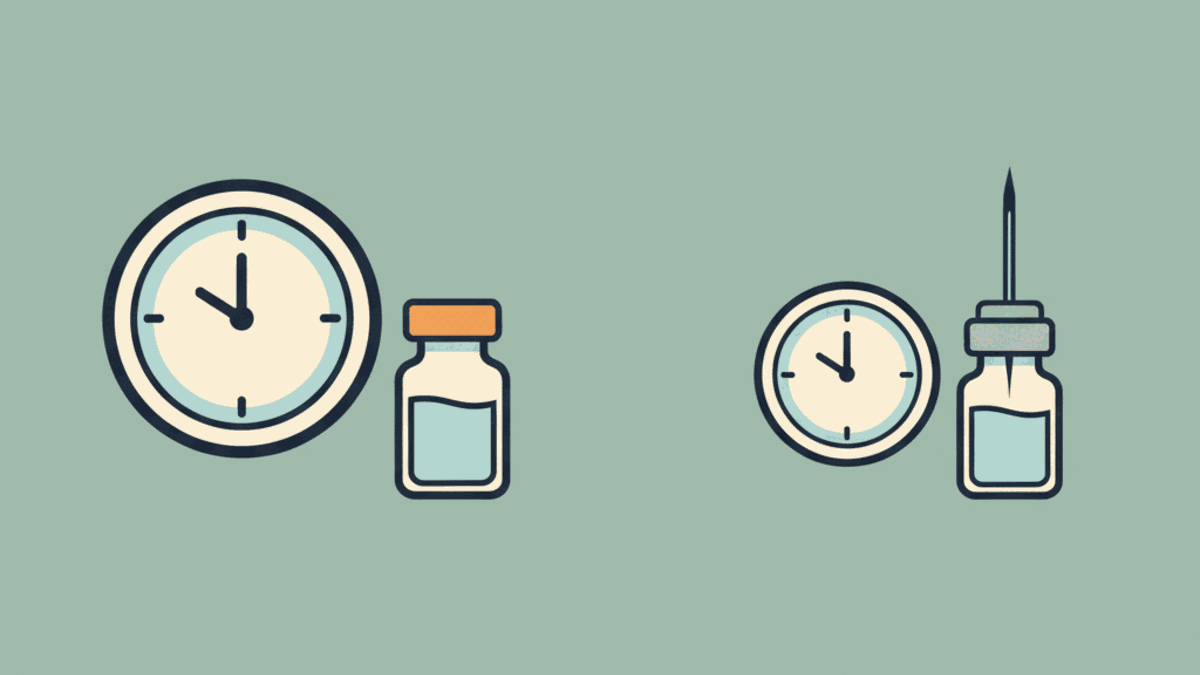
The moment a needle crosses the stopper a second clock starts, and it is the shorter one. Three independent documents put the same number on it. FDA guidance states that "the beyond-use date for an opened or entered (e.g., needle-punctured) multiple-dose container is 28 days, unless otherwise specified by the manufacturer on the label". USP <797>, the sterile compounding standard, requires "that multiple-dose containers not be used for more than 28 days unless otherwise specified on the labeling", and its FAQ separates the beyond-use date assigned to a preparation from the in-use time that starts at the first puncture: "The BUD is not the same as in-use time. A multiple-dose vial may have a BUD of 60 days but must still be discarded no later 28 days after first puncture." CDC injection-safety guidance says an opened vial "should be dated and discarded within 28 days unless the manufacturer states another date".
The three documents agree on the number and part company over the word. FDA labelling guidance calls the 28 days a beyond-use date; the USP <797> FAQ reserves that term for the date assigned to a preparation, which may be longer, and treats the 28 days as the in-use time after the first puncture. One limit, two vocabularies, which is worth knowing when two sources appear to disagree and are in fact saying the same thing.
| Clock | Starts | Ends | Set by |
|---|---|---|---|
| Expiration date | Manufacture | The date printed on the vial | Manufacturer, on stability data |
| In-use time after first entry (FDA labelling: beyond-use date) | First entry or puncture | 28 days later, or the expiration date, whichever comes first | FDA guidance (28-day beyond-use date); USP <797> (28-day limit for entering or puncturing); CDC (28 days) |
The figure is an upper bound from a controlled setting, not a guarantee attached to an individual vial, and a limit rather than a permission. The preservative that makes the classification possible does not extend the manufacturer's expiration date: the second clock can only shorten the window, never carry it past the printed date.
The clock starts at the puncture for mechanical reasons. A stopper reseals after a needle is withdrawn, but each entry is an opportunity for organisms from skin, air or needle to cross into the vial. A hospital screening study of multi-dose vials lists the variables that decide the outcome: "the number of times the drug is withdrawn from the vial, the aseptic technique used by the personnel, the resealability of the rubber closure, the air injected from the environment into the vial, and the duration of storage". The preservative acts on what gets in, not on whether it gets in.
Fridge or room temperature after opening
The labelled condition does not change once the vial is open, because the label describes no separate in-use condition: the one storage statement it carries, controlled room temperature, applies before and after the first puncture.
Refrigeration is a defined condition in its own right. CDC cold-chain guidance puts the refrigerator range at "between 2° C and 8° C (36° F and 46° F)" and, for household-grade units, advises against "deli, fruit, or vegetable drawers; or on refrigerator door shelves", where temperatures and air flow are unstable.
One mechanism belongs to the cold option. A vial taken out of a refrigerator is colder than the air around it, and where that air is humid enough, condensation forms on the glass and on the stopper: water on the exact surface disinfected before entry, renewed at every removal.
| Controlled room temperature | Refrigerated | |
|---|---|---|
| Named on the label | Yes, 20–25 °C | No |
| Effect on the expiration date | The date is assigned for this condition | Not addressed by any cited source; the printed date is assigned for the labelled condition |
| Effect on the 28-day limit after first puncture | None | None |
| Condensation on removal | Not a factor | Forms on glass and stopper whenever the surrounding air is humid enough |
| Defined range | USP <659>: 20–25 °C, excursions 15–30 °C provided the mean kinetic temperature stays at or below 25 °C | CDC: 2–8 °C, away from door shelves and drawers |
Neither condition extends either date, and no cited source assigns a separate shelf life to refrigerated storage; the printed date is assigned for the labelled condition. Storage temperature decides whether the vial stayed inside that condition, not how long either date runs.
Every state in one table
| State of the vial | Storage location | Limit that applies | Source of the limit |
|---|---|---|---|
| Sealed, never entered | Controlled room temperature, 20–25 °C | Expiration date printed on the vial | Label; USP <659> |
| Sealed, never entered | Refrigerated, 2–8 °C | Printed expiration date; no cited source assigns a separate shelf life to refrigerated storage, and the printed date is assigned for 20–25 °C | Label; USP <659> |
| Sealed, never entered | Sunlit or hot spot above 30 °C | Printed expiration date, assigned for a condition the vial has left; no cited source states what a stay outside the excursion band costs | USP <659> |
| Entered at least once | Controlled room temperature | 28 days from first puncture, or the expiration date if sooner | USP <797>; FDA guidance; CDC |
| Entered at least once | Refrigerated | 28 days from first puncture, or the expiration date if sooner; cold storage extends neither, and the condition is outside the labelled one | USP <797>; FDA guidance; CDC |
| Frozen at any point | Freezer | No shelf life is defined for this condition; the label names no freezing statement | Label |
| Cloudy, particulate, discoloured, seal not intact | Any | No date applies; the vial is discarded | Label; CDC |
What should never happen
Freezing. The CDC vaccine storage toolkit states, for diluents in the vaccine cold chain, "Never store diluent in a freezer." For this preparation, freezing simply lies outside the labelled 20 to 25 °C condition. The container is as much the reason as the contents. Water takes up more room as it turns to ice, with USGS putting the density drop at "about 9 percent", a mechanical load on a sealed glass vial and its crimped closure that need not leave a visible crack.
Direct sun and heat. Anything outside the 15 to 30 °C excursion band USP <659> allows, or a mean kinetic temperature above 25 °C, lies outside the condition the printed date assumes, and a windowsill, a car interior or a radiator shelf passes it quickly.
Cloudiness, particles, discolouration, or a compromised seal. The label makes this a check that precedes every date: "Do not use unless the solution is clear and seal intact." The same label addresses reconstituted preparations separately, asking that they be inspected "for clarity (if soluble) and freedom from unexpected precipitation or discoloration". CDC adds the rule for what the eye cannot settle: vials are discarded "whenever sterility is compromised or questionable".
The same two-clock logic governs what the water is used on: peptide storage covers powders and prepared solutions, reconstitution the volume arithmetic.
Common questions
Does bac water need to be refrigerated?
Refrigeration is not specified. The DailyMed label records for Bacteriostatic Water for Injection, USP carry one storage statement, "Store at 20 to 25°C (68 to 77°F). See USP Controlled Room Temperature." Cold storage is neither required by that labelling nor named in it as an alternative.
How long does bac water last in the fridge?
A refrigerator does not create a shelf life of its own. A sealed vial is governed by its printed expiration date, a punctured one by the 28-day limit that USP <797> and FDA guidance apply to a multiple-dose container after the first puncture, and that FDA labelling guidance calls a beyond-use date. Cold storage extends neither limit.
How long is bac water good for once opened?
In pharmacy practice a beyond-use date of 28 days from the first puncture is applied to a multiple-dose container, unless the labelling states another date. FDA guidance names the same 28 days, and CDC guidance adds that a vial is discarded whenever sterility is compromised or questionable.
Does unopened bac water need to be refrigerated?
No refrigeration is described for a sealed vial. The labelled condition is controlled room temperature, which USP <659> defines as 20 to 25 °C with excursions between 15 and 30 °C permitted provided the mean kinetic temperature does not exceed 25 °C. For a container never entered, the printed expiration date is the limit.
Does bacteriostatic water expire?
Yes. Every vial carries a manufacturer's expiration date, the outer limit for a sealed container. After the first puncture a second and usually shorter limit applies, the 28-day beyond-use date for multiple-dose containers, which never runs past the expiration date.
Can bacteriostatic water be frozen?
Freezing lies outside the labelled storage condition of 20 to 25 °C, which is the only condition the label names. Water also takes up more room as it freezes; USGS puts the density drop at about 9 percent, which loads a sealed glass container and its closure.
Sources
- DailyMed (U.S. National Library of Medicine), label record for Bacteriostatic Water for Injection, USP, setid ccadcf46-6a6f-436b-9bbc-17e2983a335f: description, benzyl alcohol content, pH, storage statement and inspection wording. https://dailymed.nlm.nih.gov/dailymed/fda/fdaDrugXsl.cfm?setid=ccadcf46-6a6f-436b-9bbc-17e2983a335f
- U.S. Food and Drug Administration, "Selection of the Appropriate Package Type Terms and Recommendations for Labeling Injectable Medical Products Packaged in Multiple-Dose, Single-Dose, and Single-Patient-Use Containers for Human Use", Guidance for Industry, October 2018: definition of a multiple-dose container including the antimicrobial effectiveness testing criterion, the 28-day beyond-use date, and the absence of a discard statement. https://www.fda.gov/media/117883/download
- United States Pharmacopeia, General Chapter <797> Pharmaceutical Compounding – Sterile Preparations, Frequently Asked Questions, 11 December 2023: the definition of a multiple-dose container, the 28-day limit after first puncture, and beyond-use date versus in-use time. https://pages.usp.org/rs/711-SXF-172/images/USP_HQS_797_FAQs_December2023_V6__002.pdf
- Centers for Disease Control and Prevention, Preventing Unsafe Injection Practices: dating and discarding multi-dose vials within 28 days, and discarding whenever sterility is compromised or questionable. https://www.cdc.gov/injection-safety/hcp/clinical-safety/index.html
- Centers for Disease Control and Prevention, Vaccine Storage and Handling Toolkit: the 2–8 °C refrigerator range, unsuitable positions inside household units, and the exclusion of freezer storage for vaccine diluent. https://www.cdc.gov/vaccines/hcp/admin/storage/toolkit/storage-handling-toolkit.pdf
- United States Pharmacopeia, USP–NF General Chapter <659> Packaging and Storage Requirements, Temperature and Storage Definitions: storage-condition definitions for cold, cool, room temperature and controlled room temperature. https://doi.usp.org/USPNF/USPNF_M2773_06_01.html — the same definitions as published by USP: https://www.usp.org/sites/default/files/usp/document/our-impact/covid-19/uspnf-standards-vaccine-handling.pdf
- "Screening for Microbial Contamination of Multi-dose Lignocaine Vials in a Dental Hospital: A Prospective Study", International Journal of Clinical Pediatric Dentistry, 2023: the variables governing contamination of multi-dose vials and the 28-day discard interval. https://pmc.ncbi.nlm.nih.gov/articles/PMC10753101/
- U.S. Geological Survey, Water Science School, "Water Density": the density decrease of about 9 percent on freezing. https://www.usgs.gov/special-topics/water-science-school/science/water-density
- DailyMed (U.S. National Library of Medicine), a further label record for the same preparation, setid 87d6e9dc-fe3b-4593-ac9a-d7493d1959c7: benzyl alcohol stated as 0.9% (9 mg/mL) or 1.1% (11 mg/mL), with the same storage statement. https://dailymed.nlm.nih.gov/dailymed/fda/fdaDrugXsl.cfm?setid=87d6e9dc-fe3b-4593-ac9a-d7493d1959c7
Every figure above is a labelling or practice convention reported by the cited standards, not a quality or suitability assurance for any individual container. For an approved medicinal product the storage condition and in-use period on its own label take precedence, and questions about a specific product belong with a pharmacist or another qualified healthcare professional.